 |
|
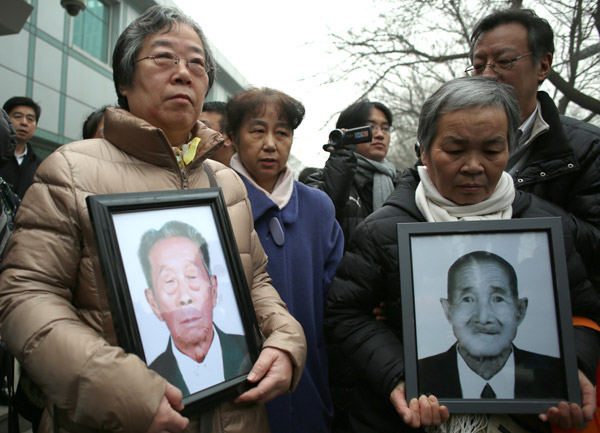
Relatives of deceased Chinese forced laborers, accompanied by lawyer Kang Jian (center, in blue coat), attend Beijing No 1 Intermediate People's Court on Feb 26, 2014, to sue two Japanese companies over forced labor during World War II. The lawsuit seeks printed apologies to be carried in Chinese and Japanese newspapers as well as compensation from the Japanese companies. WANG JING / CHINA DAILY |
There are now more Chinese and Japanese coming into contact with each other than ever before.
For instance, about 5 million Chinese visitors landed in Japan in 2015, double the previous year's figure, according to the Japan National Tourism Organization.
It is commonly believed that the more people communicate, the closer they come. But this is not the case in Japan.
The latest survey by Japan's Cabinet Office showed that a record high 83.2 percent of Japanese people do not feel friendly to China.
Japan's media say Japanese public sentiment toward China has deteriorated since 2012.
It was that year that Japanese government illegally "nationalized" China's Diaoyu Islands. In response, China has had to send ships to patrol its islets. The Japanese government has played up China's countermeasures as one of its justifications for increasing military spending and revising Japan's Constitution.
In 2014, China's condemnation of Japanese Prime Minister Shinzo Abe's visit to the Yasukuni Shrine where Japan's Class-A war criminals are enshrined along with 2.5 million war dead was taken as an act of interference in Japan's internal affairs.
And the Abe administration is working on bending the minds of Japanese young people to an edited version of Japan's past.
Japan's Ministry of Education, Culture, Sports, Science and Technology screens textbooks for elementary, junior high and high schools every four years and it recently announced the list of authorized high school textbooks for the 2017 academic year.
The ministry revised the criteria for textbook screening in 2014 in response to requests by the ruling Liberal Democratic Party that has called into question what it called a "masochistic view of history".
Abe has instructed the education ministry to approve only textbooks that promote patriotism and government positions. He is primarily concerned about the World War II era and wants to shift the focus away from his country's disgraceful chapters in that history.
His critics say he is trying to foster dangerous nationalism by sanitizing Japan's wartime aggression.
At the urging of the education ministry, publishers rewrote many of the descriptions of security policies for the books to be used next year.
Standing facts on their heads, the new textbooks call the Diaoyu Islands an inherent part of Japan. Others revise the references to the 1937 Nanjing Massacre. The Japanese government has always sought to downplay the mass killings that killed 300,000 Chinese soldiers and civilians in Nanjing 79 years ago.
Besides China, Japan's new textbooks have angered the Republic of Korea, too.
"The Japanese government must understand that a correct teaching of history is a duty, not only to its future generations, but also to neighboring countries that have suffered from Japan's past aggression," a statement from the ROK foreign ministry said.
Japanese newspaper Mainichi Shimbun says the new textbooks deeply reflect the views of the Abe administration.
In an interview with Mainichi Shimbun, Hidenori Fujita, professor emeritus of sociology at the University of Tokyo, warned that the input of Japan's positions on the territorial issues in textbooks might make students develop a feeling of hostility.
But despite the pessimism, there is a ray of hope in the Japanese Cabinet Office's survey, as 73 percent of respondents said China-Japan relations are important, far higher than 22.5 percent thinking otherwise.
Changing public attitudes will take time. It depends on responsible education and journalism that offer accurate and unbiased information.
The author is China Daily Tokyo bureau chief. caihong@chinadaily.com.cn



I’ve lived in China for quite a considerable time including my graduate school years, travelled and worked in a few cities and still choose my destination taking into consideration the density of smog or PM2.5 particulate matter in the region.
Copyright 1995 - . All rights reserved. The content (including but not limited to text, photo, multimedia information, etc) published in this site belongs to China Daily Information Co (CDIC). Without written authorization from CDIC, such content shall not be republished or used in any form. Note: Browsers with 1024*768 or higher resolution are suggested for this site.
License for publishing multimedia online 0108263 Registration Number: 130349