 |
|
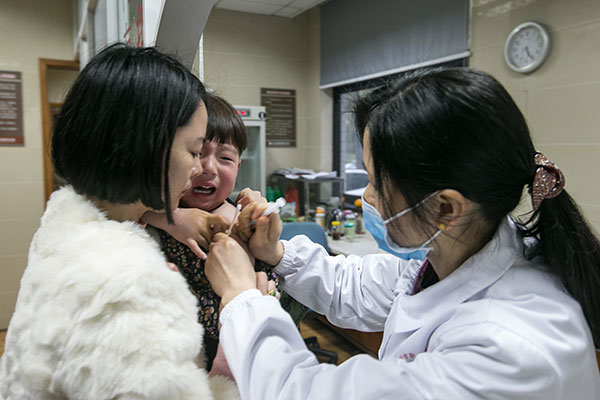
A patient receives rabies vaccine injection at Hangzhou hospital, March 22. [Photo/Agencies] |
The disclosure of a vaccine scandal has provoked a public health crisis in China. The authorities of East China's Shandong province revealed earlier this month the arrest of a mother and her daughter accused of trafficking expired or improperly refrigerated vaccines valued at $88 million. The vaccines, against rabies, meningitis, hepatitis B and other diseases, were illegally traded across 24 provinces, municipalities and autonomous regions since 2011.
Despite the World Health Organization's prompt statement that an adverse reaction to the vaccines is unlikely, this has done little to calm public outrage.
That's not surprising since the scandal has highlighted the loopholes in China's porous public health system and its weak management.
In particular, why did the local authorities not alert the public earlier, as the suspects were already arrested last year? This gives rise to legitimate suspicion of a bureaucratic cover-up of a health scare at the local level, a painful lesson the authorities should have learned not to do after the severe acute respiratory syndrome outbreak in 2003, which led to both the minister of health and mayor of Beijing stepping down.
Moreover, the widespread public fear comes from the fact that the illegal vaccine ring has been in operation for over four years, exposing big problems in the whole regulatory chain for vaccines in terms of acquisition, distribution and inoculation.
Numerous lessons from incidents both home and abroad, including the scandal of tainted milk powder not long ago, suggest how easy it is to destroy public confidence in a country's public health system and how difficult it is to restore it. The continued prosperity of massive cross-border smuggling of formula milk powder from Hong Kong to the mainland offers the best example. And there is a growing concern in the special administrative region that there will be excessive pressure on Hong Kong's health service as mainland residents may now flock there to get their children vaccinated. The authorities need to take measures to prevent this from happening.
Such health scandals rarely occur in Hong Kong, thanks to its well-established rule of law and strict quality assurance mechanisms exercised by both public and private health facilities. Even though a similar event on a much smaller scale and severity occurred three years ago in a public hospital in Hong Kong, the internal quality control mechanism of the hospital soon detected the irregularity and prompted follow-up remedies by the city's Hospital Authority and Health Protection Center, which brought the incident to an end in just two weeks.
Significant budgetary injections have been made into China's public health system since the traumatizing SARS crisis in 2003. The previously under-funded centers for disease control and prevention are now both well equipped and well staffed. And the central authorities have made immediate remedial efforts this time in ordering a thorough probe and keeping the public informed.
However, the scandal has shown that there has been little improvement in exercising transparency on the part of local governments when it comes to handling public health crises, even though all local governments are supposed to have enacted official protocols for managing them.
Even more important, the scandal has exposed the vulnerability of the country's public health system due to the lack of effective enforcement of the relevant regulations.
Enforcing regulations with bona fide adherence to the rule of law is arguably more crucial than introduction of more regulations or more investment in the system. This scandal has sounded an alarm.
The author is assistant professor of the Department of Asian and Policy Studies, Hong Kong Institute of Education.



I’ve lived in China for quite a considerable time including my graduate school years, travelled and worked in a few cities and still choose my destination taking into consideration the density of smog or PM2.5 particulate matter in the region.
Copyright 1995 - . All rights reserved. The content (including but not limited to text, photo, multimedia information, etc) published in this site belongs to China Daily Information Co (CDIC). Without written authorization from CDIC, such content shall not be republished or used in any form. Note: Browsers with 1024*768 or higher resolution are suggested for this site.
License for publishing multimedia online 0108263 Registration Number: 130349