 |
|
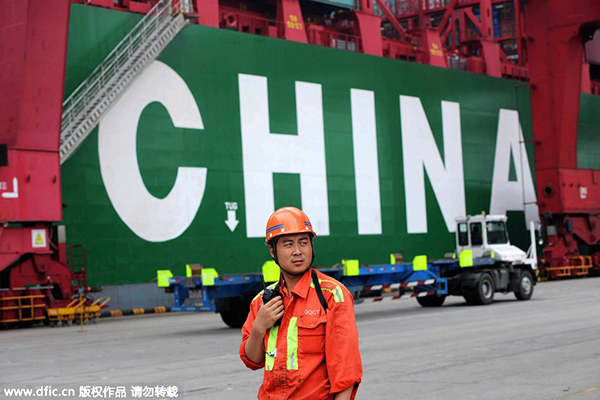
A stevedore works at Qingdao port in Shandong province, July 1, 2015. [Photo/IC] |
The "China collapse" theory can be analyzed in three parts: What is the argument? Who are its advocates? Why does it resonate?
I explain why the theory is either misconceived or underdetermined, and at best wrongly categorizes complex, evolving issues under a simplistic, inflammatory title.
These issues are real, each the natural result of unprecedented economic development in a compressed period of time. But what follows? Each issue is being addressed, imperfectly of course, but in a coordinated manner. China's focus on innovation, entrepreneurship, science and technology, Made in China 2025, hukou (household registration) reforms to help migrant workers, and the like, are all part of the country's 13th Five-Year Plan (2016-20). When mistakes are made, such as tight circuit breakers on stock market volatility that fueled rather than doused anxiety, they are corrected rapidly.
In mid-2015, China's stock market "collapsed", but stability was restored. Economics runs in cycles, boom and bust, with peaks and troughs higher or lower. So those who predict China's "collapse", loosely defined, must be "correct" at some points in the cycle.
A fallacy of China's slowing GDP growth is using year-on-year percentages as the benchmark. If China's GDP grows at 6.5 percent this year, on a base of almost $11 trillion, the absolute increase (about $700 billion) would be roughly double of what it was 10 years ago (in 2006, when the economy grew at 12.7 percent).
Moreover, because China's population is now only slightly larger, the incremental per capita GDP today is larger than what it was in those so-called high-growth years. Yet the problem of China's unproductive growth is real, which has led to overcapacity in industry, housing and infrastructure. China's story is not a simple one.
Who advocates "China's collapse"? Some economists are pessimistic about China's short-term prospects, but almost none would use the term "collapse". Rather, some of their comments are taken, selectively, by those who have a vested interest in China's "collapse"-authors of books on sensationalized doom, political analysts viscerally opposed to China's system of governance, financial short-sellers seeking short-term profits and the like.
I've been amused that purveyors of the "China collapse" theory are often also purveyors of the "China threat" theory. How China could "threaten", which requires power, at the same time that it "collapses", which reduces power, is a mystery. Although self-refuting, the threat-collapse nexus reveals a common connection, as "threat" and "collapse" both emanate from a built-in bias toward China. But even as "China collapse" advocates remain few in number, the idea has gained in prominence. Why?
Two factors drive "China's collapse" in the public eye. The first is not so much that China's economy has become more fragile but that world markets have come to depend too much on China's growth. China is still a developing country and cannot bear the world's burden. The second is that China's increasing clout generates a natural backlash.
Politically, there are no broad, boiling tensions as "China collapse" advocates contend. The vast majority of the Chinese people want social stability, a watchword in China, which is required for increasing standards of living. The Chinese government is exquisitely sensitive to instability and reacts rapidly to even early indicators of unrest. This can lead to stricter regulations, such as in traditional and social media, but almost everyone accepts the tradeoff.
China's economy will cycle but it won't collapse. I'm sorry if this disappoints a few false prophets, but assuming that people do what is best for themselves, other than the handful of doomsayers who make their money by bashing China, no one should root for China's collapse. China's success is the world's success.
The author is a public intellectual, political/economics commentator, and international corporate strategist.



I’ve lived in China for quite a considerable time including my graduate school years, travelled and worked in a few cities and still choose my destination taking into consideration the density of smog or PM2.5 particulate matter in the region.
Copyright 1995 - . All rights reserved. The content (including but not limited to text, photo, multimedia information, etc) published in this site belongs to China Daily Information Co (CDIC). Without written authorization from CDIC, such content shall not be republished or used in any form. Note: Browsers with 1024*768 or higher resolution are suggested for this site.
License for publishing multimedia online 0108263 Registration Number: 130349