 |
|
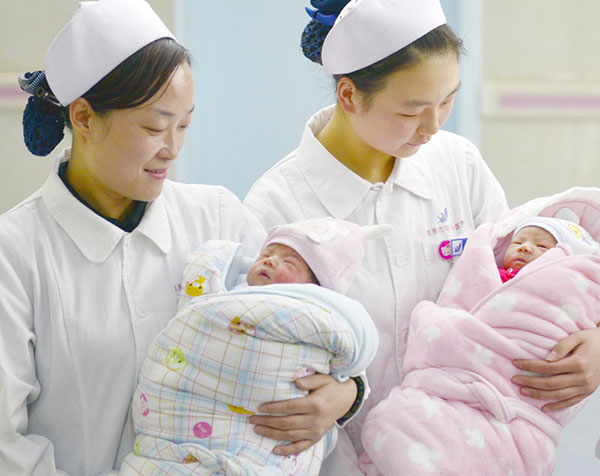
Obstetric nurses in the Central Hospital of Enshi, Hubei province, take care of newborns at the hospital. [Li Yuanyuan / for China Daily] |
China has formally introduced a national two-child policy. Most newspaper reports say the move is aimed at addressing the problem of the country's rapidly aging population. In late January, an article in China Daily, headlined "Two-child policy to add 30 m workers", was accompanied by a second-deck headline, "Scrapping one-child policy should help China ease challenges of aging society". The article quoted Yuan Xin of Nankai University, who suggested that the fertility rate would increase to about two children per woman by 2018 (up from about 1.3-1.5 today).
However, these demographic expectations from the policy reform need to be tempered somewhat. There seems to be a view among many that the "one-child policy" operates as a kind of pressure valve, holding down Chinese fertility. In this view, most of the couples are currently allowed to have one child, but would like to have more. As such, reforms mean that more children come "on stream" and, hence, create a better balance between "workers" and "older people".
This is wrong.
The first common misinterpretation is that there has been a national "one-child policy" in place since late 1970s. Rather, there have been myriad reforms since 1984 implemented at the prefecture level allowing a second child under certain conditions. In this sense, the 2015-16 reform is not the watershed the media has made it out to be in that the majority of parents with one child in 2015 were already eligible to have a second.
Second, and building on this notion of gradual reform, the evidence seems to suggest only a limited impact of the last national reform which, in November 2013, allowed couples even if one of them was the only child of his/her parents to two children. While 10-12 million extra births were anticipated over three-to-four years as a result of this reform, about 1 million couples had applied to have a second child by the end of 2014. Of these, less than half a million births actually transpired. Therefore, while even more people became eligible to have a second child, the vast majority of couples seem to have chosen not to.
This limited impact of the previous reform came as little surprise to those of us who have been studying Chinese fertility. This is because there is a misinterpretation that the policy is holding down fertility somehow. Surveys show that while many Chinese parents might like to have two children, they intend to have only one even if they are allowed to have more. The reasons for this will be familiar: high costs of education and housing relative to incomes; impact on career development (especially for women); wanting to invest more in the success of one child; fragile family arrangements (especially for the floating population); the burden of responsibility for caring for elderly parents and so on. All of these added to the fact that one-child families have been privileged by the State for the past three decades.
Furthermore, these concerns are generally more pronounced in cities and coastal provinces, which are precisely the areas which the two-child policy reform will affect the most. In other words, our research suggests that the people most affected by the move to a two-child policy are precisely those who are least likely to have a second child.
All of this suggests that the demographic response to the two-child policy will likely be muted, and China is likely to continue to age extremely rapidly.
This brings us to why the policy was changed. I would suggest the Chinese government well knew that these reforms would have a limited demographic impact, and that the fears over a stress on public services were unwarranted. In addition, cases of localized corruption and illegal practices were becoming an increasing source of embarrassment to the State. Finally, couples who have dreamed of a second child can have had their wishes granted.
Politically, the reform may be a huge success; but to truly tackle the economic, social and demographic challenges of its rapidly aging society, China will need to do much more than fix its broken pressure valve.
The author is an associate professor in Social Policy at the University of Oxford.



I’ve lived in China for quite a considerable time including my graduate school years, travelled and worked in a few cities and still choose my destination taking into consideration the density of smog or PM2.5 particulate matter in the region.
Copyright 1995 - . All rights reserved. The content (including but not limited to text, photo, multimedia information, etc) published in this site belongs to China Daily Information Co (CDIC). Without written authorization from CDIC, such content shall not be republished or used in any form. Note: Browsers with 1024*768 or higher resolution are suggested for this site.
License for publishing multimedia online 0108263 Registration Number: 130349