 |
|
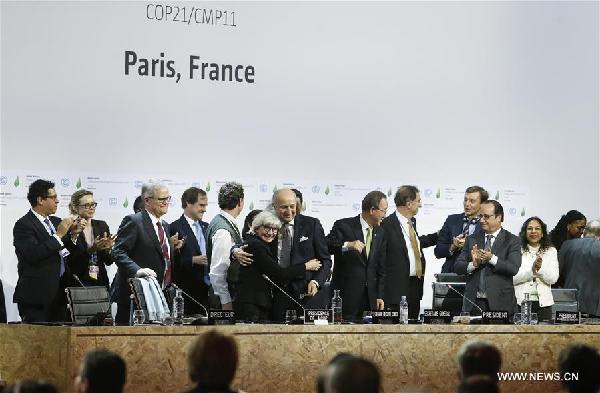
The final conference at the COP21, in Le Bourget, Paris, Dec 12, 2015. [Photo/Xinhua] |
As we undergo the fourth industrial revolution, companies are uniquely positioned to partner with governments to address some of the world's greatest challenges. Urbanization continues to spread globally, with 70 percent of the world's population expected to live in cities by 2030. This trend brings with it the urgent need for more efficient use of energy, cleaner energy generation and effective energy storage. While the public-sector must lead, it should work closely with the private-sector to rapidly implement best policies, programs and projects that will improve urban efficiency and sustainability.
Buildings are responsible for up to one-third of greenhouse gas emissions globally. The most cost-effective time to reduce energy consumption in buildings is before construction where integrated designs and off-the-shelf building technologies can yield up to a 50 percent reduction in energy use and positive returns on investments. For existing buildings, energy efficiency retrofits using these same principles can deliver 15 to 40 percent savings that pay for themselves over time through energy cost savings.
Best practices for improving building energy efficiency in cities include: adopting and enforcing building codes and appliance standards, setting reduction targets and adopting sustainable construction and leasing policies, establishing retrofit programs for public and private-sector buildings, introducing certification, benchmarking and transparency programs, accepting innovative financial models and programs and coordinating efforts with local utilities. While the results are promising, very few cities globally have implemented a comprehensive set of these elements.
While buildings represent a great opportunity to improve demand-side urban efficiency, district energy systems are seeing a resurgence of interest in urban sustainability on the supply-side. Modern district energy systems provide centralized heating and cooling to urban areas with efficiency gains of up to 80 to 90 percent on conventional solutions.



I’ve lived in China for quite a considerable time including my graduate school years, travelled and worked in a few cities and still choose my destination taking into consideration the density of smog or PM2.5 particulate matter in the region.
Copyright 1995 - . All rights reserved. The content (including but not limited to text, photo, multimedia information, etc) published in this site belongs to China Daily Information Co (CDIC). Without written authorization from CDIC, such content shall not be republished or used in any form. Note: Browsers with 1024*768 or higher resolution are suggested for this site.
License for publishing multimedia online 0108263 Registration Number: 130349