 |
|
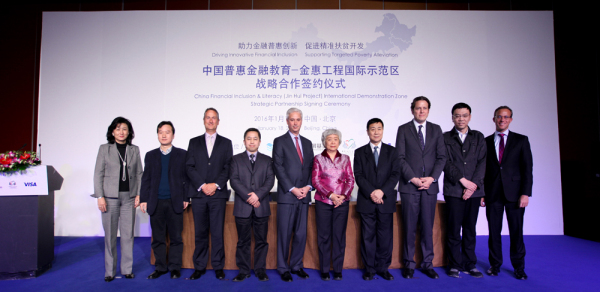
China Financial Inclusion & Literacy (Jin Hui Project) International Demonstration Zone Strategic Partnership Signing Ceremony is held in Beijing on January 18, 2016. [Photo provided to chinadaily.com.cn] |
Last year, President Xi Jinping set a target for lifting 70 million more people out of poverty in the next five years. And it is clear that strong efforts to galvanize the Chinese agencies into action are already underway.
Just on Jan 15, the State Council, China's Cabinet, published a five-year development plan for inclusive finance which outlines a series of measures and targets to make banking and lending services more accessible to ordinary people, especially those that are under-privileged or live in remote areas. The plan notes the importance of ensuring farmers, small and micro enterprises, low-income urban populations, people with disabilities and the elderly in particular are able to get timely, reasonably priced, convenient and secure financial services.
Around the world, initiatives to promote universal access to quality financial services have been gaining traction, as recognition has grown that the more people are included in the financial system the more people are lifted, over time, out of poverty. The fact is, when people can more easily save for their future, when they are more easily able to protect themselves and their property from unforeseen circumstances, such as illness or natural disasters and when they can get access to affordable credit, their lives - and livelihoods - improve.
And it's not just individuals and communities which benefit, economies do, too.
China's moves to promote inclusive finance are therefore significant and we (at Visa Inc) should predict they will have meaningful impact on the lives of millions of people. In fact, given the pace of change in China and the ready availability of connected technologies, the potential is for these measures to have a bigger impact than anywhere else in the world. This may be especially true in 2016, the year when China takes the helm of the G20 discussions, part of which will be dedicated to promoting financial inclusion.
Moreover, China has a head start. The number of Chinese who already have some form of formal bank account is significantly higher, about 79 percent, than in most other countries. Yet the take-up and usage of services, particularly to get access to formal credit is small, hovering around 10 percent, and is likely to be even lower in rural and remote areas.
Of course, making it possible for more people to access different financial services in rural and remote areas is by no means easy. That is why we believe there is an important role for the private sector to help China meet its laudable inclusive finance goals.
Doing so has been an important priority for Visa. Since 2011, Visa has connected an estimated 200 million previously underserved people around the world to the financial system. In addition, more than 100,000 Chinese citizens have benefited from our financial education programs.
As a continuation of these efforts, this week we announced partnerships with the China Foundation for Financial Education and the China Foundation for Poverty Alleviation to do even more in China, beginning with a program to reach some 5 million rural residents over the next three years in underserved cities and counties in Heilongjiang and Jilin provinces, and the Inner Mongolia autonomous region.
These initiatives are designed to find ways to bring the long-term benefits of a range of financial services to entire communities of underserved people. As such, with our partners, we will provide financial education to farmers and other rural residents, financial inclusion training for local officials, and financial literacy projects for rural middle schools.
As I look at the opportunities ahead in China and the commitment of the government to drive an active inclusive finance agenda, I am optimistic President Xi's next set of poverty alleviation targets can be met, particularly if we can encourage greater collaboration between the public and private sector. China has an opportunity this year as a result of its leadership of the G20 to make that happen in a significant way.
The author is CEO of Visa Inc.

普惠金融 (puhui jinrong): Inclusive finance


I’ve lived in China for quite a considerable time including my graduate school years, travelled and worked in a few cities and still choose my destination taking into consideration the density of smog or PM2.5 particulate matter in the region.
Copyright 1995 - . All rights reserved. The content (including but not limited to text, photo, multimedia information, etc) published in this site belongs to China Daily Information Co (CDIC). Without written authorization from CDIC, such content shall not be republished or used in any form. Note: Browsers with 1024*768 or higher resolution are suggested for this site.
License for publishing multimedia online 0108263 Registration Number: 130349