The year 2015 has been a hard one all around. Brazil fell into recession. China's economy experienced its first serious bumps after almost four decades of breakneck growth. The eurozone managed to avoid a meltdown over Greece, but its near-stagnation has continued, contributing to what surely will be viewed as a lost decade. For the United States, 2015 is supposed to be the year that finally closed the book on the Great Recession that began back in 2008; instead, the US recovery has been middling.
 |
|
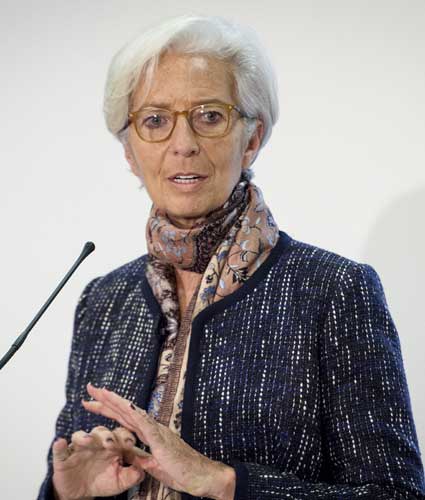
Managing Director of the International Monetary Fund Christine Lagarde speaks at a press conference at the Treasury in London, which was attended by Britain's Chancellor of the Exchequer George Osborne, December 11, 2015. [Photo/Agencies] |

Indeed, International Monetary Fund Managing Director Christine Lagarde has declared the current state of the global economy the "new mediocre". Others, harking back to the profound pessimism after the end of World War II, fear that the global economy could slip into depression, or at least into prolonged stagnation.
In early 2010, I warned in my book Freefall, which describes the events leading up to the Great Recession, that without the appropriate responses, the world risked sliding into what I called a "great malaise". Unfortunately, I was right: We didn't do what was needed, and we have ended up precisely where I feared we would.
The economics of this inertia is easy to understand, and there are readily available remedies. The world faces a deficiency of aggregate demand, brought on by a combination of growing inequality and a mindless wave of fiscal austerity. Those at the top spend far less than those at the bottom, so that as money moves up, demand goes down. And countries like Germany that consistently maintain external surpluses are contributing significantly to the key problem of insufficient global demand.
At the same time, the US suffers from a milder form of the fiscal austerity prevailing in Europe. Indeed, some 500,000 fewer people are employed by the public sector in the US than before the crisis; with normal expansion in government employment since 2008, there would have been 2 million more.
Moreover, much of the world is confronting-with difficulty-the need for structural transformation: from manufacturing to services in Europe and America, and from export-led growth to a domestic-demand-driven economy in China. Likewise, most natural-resource-based economies in Africa and Latin America failed to take advantage of the commodity price boom underpinned by China's rise to create a diversified economy; now they face the consequences of depressed prices for their main exports. Markets never have been able to make such structural transformations easily on their own.
There are huge unmet global needs that could spur growth. Infrastructure alone could absorb trillions of dollars in investment, not only true in the developing world, but also in the US, which has under-invested in its core infrastructure for decades. Furthermore, the entire world needs to retrofit itself to face the reality of global warming.
While our banks are back to a reasonable state of health, they have demonstrated that they are not fit to fulfill their purpose. They excel in exploitation and market manipulation, but they have failed in their essential function of intermediation. Between long-term savers (for example, sovereign wealth funds and those saving for retirement) and long-term investment in infrastructure stands our shortsighted and dysfunctional financial sector.
Former US Federal Reserve Board chairman Ben Bernanke once said that the world is suffering from a "savings glut". That might have been the case had the best use of the world's savings been investing in shoddy homes in the Nevada desert. But in the real world, there is a shortage of funds; even projects with high social returns often can't get financing.
The only cure for the world's malaise is an increase in aggregate demand. Far-reaching redistribution of income would help, as would deep reform of our financial system, not just to prevent it from harming the rest of us, but also to get banks and other financial institutions to do what they are supposed to do: match long-term savings to long-term investment needs.
But some of the world's most important problems will require government investment. Such outlays are needed in infrastructure, education, technology, the environment, and facilitating the structural transformations that are needed in every corner of the earth.
The obstacles the global economy faces are not rooted in economics, but in politics and ideology. The private sector created the inequality and environmental degradation with which we must now reckon. Markets won't be able to solve these and other critical problems that they have created, or restore prosperity, on their own. Active government policies are needed.
That means overcoming deficit fetishism. It makes sense for countries like the US and Germany that can borrow at negative real long-term interest rates to borrow to make the investments that are needed. Likewise, in most other countries, rates of return on public investment far exceed the cost of funds.
For those countries whose borrowing is constrained, there is a way out, based on the long-established principle of the balanced-budget multiplier: An increase in government spending matched by increased taxes stimulates the economy. But many countries, including France, are engaged in balanced-budget contractions.
Optimists say 2016 will be better than 2015. That may turn out to be true, but only imperceptibly so. Unless we address the problem of insufficient global aggregate demand, the great malaise will continue.
The author, a winner of the Nobel Prize in economics, is university professor at Columbia University and chief economist at the Roosevelt Institute.
Project Syndicate



I’ve lived in China for quite a considerable time including my graduate school years, travelled and worked in a few cities and still choose my destination taking into consideration the density of smog or PM2.5 particulate matter in the region.
Copyright 1995 - . All rights reserved. The content (including but not limited to text, photo, multimedia information, etc) published in this site belongs to China Daily Information Co (CDIC). Without written authorization from CDIC, such content shall not be republished or used in any form. Note: Browsers with 1024*768 or higher resolution are suggested for this site.
License for publishing multimedia online 0108263 Registration Number: 130349