 |
|
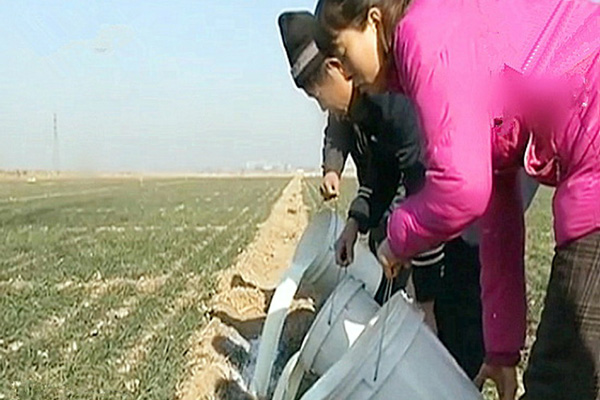
Farmers dump milk in the field in Weifang city, Shandong province, on Jan 6, 2015. [Photo / IC] |
Since the end of 2014, some dairy farmers in Shandong and Shaanxi provinces have been dumping milk - and have even killed some cows - because of low milk prices. Several factors are responsible for this situation.
First, some companies processing dairy products didn't honor their purchase contracts. About 4,470 tons of fresh milk lay unsold in East China's Shandong alone in the first week of January.
Second, some dairy product companies have raised their quality requirements to buy raw milk, forcing some dairy farmers who couldn't meet the standards to dump their milk. The national quality standard for raw milk is relatively low, and during shortages enterprises tend to buy raw milk following the national standard, but in times of surplus supply they raise their quality requirements.
Third, the average purchase price of raw milk has been declining in recent months, and dairy farmers cannot even recover their productions costs. The purchase price of raw milk fluctuates periodically in China. The average purchase price had been 3.25 yuan a kilogram since January 2012. It increased to 4.25 yuan ($0.68) a kg in February 2014, after which it began falling and reached 3.4 yuan in May 2015.
Besides, the purchase price varies from region to region. In Shandong, for example, the average purchase price is only 2.96 yuan a kg, with the lowest being just 1 yuan a kg, compared with the average production cost of about 3.5 yuan a kg. This has forced many in Shandong to kill their cows and exit the dairy industry. By April 2015, the number of milk-giving cows in the province had fallen by 7.5 percent year-on-year.
And fourth, the rapidly rising import of dairy products has hurt the domestic dairy industry. Since the 2008 melamine scandal the sales of imported dairy products have increased dramatically in China. For instance, the import of milk powder increased from 101,800 tons in 2008 to 923,000 tons in 2014 and that of liquid milk rose from 7,500 tons to 328,900 tons in 2014.
Dairy farmers are suffering also because they lack comparative advantage. The cost of milk production is 3.56 yuan a kg in China - compared with 1.79 yuan a kg in New Zealand, 2.09 yuan in Russia and 2.27 yuan in Argentina - because the country's dairy industry depends heavily on imported cows, stud bulls and fodder.
The conflict of interest between raw milk producers and dairy product processors is also to blame for the sorry state of affairs. Processing enterprises dominate the industry. They monopolize not only the processing link of dairy products but also the pricing of raw milk. And during unfavorable market conditions, dairy farmers are the first to be sacrificed.
To streamline the dairy industry, the authorities should first establish an industrial interest community in which all sectors have to share the risks, and dairy farmers and family ranches should be allowed to establish cooperatives and start companies to process dairy products. The organizational level and profit-sharing mechanism between dairy farmers and dairy product companies, too, should be changed.
Second, the sale of pasteurized milk should be encouraged. To be kept at normal temperature, milk has to undergo ultra-high temperature sterilization, that is, above 135 Celsius. Pasteurized milk, on the other hand, is sterilized at between 85 C and 90 C, and thus retains more bioactive substances such as micro-elements and immunoglobulin. But pasteurized milk has to be stored between 2 and 6 C, and is good for use only for 5 to 7 days. The shorter shelf life of milk will ensure the demand for raw milk remains almost consistent, which is favorable for dairy farmers.
The author is a researcher at the Rural Development Institute, Chinese Academy of Social Sciences.



I’ve lived in China for quite a considerable time including my graduate school years, travelled and worked in a few cities and still choose my destination taking into consideration the density of smog or PM2.5 particulate matter in the region.
Copyright 1995 - . All rights reserved. The content (including but not limited to text, photo, multimedia information, etc) published in this site belongs to China Daily Information Co (CDIC). Without written authorization from CDIC, such content shall not be republished or used in any form. Note: Browsers with 1024*768 or higher resolution are suggested for this site.
License for publishing multimedia online 0108263 Registration Number: 130349