 |
|
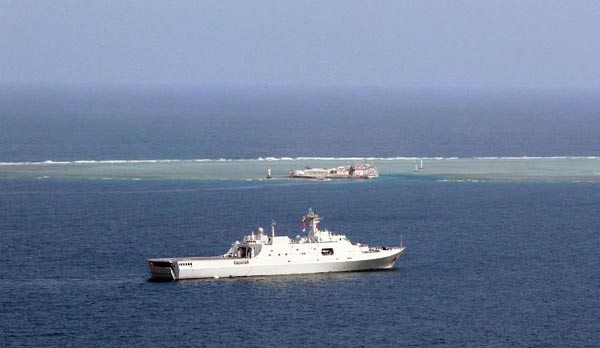
China firmly upholds her sovereignty and maritime rights and interests in the South China Sea. [Photo/Xinhua] |
Despite not having any territorial dispute with China in the South China Sea, Japan has been interfering in the issue. At the recently concluded G7 summit in Germany, Japanese Prime Minister Shinzo Abe raised the South China Sea issue, saying China is making forcible attempts to "change the status quo".
The other G7 leaders - from Canada, France, Germany, Italy, the United Kingdom and the United States - have echoed Abe's concerns. Futile though it was, Abe's move has political implications.
Although not related to Japan, the South China Sea connects the Indian Ocean and the Pacific Ocean, and as such is of immense geopolitical importance to Tokyo. Being largely dependent on imports for lack of natural resources, Japan has long attached great, sometimes excessive, importance to maritime security, which to some extent explains its constant interference in the South China Sea issue.
Abe's attempt to "set the agenda" at the G7 meeting is a continuation of Japan's Southeast Asia policy, which is aimed at restoring its regional leadership. The Fukuda Doctrine of 1977 that then Japanese prime minister Takeo Fukuda proposed, for instance, marked Japan's major strategic shift toward the Association of Southeast Asian Nations. The doctrine promised to share peace and prosperity with ASEAN member states through "heart-to-heart" interactions and never become a military power.
But to contain China's peaceful rise, Japan is trying to sell the "China threat" theory to Southeast Asian countries and thus intervene in the maritime disputes between China and some of its neighbors such as the Philippines and Vietnam. The worrying right-wing tendency of the Abe administration, aimed principally at containing China, might further complicate the South China Sea issue.
Abe sees the maritime disputes as an opportunity which he can use to transform Japan into a military power again. Since its economic boom in the early postwar years, Japan has never stopped looking for opportunities to expand its political influence and military presence across the world. In fact, the Abe administration is gradually getting its way after lifting the ban on the country's right to collective self-defense following the revision of the pacifist Constitution last year.
Japan is using the South China Sea issue to strengthen its ties with ASEAN member states and to forge an "anti-China" coalition by exporting weapons to them. By doing so, it can boost its regional military deployment. In this regard, the Philippines has already hinted at the possibility of offering its military bases to refuel and re-supply Japanese fighter jets and warships that patrol the region.
Besides, Japan's interference in the South China Sea issue is also in the interest of the US' policy of "pivot to Asia", apparently designed to contain China and maintain Washington's global hegemony. The US has greatly slashed its military expenditure because of its sagging economy in recent years, thus allowing its close ally Japan to pressure China on its behalf. The new US-Japan defense guidelines issued in April - revised for the first time since 1997 - allows Japan to exercise collective self-defense and increase regional and global cooperation as part of the Washington-Tokyo alliance.
It is also highly likely that Japan is testing China's bottom line with regard to the Diaoyu Islands dispute between the two countries. Given the fact that Beijing will never give up its claim of sovereignty over the Diaoyu Islands, Tokyo believes it can win some brownie points by interfering in South China Sea issue, because by doing so it can disturb Beijing's strategic deployment in the East China Sea.
Neither the US nor Japan can confront China on the basis of the UN Convention on the Law of the Sea, which incidentally has not been ratified by Washington and violated by the Tokyo many times. It is clear that groundless accusations of Japan and the US are only aimed at containing China's peaceful development and creating hostilities and uncertainties in its neighborhood.
The author is with the Institute of Japan Studies, Nankai University in Tianjin.



I’ve lived in China for quite a considerable time including my graduate school years, travelled and worked in a few cities and still choose my destination taking into consideration the density of smog or PM2.5 particulate matter in the region.
Copyright 1995 - . All rights reserved. The content (including but not limited to text, photo, multimedia information, etc) published in this site belongs to China Daily Information Co (CDIC). Without written authorization from CDIC, such content shall not be republished or used in any form. Note: Browsers with 1024*768 or higher resolution are suggested for this site.
License for publishing multimedia online 0108263 Registration Number: 130349