 |
|
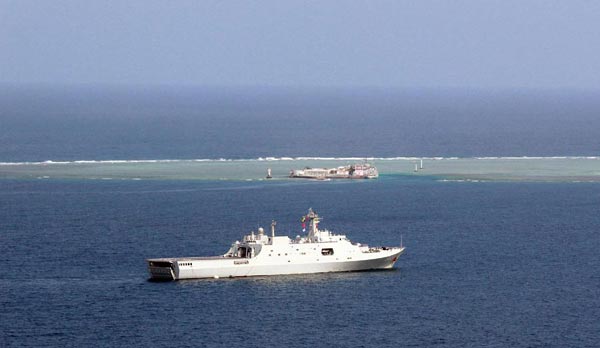
A formation of the Nanhai Fleet of China's Navy on Saturday finished a three-day patrol of the Nansha islands in the South China Sea. [Photo/Xinhua] |
A series of recent remarks and actions by the US has again pushed the South China Sea issue into the international spotlight. These include US Deputy Secretary of State Antony Blinken’s comment that by reinforcing some islands and reefs of Nansha Islands, China is heightening tensions and instability in the region and the US Navy P-8A Poseidon surveillance flights over China’s islands.
Since such remarks and actions have raised the international community’s concerns and will affect China’s diplomacy, sovereignty and security, the government should clarify its activities in the South China Sea from a legal point of view to defuse tensions.
Given the lack of specific provisions on “military activities” in the UN Convention on the Law of the Sea, China and the US have diverse, even conflicting, views on such activities, including military surveys, reconnaissance and joint drills within a country’s exclusive economic zone (EEZ). And because of their differing views, Beijing and Washington have formed different ideas about the peaceful use, including research, of oceans and seas. The root cause of the dispute is whether a country needs the prior consent of other countries to carry out military activities within its EEZ or is there no need for such consent on the grounds of “freedom of navigation rights”.
The US is not a member of the UNCLOS, but the EEZ provisions of the Convention have become a universally recognized law, which the US too should abide by. In situations where China and the US cannot resolve their differences over the definition of “military activities” according to the UNCLOS, they should hold talks to enhance mutual understanding and, in particular, comply with two documents signed in October and November 2014, which present a mechanism for mutual reporting of each other’s major military activities and the code of conduct during sea and air encounters.
The US is concerned over China’s reclamation activities on some islands and reefs in the South China Sea, saying that that will not legalize its expanded territorial sovereignty. The US also accuses China of posing a threat to marine ecology and violating the Declaration on the Code of Conduct in the South China Sea.
But these accusations are baseless. China is not the only country to implement island or reef reinforcement projects it the South China Sea but the US has never expressed concern over similar activities of other countries, which exposes its double standards.
China’s reinforcement work is only aimed at maintaining its maritime rights and interests, including improving its maritime facilities, in the South China Sea. It has nothing to do with the expansion of its territorial sovereignty as some countries have alleged. Since its actions are within the scope of its sovereignty, they do not warrant ay question or criticism. China’s reinforcement activities will not stop because of baseless charges by other countries, but it is willing to strengthen coordination and enhance communications with relevant parties to work out norms and systems to deepen mutual trust and avoid misunderstandings and misjudgments.
Enhanced communications with the US, especially under the framework of the October and November 2014 documents, will help China deepen mutual understanding and avoid possible misunderstandings. The Chinese government should also strengthen cooperation and exchanges with ASEAN member states, including through joint drills for maritime rescue and anti-piracy operations, to reach a code of conduct for the South China Sea, and the efforts to make this possible should be accelerated.
But even if China and the ASEAN member states agree to such a code of conduct, the South China Sea dispute should still be resolved through political and/or legal means directly between the parties concerned.
Besides, to better maintain its territorial sovereignty it the South China Sea, China also needs to improve its domestic maritime policies and legal system to legally back up its justified claims.
The author is a researcher at and director of Ocean Strategy Studies Center, Shanghai Academy of Social Sciences.


Copyright 1995 - . All rights reserved. The content (including but not limited to text, photo, multimedia information, etc) published in this site belongs to China Daily Information Co (CDIC). Without written authorization from CDIC, such content shall not be republished or used in any form. Note: Browsers with 1024*768 or higher resolution are suggested for this site.
License for publishing multimedia online 0108263 Registration Number: 130349