 |
|
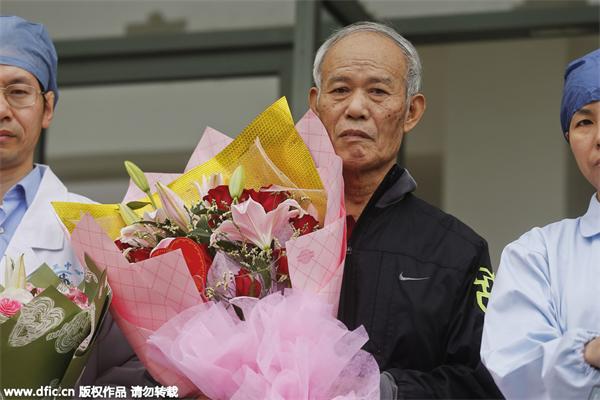
A Chinese man (center), 65, who was infected with the H7N9 avian flu virus in early April and has recovered, poses with medical workers as he leaves the Shanghai public health Clinical Center in Shanghai, china, 18 April 2013. |
There has been widespread interest in China's health sector among economists around the world. Much of this interest is found in public health communities at universities, and a large literature of scholarly work has emerged. These economists are largely interested in access and delivery of medical care and public health infrastructure. A smaller group of economists focuses on the role of health services in macroeconomic structural adjustment.
The two groups are largely separate and a more complete picture of economic planning emerges by integrating their perspectives.
China's health sector has evolved erratically since 1949. Initially, its infrastructure was rudimentary with emphasis on public health. Rural reform was an early priority, with efforts to increase the numbers of hospital beds, doctors and antibiotics. The use of "barefoot doctors" was cultivated in the years before 1978 and received widespread international recognition.
But Deng Xiaoping's watershed shift toward the market had a profound effect on health services. State support for hospitals, and healthcare more broadly, diminished as China decentralized and turned to more organizational self-sufficiency. Much of the Chinese population was left without adequate access to health services, especially in rural areas. Hospitals increasingly relied on sales of drugs, devices and high technology services to supplement their budgets.
That led to a high share of pharmaceutical costs in the health sector, as well as relatively low State spending on health. After recognizing these problems, China sought to re-engage the State in a strategy of improved public finance and provision of healthcare. The 2003 SARS epidemic underscored the need to improve public health as well.
Today, China is in transition, from export- and investment-oriented to consumption- and services-driven economic development. The role of health insurance is central to this transition. Studies have shown improved health insurance has a huge impact on consumption as the need for precautionary savings falls. Increased spending on health insurance will facilitate China's shift to consumption- and services-driven development, as well as ensure equity of resource allocation. The establishment of a better social safety net for health with two urban and one rural insurance scheme is an important achievement. But despite being widespread, this insurance is shallow and Chinese people still believe in precautionary savings, particularly as healthcare costs rise.
The advantage of more reliance on health insurance and healthcare is evident. Lower savings and higher consumption rates blunt the impact of slower growth on improving living standards.
But there are hazards in this scenario. Healthcare has historically suffered from low productivity gains. China will consign itself to lower growth rates in the long run unless it develops a health sector that relies more on technology than the prevailing hospital-centric and labor-intensive approaches. The primary output should be health not hospital use, physician visits or any other intermediate service.
The use of electronic medical records, mobile communications and monitoring technology alongside computer-assisted diagnosis and treatment hold promise for improving efficiency in production. This can be combined with more consumer-centric organization and higher levels of health-related education to improve buyer decision-making.
An even more important issue in the long run is efficiency in allocation. This involves identification of health services that are not worth paying for. No society can afford all the benefits that technology can offer. Drawing the line between which services are covered by insurance and which are not is difficult. Insurance beneficiaries will not be very constrained by the expense of others. Social consciousness and robust economic institutions are necessary to cope with such important decisions.
China is better positioned to make these allocations than the United States where there is great discomfort with public intervention in the healthcare sector. But China needs to be prepared for daunting challenges in this arena that will increasingly become important components of economic planning.
The author is Joseph M. Long chair in healthcare management and professor of economics in the University of the Pacific in Stockton, California, and a guest professor at Shandong University of Finance and Economics in Jinan.



I’ve lived in China for quite a considerable time including my graduate school years, travelled and worked in a few cities and still choose my destination taking into consideration the density of smog or PM2.5 particulate matter in the region.
Copyright 1995 - . All rights reserved. The content (including but not limited to text, photo, multimedia information, etc) published in this site belongs to China Daily Information Co (CDIC). Without written authorization from CDIC, such content shall not be republished or used in any form. Note: Browsers with 1024*768 or higher resolution are suggested for this site.
License for publishing multimedia online 0108263 Registration Number: 130349