 |
|
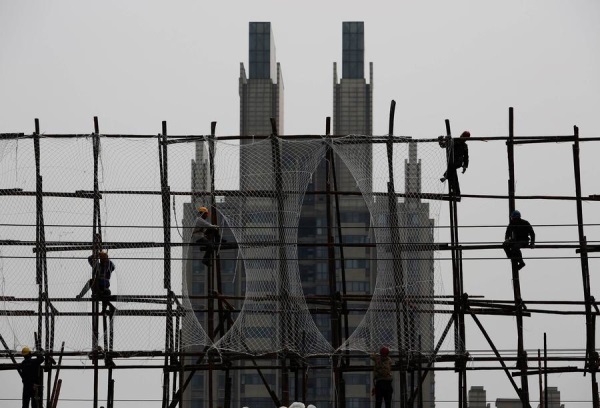
Labourers work on the scaffolding of a construction site for a new residential building in Beijing, May 6, 2014. China will increasingly manage its troubled property sector at a local level as it seeks to avoid sparking either an abrupt slowdown that undermines the economy or another surge in prices, according to government economists involved in policy discussions. After increasing at double-digit rates through most of last year, home prices started cooling in late 2013 as a sustained campaign to clamp down on speculative investment and easy credit gained traction. To match Analysis CHINA-ECONOMY/PROPERTY Picture taken May 6, 2014. REUTERS/Kim Kyung-Hoon |
The Chinese economy saw further signs of a slowdown and worsening deflationary pressure in 2014. Growth has leveled out at just above 7 percent, which may be high by international standards but it has raised concerns that it may not be the new normal.
China's producer price index (PPI) has been on the retreat for the past 34 months, reaching an average of minus 1.8 percent from January to November year-on-year. The drop was driven partly by a sharp fall in global oil prices. Its consumer price index was down from 3.2 percent a year ago to 1.4 percent in November. And the housing price index for 70 major cities declined from 9.6 percent in January 2014 to minus 1.3 percent in September and minus 2.6 percent in October. As a result, the confidence level of investors and companies appears to be at its lowest since 2007.
There are worries that China's growth could decline even further if reforms and macro policies do not yield the expected results on time.
In November 2014, the People's Bank of China (the central bank) responded to slowing growth by cutting interest rates for the first time since July 2012, signaling the shift of China's macro policy from controlling the property bubble, local government debts and overcapacity to stimulating growth. But the benefits of signaling a more relaxed monetary policy by the PBoC were not easily transferred to the real sectors, although in the short run, the interest rate cut might have helped the increase of the leveraged trading of bonds and stocks.
On the stock market front, the Shanghai A-Share Composite Index rose more than 40 percent to about 3,100 from July to December, with the sharpest increase being after November's interest rate cut. But the rate cut failed to lower the actual borrowing costs of small and medium-sized enterprises and non-financial companies.
The official lending rate (usually reserved for State-owned and big enterprises) is about 8 percent but the market-oriented lending rate (set mostly for private enterprises and local government projects that rely on shadow banking) is about 20 percent. The low deposit rate and the dual-lending rates reflect China's financial repression, which create strong incentives for regulatory arbitrage through shadow banking. Since the banking sector is more than three times as large as either the equity or the bond market, its inefficiency has significantly undermined China's growth.
In the past two years, China's macro authorities should have probably put more effort in preventing deflation and in providing an accommodative macro environment for positive risk-taking by innovative and productive companies. The risk-averse regulatory and policy moves reflect challenges in structural reforms and a lack of effective tools to carry out structural changes, such as deposit insurance and bankruptcy mechanisms. Consequently, even the monetary policy, usually not suitable for discriminative use towards different parts of the economy, has been employed regularly to deal with structural problems such as supporting SMEs and providing housing for low-income people through targeted releases of central bank funds.


Copyright 1995 - . All rights reserved. The content (including but not limited to text, photo, multimedia information, etc) published in this site belongs to China Daily Information Co (CDIC). Without written authorization from CDIC, such content shall not be republished or used in any form. Note: Browsers with 1024*768 or higher resolution are suggested for this site.
License for publishing multimedia online 0108263 Registration Number: 130349