-
-
Calm&Chaos
For the past few days Li Qingda's life has felt like being in a Hollywood action flick ? surviving a 9.0-magnitude earthquake and escaping possible nuclear radiation. Li is a 21-year-old law student at Sendai's Tohoku University, located close to the epicenter of the earthquake that struck off the coast of Japan on Friday. It spawned a tsunami that swallowed up whole villages and towns, killing at least 3,600 people, with more than 7,800 still missing.
-

Childcare
Just like new moms, new fathers can be depressed, and a study found a surprising number of sad dads spanked their 1-year-olds. About 40 percent of depressed fathers in a survey said they'd spanked kids that age, versus just 13 percent of fathers who weren't depressed. Most dads also had had recent contact with their child's doctor ?a missed opportunity to get help, authors of the study said.
-
A SAD fact
Before finally accepting a position as department head, Wu Ting turned down three promotion opportunities in the past 20 years just so she could avoid giving presentations at large gatherings.
-
-

-

-
-
Key Words
Porcelain ???
Tea??? Peking Opera
Confucius
Cultural Heritage
Jade? Chinese? New Year
Imperial Palace
Chinese Painting
Books
The future is now
By Chitralekha Basu (China Daily)
Updated: 2011-03-18 10:48
 |
Large Medium Small |
 |
|
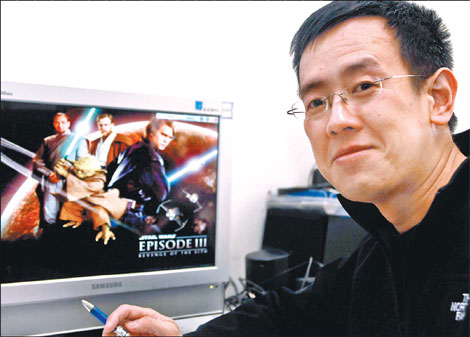
While most mainstream literature today focuses on the country's past, sci-fi writers like Han Song, look to the future. Feng Yongbin / China Daily |
The country's rapid modernization is the stuff of fiction. One sci-fi writer is chronicling its most dynamic dimensions. Chitralekha Basu reports.
A writer in present-day China does not have to make an effort to imagine the future, as any day-to-day record of urban China's dramatic and high-speed transformations is futuristic in itself, Han Song says.
"To be a journalist in present-day China is like inhabiting a science fiction world," he explains.
Han, who wears several hats - those of a Xinhua journalist, a blogger, a science fiction writer and a sci-fi historian - feels today's China lends itself to science fiction writing like never before, being "both a pre-industrial and a post-industrial culture". While most mainstream literature today focuses on China's past, sci-fi looks into the future, he says. "And in China, the future is now."
He comes across as a self-effacing, mild-mannered guy who, given a choice, would love to spend all day burrowing into the mini mountain of sci-fi reads that keep accumulating on his desk.
The softness in his voice and deportment is quite at odds with Han's ruthless vision of the future, in which the conflicts and confusions experienced in a fast-changing culture is not only exaggerated manifold but also fraught with a deep sense of foreboding.
Drawn to the dystopian world picture in novels by Isaac Asimov and Philip K. Dick (see sidebar) since his school days in the early 1980s in Chongqing, the idea of humankind's struggle to find oneself a space in an unsparing and mysterious world keeps returning in Han's work.
His maiden collection of short stories, Gravestone of the Universe (1998), featuring an astronaut who builds tombstones in memory of fellow explorers in space, was kept 10 years in waiting as prospective publishers found the pervasive tone of despair "too dark".
In Subway (2010), his latest book, a group of Chinese explorers, whose ancestors were thrown out of the solar system when Western powers took control of Earth and sealed off the skies, return on a mission to their homeland to look for the remnants of Chinese people and culture. They land in a Beijing subway tunnel, which has been relegated to a graveyard, and find themselves on a train, rushing at breakneck speed to the point of no return.
The story is reflective, Han says, "of the human race, finding itself in an increasingly dark, endless, despairing environment, and there is no way out of this pervasive darkness".
The subway offers a mirage of a shelter, as opposed to a real one, as the train is heading toward "an unknowable, uncontrollable future", Han says. It's a metaphor for modern urbanized China, he says, "moving at high speed and never stopping it's an existentialist situation where people stand face to face and never know each other."
His conjectures about the future proved bone-chillingly prescient with the collapse of the World Trade Center in New York in September 2001. He had come up with a similar, although far more head-bludgeoning and apocalyptic, vision - the sea rising to engulf and shatter the Manhattan skyline - in 2066: Red Star Over America (2000).
The book derives its name from Edgar Snow's account of the emergence of the Communist Party of China, Red Star Over China. In some ways, it takes the story forward, by imagining a large-scale terrorist attack, a body blow to the spirit of equality and fraternity among nations.
Han used a similar motif of large-scale destruction in two other short stories.
"I often had a feeling that there would be a crisis in Western society, that it won't be able to sustain itself on its present set of values," he says.
His concern for the future of China in an increasingly mechanized, competitive and conflicted world remains an overriding one. A "staunch nationalist at heart", Han's anxiety that the Western model of development may not be the best for China runs through almost all that he writes.
"We want to be as powerful and as developed as the Western societies, but our ethos is different. Fast-track development does not agree with core Asian values," he says.
"Science, technology and modernization are not inherent in Chinese culture. They are like alien entities. If we buy into them, we turn ourselves into monsters, and that's the only way we can get along with Western notions of progress."
A chronicler of sci-fi writing in China, Han is excited by the freshness of ideas and, sometimes, the profundity of philosophical thought that his juniors in the business - Pan Haitian, who was born in the 1970s and Fei Dao, born in the 1980s - are bringing to the table.
He mentions a story by Fei Dao, in which Confucius returns to Taishan Mountain, trying to unravel the mysteries of the future. The 5th century BC ideologue, whose ideas of society, government, filial duty and justice have long influenced Chinese culture, is depicted still looking for answers at the end of the story. And his traditionally held beliefs are shaken during the process.
While the science fiction writer tag might sound cool, Han insists it is still a marginal activity in China.
"Sci-fi is seen as unreal and inconsequential, as it is unable to solve real-life problems," he says.


