Heritage
Dunhuang Mogao Caves
(chinaculture.org)
Updated: 2007-12-18 16:23
 |
Large Medium Small |
Brief Introduction
The grottoes in the Mogao Caves are the world's largest and oldest treasure house of Buddhist art.
The Dunhuang Mogao Grottoes, also known as the One-Thousand-Buddha Grottoes, are located on the eastern, rocky side of Singing Sand Mountain, near Dunhang city, Gansu province. According to historical records, the carving of them was started in 366 AD and continued for about 1,000 years. Now, there are 492 grottoes in existence, with some 45,000 square m of murals and 2,400-odd painted clay figures. The painted clay figures vary greatly in size, with the largest one being 33 m high and the smallest only 10 cm.
Painted clay sculptures and murals in the Mogao Grottoes have mainly Buddhist themes, but they also include human figures, reflecting various societies and cultures of different times. Besides, they also demonstrate painting styles of different times in layout, figure design, delineation and coloring, as well as the integration of Chinese and Western arts.
In 1900, a total of 4,500 valuable cultural relics dating from 256 AD to 1002 were found in the Buddhist Sutra Cave here, including silk paintings, embroidery and documents in rare languages such as ancient Tibetan and Sanskrit. This is regarded as one of the world's greatest Oriental cultural discoveries.
Cultural Heritage
The Mogao Grottoes show examples of various types of art, such as architecture, painting and statuary. By inheriting the artistic traditions of the central and western regions of China and absorbing the merits of ancient arts from India, Greece and Iran, ancient Chinese artists created Buddhist art works with strong local features. These art works are treasures of human civilization, providing valuable material for studies of the politics, economy, culture, religion, ethnic relations and foreign exchanges of China in olden times. Besides, there are also about 50,000 items of scriptures, documents, paintings and weavings written in several languages spanning the period from the Three Kingdoms Period to Northern Song Dynasty.
Grottoes
So far there are 492 grottoes, with murals and painted clay figures. There are meditation grottoes, Buddha hall grottoes, temple grottoes, vault-roofed grottoes and shadow grottoes. The largest grotto is 40 m high and 30 m wide, whereas the smallest is less than one foot high.Painted Clay Figures
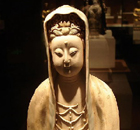
These are the main treasures of the Dunhuang Grottoes. The figures are in different forms, including round figures and relief figures. The tallest is 34.5 m high, while the smallest is only 2 cm. These painted clay figures show such a great variety of themes and subject matter, as well as advanced techniques, that the Mogao Grottoes are generally regarded as the world's leading museum of Buddhist painted clay figures.
Murals
The murals in the Mogao Grottoes display Buddhist sutras, natural scenery, buildings, mountain and water paintings, flower patterns, flying Apsaras (Buddhist fairies) and ancient farming and production scenes. There are 1,045 murals extant, with a total area of 45,000 sq. m. They are artistic records of historical changes and customs and traditions from the 4th to the 18th centuries.
Excavated Articles
In 1900, about 50,000 cultural relics were found in a sanctum sealed behind the northern wall of Grotto No. 16. These articles included Buddhist sutras, documents, embroidery works and paintings from the 4th to the 12th centuries. Apart from ancient Chinese documents, there were also documents in other ancient languages, including Tibetan, Sanskrit and Uygur. The subjects of these documents include religion, literature, contracts, ledgers and official files. This discovery, which attracted world attention, is of great research value for supplementing and emending ancient Chinese documents.
Buddhist Culture
The Sui Dynasty (518-618) was a golden age for Buddhism in Chinese history. And the Mogao Grottoes experienced their heyday of construction during this dynasty.
Born and brought up in a Buddhist nunnery, Emperor Yang Jian, founder of the Sui Dynasty, was an enthusiastic Buddhist. After he united the whole country, he made Buddhism the national religion. About 5,000 temples were built, thousands of Buddhist sculptures were carved, and there were some 500,000 Buddhist monks and nuns. His son Emperor Yang Guang was also keen on Buddhism. He had 1,000 copies of the Fahua Sutra published and established a school of Buddhism.
In this period, a large number of grottoes were carved at Mogao. The most common form of grotto dating from this dynasty is the inverted conical grotto. A typical example is the seven-layer conical tower in Grotto No. 303, converted from a central tower pillar. Murals in this period were freed from the limit of foreign arts and demonstrated a liberated dynamic creativity. Generally, they show three major features.
First, murals depicting how Buddhists underwent arduous training and endured humiliation for progress in this life receded, and murals depicting easy ways to become a Buddha and attain Paradise began to occupy prominent positions in the grottoes. Second, Avalokitesvara was no longer an accompanying figure for Sakyamuni Buddha. Instead, she was depicted separately and with more grandeur. The appearance of the separate Avalokitesvara marked progress in China's Buddhism. Third, as secularization of Buddhist art began to emerge, figures in murals in this period were more lifelike.