Dongba painting of Naxi ethnic group
Dongba painting, the oldest and most representative religious painting of the ancient Naxi people, is also their most special and characteristic artistic legacy. It is mainly found in the Naxi region of Lijiang City, Yunnan Province in southwest China.
 |
Dongba painting originated from ancient Dongba hieroglyphs as well as from various Dongba religious activities. For instance, during the sacrificial ceremonies, the ceremony masters had to dress like Buddha, gods, animals, plants, or even demons. Dongba artists then would draw these images down on paper, creating a primitive form of today's Dongba painting.
 |
A. Categories Dongba paintings, as an important part of Dongba culture, were mainly about gods and ghosts which the Naxi believed in. The paintings also reflected various aspects of people's social lives.
The materials used are primarily wood flakes, Dongba paper, and flax. The outline of a picture is first sketched with a bamboo pen and ink made from pine trees, and then pigmented with various natural colors that are bright and colorfast.
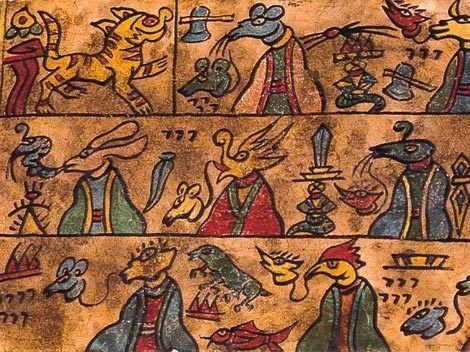
Dongba painting incorporates the five classic artistic characters of hieroglyphs: the Beiye scripture form, exquisite lines, beautiful colors, dynamic expression and sharp features. It falls into different categories, with each one depicting one or several moving stories. The paintings can be categorized into the following kinds according to the forms employed.
1. Bamboo-pen Paintings They were mostly used for the bindings and illustrations of Dongba scripts. These paintings were painted on a piece of bark-paper using a tipped bamboo plate as a pen with ink on the tip.
2. Wooden Plate Paintings These were a special kind of Dongba painting that was used for sorcery. On a flat wooden plate, a Dongba artist would first draw the sketch with a brush and then add colors to finish the picture. Usually with ingenious designs, odd appearances, vivid expressions and bright colors, this type of painting possessed a unique artistic style.
 |
3.Scroll Paintings These blended the painting styles of the Naxi, Han and Tibetan people. Scroll paintings were, as the name implies, long, multi-piece or single-piece scroll paintings. In ancient times, Dongba artists painted on flax, and later on calico. Sometimes, paper was also used. Compared with the above two types, scroll paintings were more accurate in design patterns, and richer in tableau and were sometimes sketched with gold or silver lines.
4. Card paintings They were done in different forms. Some card paintings were done with bamboo pens, and so were also referred to as "bamboo pen paintings." Yet there were also some colored ones done with a brush. A few of these paintings were done on paper flags, which were used for funerals.
B. The Road to Heaven Of all the Dongba paintings, "The Road to Heaven" is the most famous. With a length of over 14 meters and a width of 26 centimeters, it consists of four parts: hell, the human world, nature and heaven, vividly depicting more than 300 figures and dozens of rare animals and birds. Featuring bright colors and vivid characters, the piece, while influenced by Tibetan art, also boasts the styles and characteristics of the traditional Naxi painting.
"The Road to Heaven" was mostly used at funerals to release the deceased people's souls from purgatory. The painting displayed the scenes of the souls going through hell, the human world, the natural world and heaven. It is a piece with high cultural and artistic value.