中國網站品牌欄目(頻道)
|
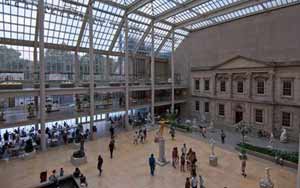 Inside the Metropolitan Museum of Art in New York City |
I'm Steve Ember.
SHIRLEY GRIFFITH:
And I'm Shirley Griffith with EXPLORATIONS in VOA Special English. Today we travel to New York City to visit one of the most famous museums in the world. The Metropolitan Museum of Art collection covers 5,000 years of human culture from all over the world. The museum, also known as the Met, was created in 1870 by a group of businessmen, artists and thinkers. Their goal was to create a leading museum that would bring art and art education to the American people.
(MUSIC)
STEVE EMBER:
We start our visit on Fifth Avenue at 82nd Street and climb up the huge number of steps of the Metropolitan Museum of Art to enter its Great Hall.
(SOUND)
In this huge room with tall ceilings visitors can pick up a map and decide what area of the museum they want to explore. It is a hard decision as there are more than two million works of art. Let us begin with the collection of Greek and Roman Art.
SHIRLEY GRIFFITH:
We look closely at a marble statue of a "kouros", or young man that was made over 2,500 years ago. It is one of the earliest known marble statues of a human from the Greek area of Attica. The man is standing very straight, with his left leg slightly forward. His form is made up of smooth lines and geometric forms. The statue was found on the grave of a young nobleman from Athens.
To see how Greek art evolved, you can look at a statue made about 100 years later. The bronze statue is a male diskos thrower. But the artistic style is very different from the earlier statue. The work is extremely detailed and life-like. It shows careful attention to how the body's muscles work.
STEVE EMBER:
The Met's Egyptian art collection takes us even further back in time. One object is a brightly painted coffin that is nearly 4,000 years old. It once held the body of a person named Khnumnakht. The painted drawings and writings tell about gods of death and rebirth. There are many other examples of funeral art such as statues, coffins, and jewelry to protect the dead.
SHIRLEY GRIFFITH:
|
 |
STEVE EMBER:
Visitors can choose to see many other kinds of artworks. There are treasures of ancient and current art from Asia, Africa, the Pacific islands and Central and South America. There is also an entire department for musical instruments and for historical clothing.
(MUSIC)
SHIRLEY GRIFFITH:
The Met's medieval art collection centers on works made in Western Europe from the fourth to the early 16th century. This area of the museum has the feel of a church. Many objects came from Christian religious centers. For example, there are stained glass windows from European churches and many objects used in religious ceremonies.
STEVE EMBER:
A group of 16th century warriors on horseback welcomes you in the Equestrian Court. The warriors and horses are wearing finely made steel armor. Owning such protective armor helped show a ruler's wealth and power. The armor also showed the extreme skills of a country's best artisans. One protective head covering from Japan dates to the fifth century. The iron and copper helmet was probably used for ceremonies. There are also two Japanese swords, one long and one short, that were made in the 1400s.
(MUSIC)
|
 Armor on display in the Equestrian Court at the Met |
It would take a day just to explore the Met's large collection of European paintings. The paintings hanging in these large rooms give a lesson in the history of art over hundreds of years.
There are many Italian paintings of religious stories. But one is especially important. The Italian artist Duccio painted his "Madonna and Child" in 1300. His painting had a huge influence on later European art. Earlier paintings showed Mary and Jesus in an impersonal and severe way. But Duccio chose to show the very human and emotional interaction between Mary and Jesus.
STEVE EMBER:
The Spanish painter Diego Rodríguez de Silva y Velazquez made an interesting painting of his assistant in 1650. The artist captured Juan de Pareja's intense look with great skill. When this painting was first shown to the public, one critic wrote that all other works were paintings, but this one represented truth.
One well known work by the French painter Jean Antoine Watteau shows a man in a garden playing a musical instrument. The colorful painting is called "Mezzetin." This artist is most famous for painting sensual actors and dancers. He was influenced by Italian theater traditions of the late 1600s.
SHIRLEY GRIFFITH:
The English painter J.M.W. Turner painted "Venice, from the Porch of Madonna della Salute" around 1835. His specialty was representing the effect of light on an environment with color and loose brushstrokes.
Turner's awareness of changing light would also interest a group of 19th century artists known as the Impressionists. The Met's collection of Impressionist works includes paintings by Claude Monet, Camille Pissarro and Auguste Renoir.
(MUSIC)
STEVE EMBER:
The area of the museum known as the American Wing contains fine examples of American art, sculpture, glass, silver and other design objects. There are also 20 historical rooms which show different periods of American building and furniture design. The Samuel Hart Room, originally in Ipswich, Massachusetts, dates to about 1680. The room has white plaster walls with large ancient pieces of dark wood. It has very little light and very low ceilings. The room was used for cooking, eating and sleeping.
SHIRLEY GRIFFITH:
One area of the American Wing contains thousands of objects in storage. In most museums, storage areas are not open to the public. But here, the many objects are stored behind glass so the public can explore the Met's rich collection of historical objects.
Some paintings that are part of the American Wing tell about important historical events. One of these is "Washington Crossing the Delaware" painted by Emanuel Leutze in 1851. It shows George Washington and his soldiers during an important event of the American Revolution.
STEVE EMBER:
Others are portraits of individuals. John Singer Sargent's painting known as "Madame X" was disputed when it was shown in 1884. The painting is of a wealthy American woman who lived in France. She was famous for her beauty. Madame Pierre Gautreau is wearing a low-cut black dress that shows off her pale skin. Mr. Sargent considered this his best work.
One unusual painting finished in 1819 takes up a whole room. Artist John Vanderlyn created a panoramic painting of the gardens and palace of Versailles in France. The painting hangs in a circular room and completely surrounds visitors standing in the middle of the space. The circular painting was first shown in a circular building in downtown New York.
(MUSIC)
SHIRLEY GRIFFITH:
Another area of the museum is named after a major donor, the Robert Lehman Wing. Upon his death, Mr. Lehman left the museum over 3,000 works of art. Museum organizers set up the collection so that the rooms look like Mr. Lehman's apartment in New York. The many Italian and Northern European paintings hang in rooms with wall and floor coverings, lamps, and furniture.
STEVE EMBER:
|
 The painting, "Cow's Skull: Red, White, and Blue," by Georgia O'Keeffe from 1931 |
"Cow's Skull: Red, White and Blue" is a well known work by American artist Georgia O'Keefe. She often painted animal bones because of their interesting shapes and simple beauty.
SHIRLEY GRIFFITH:
We end our visit to the Metropolitan Museum of Art on the museum's Roof Garden. Here, visitors can sit and enjoy the views of New York City after a long day learning about art from around the world.
(MUSIC)
STEVE EMBER:
This program was written and produced by Dana Demange. I'm Steve Ember.
SHIRLEY GRIFFITH:
And I'm Shirley Griffith. You can see pictures of some of these works of art at our website, voaspecialenglish.com. You can also find transcripts of our programs and download audio. And you can find us on Facebook, Twitter and YouTube at VOA Learning English. Join us again next week for EXPLORATIONS in VOA Special English.
Celebrating art's past and present, at the Louvre
Self-taught artists create powerful and unusual works
At the Vatican, some of the world’s greatest art
A museum better known as the US Capitol
(來源:VOA 編輯:陳丹妮)
 |
 |
 |
 |
 |
 |