NASA’s major goal was to send the first Americans into space.
VOICE ONE:
EXPLORATIONS -- a program in Special English by the Voice of America.
(SOUND)
That announcement was made May 5th, 1961. It was the first manned flight of project Mercury. Today, Tony Riggs and Larry West tell about the beginning of the United States space program that carried humans into space.
VOICE TWO:
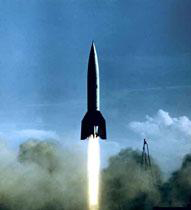
The United States entered the Space Age in 1945, at the end of World War Two. German rocket scientists, with the support of the German government, had spent 15 years developing rockets as weapons. Near the end of the war, Germany began firing huge rocket bombs at Britain.
Called V-2 rockets, the German weapons carried a ton of explosives three hundred twenty kilometers. They flew as high as 80 kilometers.
When the war ended, American forces found the parts for about 100 V-2 rockets. They brought the German rockets to America and launched 66 of them.
VOICE ONE:
The army opened the V-2 launch program to American scientists at several universities. Civilian scientists used the V-2 rockets to study the Earth's atmosphere. They gathered much new information and learned much about designing instruments for scientific rockets and satellites.
Many of Germany's top rocket scientists came to the United States after the war. They worked with American scientists and engineers to develop and test new rockets for military and scientific use. In 1956, the United States launched a Jupiter military rocket that flew more than 5,000 kilometers.
VOICE TWO:
Military officials immediately offered to use the Jupiter to put a scientific satellite into orbit around the Earth. But the American government said no. Officials decided not to mix military and civilian rocket programs. The United States said it would not launch a scientific satellite until a non-military rocket -- the Vanguard -- could be completed to carry it into space.
Navy scientists were building the Vanguard for scientific purposes. They planned to launch it in 1958.
The 22 meter long rocket would put a little scientific satellite into orbit as one of the events of the international geophysical year. The satellite itself would weigh less than two kilograms. But it would contain many tiny electronic instruments for scientific research.
(MUSIC)
VOICE ONE:
Soviet scientists also were working on rockets and satellites.
In 1957, a Soviet military rocket carried a small satellite into Earth orbit. The 83 kilogram satellite, called Sputnik, had two radios that sent signals as it circled the world. One month later, a larger Sputnik was launched with a dog inside. The dog survived the launch. But there was no way to return it to Earth. So it died in space.
A few months later, the Soviet Union put a 1360 kilogram satellite into space.
VOICE TWO:
The Soviet successes with its Sputnik satellites caused the United States to change its space plans. Officials decided to launch the Vanguard as soon as possible.
The attempt was made on December 6th, soon after the first two Sputnik launches. The attempt failed. The rocket exploded during the launch. Less than two months later, however, the United States put its first satellite into orbit.
The rocket was an army Jupiter. The satellite was Explorer One. It weighed only 14 kilograms. But it carried a great many electronic instruments for scientific research.
(SOUND)
The instruments reported much new information about conditions in space. The most important was the discovery of a belt of radiation around the Earth. It was what we now call the Van Allen Belt.
VOICE ONE:
Support was growing, in Congress and among scientists, for a United States civilian space agency. Soon, Congress passed a bill creating NASA -- the National Aeronautics and Space Administration. President Eisenhower signed the bill into law.
Its job: the scientific exploration of space. Its major goal: sending the first Americans into space.
VOICE TWO:
The new space agency was given a lot of money and thousands of engineers and technicians from military and civilian agencies. Within 3 months, the man-in-space program had a name: Project Mercury. The name came from the ancient Greeks. Mercury was the speedy messenger of the Greek gods.
Much work had to be done before Project Mercury could put an American astronaut into space. Dependable rockets needed to be built and tested. A spacecraft had to be designed and built. A worldwide radio system was needed to communicate with orbiting astronauts. And astronauts had to be chosen and trained.
(MUSIC)
VOICE ONE:
To save time, NASA decided to work on all parts of the program at the same time. It placed orders for four different kinds of military rockets for Mercury flights. It chose the McDonnell Aircraft Company to design and build the Mercury spacecraft. And it began to look for men who would be astronauts.
NASA said its astronaut candidates had to be between 25 and 40 years old and in excellent health. They could be no taller than one hundred eighty centimeters. Candidates had to be highly intelligent, with an education in science or engineering.
NASA also said the first astronauts had to be military pilots with experience in test flying airplanes. Test pilots already were trained to make quick, correct decisions in dangerous situations.
VOICE TWO:
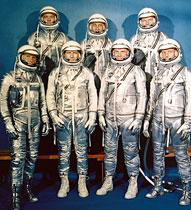
One observer said in a joking way that the space agency was just looking for a group of "normal, everyday supermen." But it was not a joke. NASA found seven normal, everyday supermen in a group of five hundred candidates.
On April 17th, 1959, the space agency introduced the first American astronauts. They were Scott Carpenter, Gordon Cooper, John Glenn, Virgil Grissom, Walter Schirra, Alan Shepard and Donald Slayton.
All were married and had children. All were from small towns or cities. All were about the same height, weight and age. And all were experienced military test pilots.
VOICE ONE:
Each of the new astronauts, however, brought his own special knowledge and skills to the Mercury project.
Navy pilot Scott Carpenter, for example, was well trained in communications and navigation. So he helped with Mercury's communications and navigation systems. Walter Schirra, another Navy flier, was an expert on the pressure suits worn by navy divers. He helped design the space suits that would protect the Mercury astronauts in space.
VOICE TWO:
Air Force pilot Gordon Cooper became an expert on the Redstone Rocket that would launch Mercury astronauts on short training flights. Donald Slayton, another Air Force flier, worked on the long-range Atlas Rocket. Marine John Glenn was an expert on airplane instruments. So he helped design easy-to-use instruments for the Mercury spacecraft.
Navy pilot Alan Shepard helped plan Mercury's worldwide communication system. And Virgil Grissom, of the Air Force, worked on Mercury's electrical systems.
(MUSIC)
VOICE ONE:
NASA made its first unmanned test flight of the Mercury spacecraft nine months after the project started. The launch was made from the space center at Cape Canaveral, Florida. The flight tested the heat shield. The shield protected the spacecraft from the great heat produced when it returned through the Earth's atmosphere.
Many other unmanned test flights followed in the next two years.
The final test flight was made at the end of January, 1961. It carried a chimpanzee named Ham on a 700 kilometer flight over the Atlantic Ocean. Several problems developed. But Ham survived the launch and the landing in the ocean. However, he never wanted to get close to a space capsule again.
VOICE TWO:
Space officials announced that astronaut Alan Shepard would become the first American in space. He would be launched early in May, 1961, on a short, 15 minute flight. That will be our story next week.
(MUSIC)
VOICE ONE:
You have been listening to EXPLORATIONS -- a program in Special English by the Voice of America. It was written by Marilyn Rice Christiano and Frank Beardsley. Your narrators were Tony Riggs and Larry West. I'm Shirley Griffith. Listen again next week to the second part of the story of the Mercury program that took the first American astronauts into space.