A priceless sip of old Beijing
 |
|
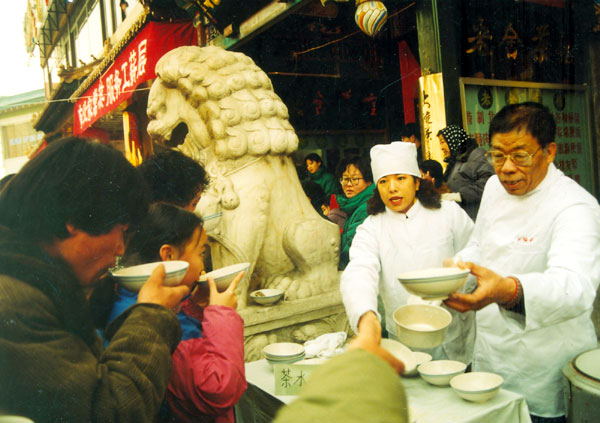
Yin Zhijun (in white cap), the general manager of Lao She Teahouse, sells dawan cha with her father Yin Shengxi, founder of the teahouse. This photo was taken in 1999. Provided to China Daily |
Tourists flock to this teahouse, attracted by the performances, the sing-song orders of the waiters, the old-world ambience and a simple serving of tea. Ye Jun tells us more about an old Beijing tradition.
A big bowl of tea offered to the thirsty is priceless, according to Yin Zhijun, general manager of the Lao She Teahouse in Beijing. That's why the teahouse still offers dawan cha, tea served in a big bowl, although the tradition has become almost obsolete elsewhere in the capital.
At the turn of the 20th century, these big bowls of tea were sold everywhere at roadside tea stands, a convenience offered to travelers, visitors and residents. But after New China was established in 1949, the tea stalls were abolished.
Lao She Teahouse was started in the early days of the economic reform of the 1980s, when the founder started selling big bowls of tea. As business boomed and the teahouse earned a reputation, the owners restored it to its former glory in 2004, and another tradition was revived and maintained to this day.
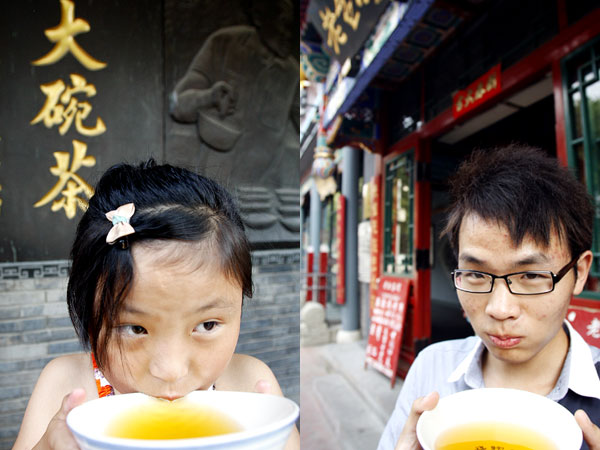
That bowl of jasmine-scented oolong tea is probably still the cheapest drink in Beijing, available in front of the Lao She Teahouse in Qianmen, at the heart of the capital. A bowl costs 2 fen ($0.03). But if you don't have the exact change, you just pay with what you have.
The counter is manned by two of Lao She Teahouse's waiters, and they sell tea drawn from a portable container, alongside two plastic buckets full of porcelain bowls and a paper box for the coins.
Many people no longer have 2-fen coins, so they often pay with a 5-fen coin, or a 10-fen coin. The tea is available daily from 10 in the morning to 4 in the afternoon, and at least several hundreds will stop by each day, according to Yin.
During peak tourist periods such as the May Day holidays or the National Day vacations in October, the tea stall serves more than a thousand thirsty patrons a day.
Lao She Teahouse makes very little from the almost-free service.
The nice, aromatic bowl of jasmine tea comes at a price. According to one manager, the tea used costs about 100 yuan ($15.74) per 500 grams, not a bad quality tea judging from its taste and price. Two fen per bowl hardly covers the cost.
In fact, the teahouse invests hundreds of thousands each year in the tea, water, hygiene and labor needed to maintain the tea stand, according to Yin. It is a homage to the teahouse's founder and history.
Yin Shengxi, Yin Zhijun's father, resigned from the civil service in 1979 and applied for a license to sell tea.
"It was just when China had started the economic reform and opening-up policy. When visitors to Beijing arrived at Tian'anmen Square, they would have just gotten off the train and had nowhere to quench their thirst," says Yin.
"A bottle of carbonated drink cost about 15 fen. People were drinking water from a hose on Tian'anmen Square," she remembers.
Yin Shengxi and his daughter decided to provide jasmine tea in big bowls to these thirsty travelers, and set up shop at the west gate of the Qianmen watchtower. Each bowl sold for 2 fen.
Soon the elder Yin added other small goods, selling albums, scarves, flashlights, foldable umbrellas and watches. By 1988 he had enough money saved to open up Lao She Teahouse.
Yin Shengxi was among the first private entrepreneurs in the 1980s, when private business was again allowed after years of a planned economy. His dawan cha became a symbol of Beijing.
He was also one of the first to invite folk artists to perform in his teahouse, and they included ballad singers, storytellers and cross-talk performers. They remain the main attraction of the teahouse today.
Lao She Teahouse is said to be the only one in Beijing to have gathered all six traditional styles of teahouses under one roof. The first-floor restaurant offers tea at 38 yuan ($6) per person, while a courtyard style high-end teahouse on the second floor offers pots of tea from 100 to 120 yuan and a place for people to meet.
As the business matures, that little tea stall in front is no longer economically viable. Instead, it is now a reminder of the past, a last visage of what was, what had been.
It is a sentimental link to the past and for its current boss, the daughter of the founder, it is a way to repay society and a symbol of the company's social responsibility.
She always sends new recruits of the company to run the stall in front of the teahouse, so they understand the company's mission to integrate enterprise and culture.
Yin wants to see the idea taken a step further. She thinks the Beijing government should set up affordable tea stalls for the old people in the city, just as her father had helped the thirsty visitors to Tian'anmen. She feels that the aging population of the city can seek some comfort in that big bowl of tea.
It is a bowl of tea that best represents the common people, and their culture, she says.
Contact the writer at yejun@chinadaily.com.cn.
 |
|
A bowl of dawan cha costs 2 fen at the tea stall in front of the Lao She Teahouse in Beijing. Zhang Wei / China Daily |