Comments()
  Print
Print  Mail
Mail  Large Medium Small
分享按鈕
0
Large Medium Small
分享按鈕
0
 |
|
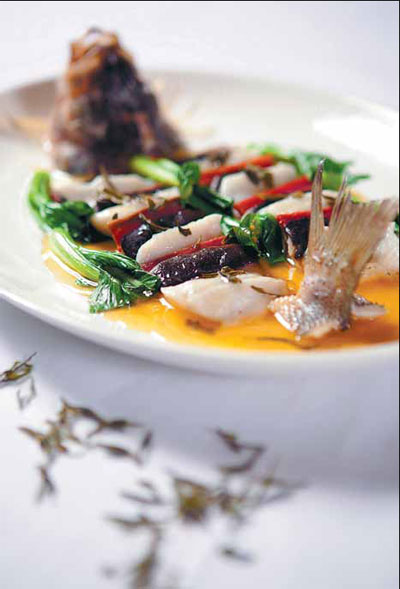
Sea bass is steamed with Xinyang maojian tea. Photos by Ye Jun / China Daily |
 |
|
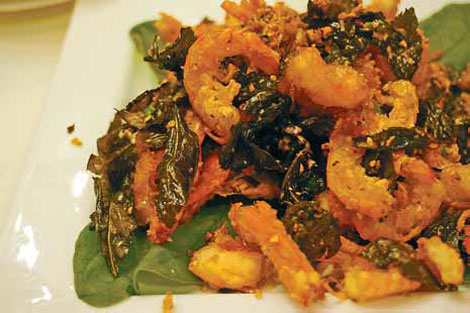
Salted tieguanyin (oolong) leaves are served with deep-fried shrimps at the restaurant. |
It was going to happen sooner or later. The idea of using tea leaves or tea infusions in food is so intriguing that many chefs have adopted it. Ye Jun looks at an increasingly popular trend in modern Chinese cuisine.
The idea of combining tea with food may be tempting but it is precisely its special characteristics that make it so hard to succeed. It was inevitable that a top class restaurant in a top class hotel in Beijing would play with the idea. Take Jewel Chinese Restaurant at the Westin Beijing Financial Street for instance. It recently pushed a new menu featuring 16 dishes using more than 10 types of tea.
Many of the major Chinese tea varieties were used, ranging from green tea, the semi-fermented oolong, jasmine tea, and aged pu'er. Infusions such as chrysanthemum and kuding were also included.
Chinese cuisine has long included classics with tea as a main ingredient. In the Hangzhou area, prawns with longjing (dragon well) tea leaves have been on the menu for hundreds of years. Shelled prawns that have been massaged in clear cold water are then fried in an intensely fragrant tea infusion with green tea leaves.
The tea produced in Hangzhou, harvested just before the Tomb-Sweeping Festival rain, is known for its chestnut-like aroma which gives the dish its distinctive taste.
Another classic dish using tea comes from Sichuan, where black tea leaves and camphor wood chips are used to smoke a duck, creating zhangcha ya, or camphor tea duck. The smoking cuts through the grease under the duck skin and the meat is turned a beautiful golden amber, with an appetizing smoky musk.
It is upon these foundations that Beijing's Chinese restaurants are trying to create new tea dishes. There have been hits and misses.
The flavor of tea is hard to capture and the dishes do not fully absorb that elusive fragrance.
Tea leaves added to the dish are sometimes more ornamental. There have been some attempts to coat the leaves in batter and fry them, but the results have been greasy and disappointing.
So it is that the chefs at Jewel must have spent considerable time slaving over their new menu. And they have done a good job at conquering the odds.
Dishes look good, taste good and in most of the dishes, you can taste the tea.
 |
|
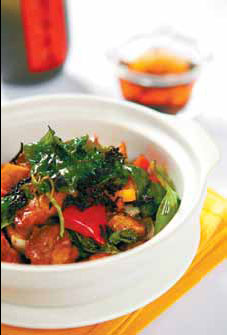
Stewed chicken with three cups sauce and pu'er tea, served at Jewel Chinese Restaurant in Beijing. Provided to China Daily |
A classic Huaiyang-style chicken soup with water shield is nicely garnished with a few chrysanthemum petals floating in the bowl. The petals are infused to extract their full flavor and you can taste the characteristic bitter-sweet of the flowers.
Salted tieguanyin (oolong) leaves are served with deep-fried shrimps, and the dish is done better than elsewhere. The shrimps are done to a crisp without losing flavor, and the tea leaves too add to the crunch.
In the wok-fried sliced beef with bitter melon and kuding, the bitter tea nicely matches the bitter vegetable while the three-cup chicken with pu'er is excellent with a bowl of rice. But the strong tastes of the sauces overwhelmed the pu'er and kuding leaves, and you need a really sensitive palate to detect the traces.
Perhaps it is due to the properties of tea, but both these dishes tasted less oily than usual.
However, it was really hard to detect tea in both the poached clams and steamed sea bass - if not for the tea leaves garnishes.
Glutinous rice balls with pu'er tea or green tea for dessert showcased the teas best, although they were a tad too sweet for me.
Jewel Chinese Restaurant sous chef Cai Guangmin says he likes tieguanyin, an oolong tea produced in southern Fujian's Anxi. He says he surfed the Internet to research the properties of various teas before deciding what ingredients worked best in the dishes.
"I think the bold flavors of pu'er will match the strong-tasting three-cup chicken," he says. "On the other hand, the bitter taste of kuding goes well with bitter melon, and can also beat the heat and reduce dryness in summer."
For both dishes, he soaked the tea leaves in hot water, and then pours the infusion into the dish, reducing the sauce before serving.
Cai says tea dishes offer the same benefits as tea drinking, and the teas will reduce the grease in the food, and help the body digest a meal better.
He has experimented with tea in different forms, using leaves, infusion and powder.
Zou Jun, director of operations with Mingjia Yaji, a company dealing with tea, says different teas are suitable for different cooking methods.
"Green tea is suitable for plain frying, and used in light, vegetable dishes. Black tea can be used for roasting, marinating and smoking. Matured pu'er has a dark color and strong taste, and is better used for seasoning in red-braised dishes," he says.
"Oolong teas such as dahongpao (Fujian's famous Big Red Robe tea), is similar to black tea, and tieguanyin is similar to green tea, and can be used likewise."
Taiwan was the first in China to design a complete set of tea dishes in the 1980s, according to Zou.
One dish that was very popular for a time was duck or pork rib soup with Taiwan's baozhong oolong, in which the amino acid in the tea emphasizes the freshness of the meats. Later, black tea was used to roast pigeon in another dish.
By the 1990s, innovative Chinese chefs in Sichuan, Huaiyang and Hangzhou created more tea dishes, one step up from the Taiwan inventions.
Zou, who graduated from the Tea Department of Zhejiang University, says Shanghai's Qiuping Tea Banquet was the first specialized restaurant in Chinese mainland to offer tea cuisine when it was founded in 1994.
The restaurant produced a West Lake tea banquet featuring Chinese teas of different colors: green, white, yellow, dark green, red and black.
Owner Liu Qiuping pairs the tea dishes with beautiful lines of ancient Chinese poetry. She uses tea instead of ordinary seasoning such as cooking wine, aniseed, and Sichuan peppercorns.
In Beijing, people can sample tea cuisine in restaurants such as Green T. House, and Wu Yu Tai Tea Restaurant. Many restaurants in big star hotels also offer some.
Zou thinks tea dishes presently cater to a minority of aficionados and that it will be quite some time before a more matured tea cuisine is developed.
"In the past 10 years or more, only 20 to 30 creative tea dishes have withstood the test of time," he says. "They are more for special occasions rather than for every day consumption."
Tea infusions are volatile, making it hard to withstand high cooking temperatures, and so are best used for cold dishes. The exception is when the tea is concentrated into essence, like what is used in some noodle restaurants in Taiwan.
"Creating new tea dishes takes a lot of creativity on the part of the chef, who must have a very good understanding of both tea and ingredients," Zou says. "It just needs more time."

 Michelle Obama addresses at Democratic National Convention
 Slides of Yanbian: place, people and prosperity
Copyright 1995 - 2010 . All rights reserved. The content (including but not limited to text, photo, multimedia information, etc) published in this site belongs to China Daily Information Co (CDIC). Without written authorization from CDIC, such content shall not be republished or used in any form. Note: Browsers with 1024*768 or higher resolution are suggested for this site.
License for publishing multimedia online 0108263 Registration Number: 20100000002731