|
|
Climb onto the roof of an urban apartment or office block to watch the night sky, and you are unlikely to see anything because of the bright city lights glaring from below.
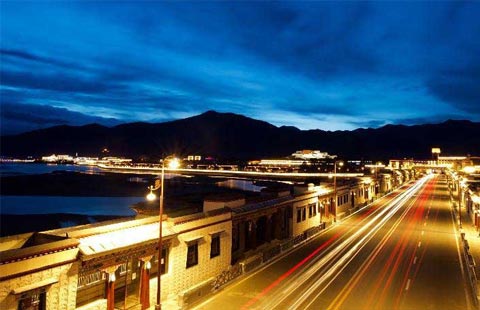
The growth of light pollution, coupled with the large number of radio waves in the atmosphere that hamper the use of radio telescopes, has driven an increasing number of professional and amateur stargazers to the roof of the world - the 4,500-meter-high Tibetan Plateau - where the clear, dark skies are a boon to astronomers.
Earlier this month, amateur Chinese astronomers promoted the country's first Dark-Sky Reserve, located in Ngari prefecture in the west of the Tibet autonomous region, at the 29th general assembly of the International Astronomical Union, held in Honolulu.
"We have planned a 2,500-square-kilometer reserve in Ngari, and will apply for accreditation from the International Dark-Sky Association next year. If everything goes smoothly, Ngari will be the first Dark-Sky Reserve in Asia," said Wang Xiaohua, of the Chinese branch of the International Dark-Sky Association, a nonprofit US-headquartered organization.
Since 2001, the association has given accreditation to 26 Dark-Sky Parks, nine Dark-Sky Communities and nine Dark-Sky Reserves that meet its criteria for low levels of light pollution. "The requirements for Dark-Sky Reserves are stricter than for Dark-Sky Parks and Dark-Sky Communities," Wang said.
Astronomers began searching for a suitable location for the reserve in 2003, eventually opting for Ngari. In August 2013, Norio Kaifu, the IAU president, visited the construction site and said the park was expected to become Asia's best location for astronomical observations.
Scientists and amateur astronomers formulated a plan to build a protected area in Ngari, and a Dark-Sky Park located inside the protection zone came into use in July last year.
"Owing to rapid industrialization and urbanization, light pollution in urban areas has become an increasingly serious problem, especially for astronomers," said Wang Junjie, a researcher for the National Astronomical Observatories at the Chinese Academy of Sciences and chief scientist at Yangbajing Observatory in Tibet.
Light pollution has also resulted in the deterioration of viewing conditions at some early observatories built close to large cities such as Beijing and Nanjing, rendering them almost useless for professional astronomers. Many are now educational facilities that promote popular science.
Instead, new observatories have been founded in remote, sparsely populated regions, including a 2.4-meter optical telescope at Lijiang in Yunnan province, and a sub-millimeter telescope called CCOSMA at Yangbajing Observatory, the first purpose-built facility of its kind in Tibet. A 500-meter Aperture Spherical Telescope is currently under construction in Pingtang, Guizhou province.
"With high altitude, little rain and light winds, the conditions for observations are better in Tibet than any other region," Wang Junjie said.
When it opened in 2011, Yangbajing Observatory, at the foot of Nyainqentanglha Mountain, was equipped with the most-advanced telescopes available, but they have been superseded by equipment installed since then. Meanwhile, the National Astronomical Observatories has been scouting for sites in other parts of Tibet in the hope of finding more locations with perfect conditions.
However, the high altitude means non-natives are advised to avoid long-term exposure to the plateau, so the National Astronomical Observatories is planning to help Tibet University found a major in astronomy.
"We've been conducting joint research in areas such as Dingri county and prefectures such as Nagqu and Ngari. As we develop more facilities in Tibet, we will train more local astronomical talent," Wang Junjie said.
chengyingqi@chinadaily.com.cn
Related Stories
Copyright 1995 - . All rights reserved. The content (including but not limited to text, photo, multimedia information, etc) published in this site belongs to China Daily Information Co (CDIC). Without written authorization from CDIC, such content shall not be republished or used in any form. Note: Browsers with 1024*768 or higher resolution are suggested for this site.
License for publishing multimedia online 0108263 Registration Number: 130349