China's army of peace marches on
PLA celebrating 27th anniversary of nation's involvement in UN missions overseas
"If you were killed during a mission, how would you like your UN death benefits to be distributed?"
That was one of the first questions Senior Colonel Yang Xijun was asked when he signed up as a military observer for the 2006 UN mission in Sudan, a North African country ravaged by tribal warfare, disease and poverty.
Yang's chosen role had historic resonance. On April 21, 1990, China participated in a peacekeeping mission for the first time by deploying five military observers in the Middle East as part of the UN Truce Supervision Organization.
|
Chinese peacekeepers train in Monrovia, Liberia, in January. Photos by Li Jinhua / Xinhua |

Two years later, the country sent 400 People's Liberation Army engineers to assist the United Nations in Cambodia, China's first deployment of military personnel on an official "blue beret" mission.
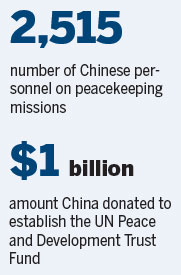
More than 2,500 Chinese peacekeepers are participating in 10 UN-led missions, meaning the country provides a greater number of personnel than the four other permanent members of the Security Council combined.
China also is the second-largest financial contributor to peacekeeping missions, providing more than 10 percent of the $7.8 billion budget for 2016-17.
In 2015, President Xi Jinping committed 8,000 troops to the UN peacekeeping standby force. He also pledged $100 million to the African standby force, which is backed by the African Union, and $1 billion to establish the UN Peace and Development Trust Fund.
According to Gao Mingbo, section director of the Department of International Organizations and Conferences at the Ministry of Foreign Affairs, the three biggest changes during the 27 years in which China has participated in peacekeeping efforts are the increasing sophistication of missions, the wider range of personnel required and the growing volume of equipment and support funding.
While Yang agreed with Gao's assessment, he noted: "The success of peacekeeping missions ultimately falls on the shoulders of the brave men and women in blue helmets."
In February, Yang signed up for his fourth mission, as a high-ranking logistics officer for the UN peacekeeping mission in Mali, West Africa.
"Initially, my family thought I was mad for constantly throwing myself into foreign conflicts and risking my life for countries they barely knew," he said. "But I think it's a great honor to represent my country and to fight not for resources or dominance, but for stability and the greater good of those in need."
Eyes and ears
Military observers are like war reporters, according to Yang. They have to interact with local people, learn about the culture and the prevailing situation, and report any suspicious activities or violations of ceasefires or human rights to the UN Security Council.
"Since we are not allowed to carry weapons, our battles are fought with binoculars, cameras and notebooks," he said. "Our goal is to raise awareness and pull the international community together to prevent crimes against humanity. We are the Security Council's eyes and ears."
However, unlike reporters, who often have the luxury of working on the sidelines, "facing life-threatening danger is part of our daily routine", he said.
One of those dangers involves long-distance patrols. According to Yang, crossing disease-filled swamps and barren wilderness is considered easy, and the real challenge lies in fields laced with landmines, a common problem in the Western Sahara and South Sudan.
"In the car, we sit on top of our bulletproof vests and put sandbags on the floor, hoping they will absorb some of the blast from a small mine. But if we hit an anti-tank mine, we are dead," he said.
"It becomes more dangerous during the rainy season because the safe tracks left by previous vehicles are washed away. Then, we rely on our memories, GPS and luck."
Some of the most unpredictable and serious difficulties come from dealing with local people. "It can be very difficult to distinguish friend from foe," he said.
"A village may look innocent, but the make-up of its population can be very complicated. Armed extremists or guerrillas often live with women and children, and sometimes even use them as hostages or weapons."
It helps that Chinese peacekeepers have a reputation for being disciplined and on good terms with the locals.
"You have to earn people's trust and respect through genuine acts of goodwill, and convince them you are risking your life for their well-being," he said.
In early 2012, conflict broke out in Mali between the government and armed groups, including Islamic radicals and Tuareg rebels. In April 2013, the UN formed the Multidimensional Integrated Stabilization Mission in Mali, known as MINUSMA.
Mali is the most dangerous ongoing peacekeeping operation in the world. In the past four years, 118 peacekeepers have been killed, and in June last year, a car bomb exploded at a UN camp in the northern city of Gao, killing Shen Liangliang, a 29-year-old sergeant first class, and injuring seven other Chinese peacekeepers.
"The enemy was hiding among the civilians; suicide bombers and car bombs were common and threats were everywhere," said Senior Colonel Zhang Geqiang, who was field commander of the first "police force" - a military unit that undertakes patrols, crowd surveillance other front-line tasks - China sent to Mali in 2013.
Before deployment, Zhang drilled his 170 elite soldiers, selected from 2,030 applicants in the People's Liberation Army Shenyang Military Region. In addition to the police force, the unit included a 155-strong engineering division and 70 medical personnel.
Peacekeepers are only allowed to use their weapons in self-defense, so during shooting drills, Zhang ordered his soldiers to hang a brick from the barrels of their rifles and tie sandbags to their arms. They were also ordered to use their trigger fingers to pluck grains of rice from a bowl.
"These exercises are meant to train their hands, to make them sensitive and steady, so they can accurately aim for nonlethal body parts or shoot a gun out of an enemy's hand," he said, adding that wilderness survival, bomb disposal, undercover and stealth exercises, and crowd surveillance and control also featured heavily during training.
Trump card
On Dec 5, 2013, the first batch of 135 Chinese peacekeepers arrived in Gao, which had been liberated from occupying insurgents less than a year before.
The Chinese force was put to the test almost immediately. On Dec 24, two rockets were fired at their compound; one landed in a river, the other exploded 1 kilometer away.
During their nine-month mission, the Chinese peacekeepers conducted more than 450 patrols and 290 escort missions, and were subjected to more than 30 rocket attacks and suicide bombers, but there was not a single causality, Zhang said.
On Aug 1, 2014, at a medal ceremony for UN peacekeepers, the then-MINUSMA force commander, Major General Jean Bosco Kazura, thanked the Chinese peacekeepers for their crucial contribution.
"The Chinese peacekeepers are MINUSMA's trump cards," he said.
Contact the writer at zhangzhihao@chinadaily.com.cn
'Iron Roses' solving thorny problems
The evolution of peacekeeping missions has seen female soldiers becoming increasingly involved in front-line action.
In 1993, female soldiers accounted for just 1 percent of uniformed personnel deployed from around the world. This year, out of approximately 96,800 uniformed peacekeepers, women constitute 3.7 percent of military personnel and 9 percent of police personnel in UN peacekeeping missions, according to UN data.
China's peacekeepers are continuing that trend and some female soldiers - nicknamed the "Iron Roses" - are at the forefront.
Liu Jia, a policewoman from the fourth batch of peacekeeping police sent to Liberia in West Africa last year, was one of six females, and the only female police officer, in the 140-strong force deployed for the UN peacekeeping mission in Monrovia, the capital.
Like her male colleagues, Liu took part in patrol and sentry duties, all in full body equipment under the baking sun. Despite the heat, she seldom drank water in the field because she did not want to inconvenience the team by wasting time finding a restroom.
"My time in Liberia has turned me from a 'princess' into a 'tough girl'," she said, laughing.
In addition to her usual duties, she also acted as the team's counselor. "The situation in Liberia is very tough, and people are often stressed out or homesick, but men tend not to admit it to their male colleagues," she said. "However, having a trusted female listener can really bring peace of mind."
On one occasion, she comforted one of her peers when his father-in-law died. "Whatever was troubling the men, whether it was family or the mission, I was always willing to listen and help," she said.