China's wealthiest village returns to rice farming
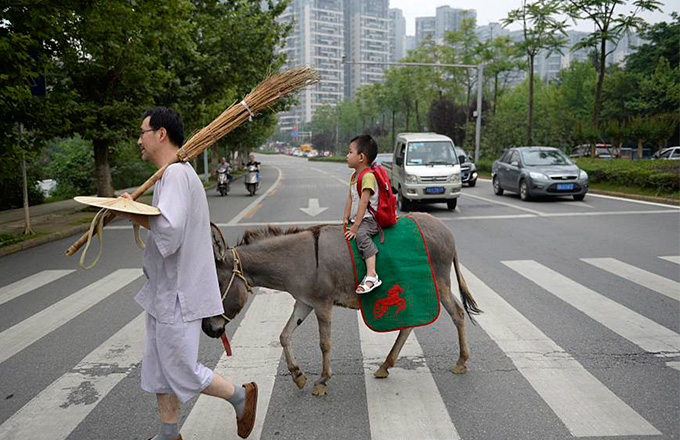
NANJING - After walking out of his spacious villa, Mei Zhenhua drives his Audi 6 to the rice farm in Huaxi village, known as China's wealthiest village.
The 34-year-old former metallurgy engineer has lived the agricultural life for a year and a half, as one of the seven "young smart intellectuals" selected by villagers to grow rice.
Huaxi in eastern China's Jiangsu Province, about 130 km away from Shanghai, has been urbanized. With skyscrapers and a village-run aviation firm, Huaxi has accumulated wealth through the development of industries ranging from steel and chemical fiber, to banking, new energy, logistics and marine transport.
However, villagers are no longer satisfied with the wealth generated from industrial development, even feeling embarrassed that agriculture has nearly died out. Nobody wants to eat produce from the village's 80 hectares of farmland, as it does not taste good.
In a decision agreed by 2,600 villagers in 2016, they gave 16 hectares of farmland to seven young people, college graduates aged 30 on average, to grow high-quality rice.
They were first sent to Asahi Noyu Farm in Japan to study how to grow high-quality rice, as none of them had farming experience.
"There is no secret in Japanese rice farming, only an artisan spirit in pursuit of perfection in each step of rice cultivation," said Mei, a graduate from China's prestigious Harbin Institute of Technology.
He said the problem of Chinese rice was a long-term focus on yield rather than taste and quality. Pollution in China due to years of industrial production has also damaged farmland.
Returning from Japan, the seven young farmers started growing rice in Huaxi in May 2016, starting by leveling soil, selecting seed and growing seedling.
Mei said they were strict in each process, using traditional manual selection for good seed.
To ensure the water was clean, they dug a small reservoir near the field, where water is treated through three filtration procedures before irrigating the farm.
The experimental field yielded only 60 tonnes of rice last year, with a per-unit output only half of a normal Chinese rice field. However, the rice won the gold award at Jiangsu provincial rice appraisal and was soon sold out.
The village committee decided this year to give all of the village's 80 hectares of farmland to the seven farmers.
"Huaxi is after all a village. We cannot give up our agricultural roots," said Wu Xie'en, Party chief of Huaxi.
Industrialization and urbanization had been seen as a measure of development for a rural town. But people are now worried that without agriculture, the village may lose its nature, according to Wu.
The village committee has spent 50 million yuan (7.3 million U.S. dollars) on the good rice cultivation program. In the next five years, it will continue to send young people to study rice farming in partnership with the Japanese farm.
Huaxi village has given Shimizu Toyoyuki, owner of the Asahi Noyu Farm, the right to choose young candidates from the village to study in his farm.
Toyoyuki said although he was initially surprised to see China's wealthiest village send people to study rice growing, he understood that China and Japan had the same problem in that most young workers were no longer interested in farming.
Cui Jingbin, one of the seven Huaxi farmers, studied in the Nishinippon Institute of Technology in Japan.
He said one thing he had learnt from the farming internship in Japan was that farming was intensive work, with every step interlinked.
"Food safety and health are new pursuits for Chinese people. With the rice program, we neither want to earn big money, nor make an attraction, but explore a modern agricultural production system to grow high-quality rice," Wu said.
The village's current annual per capita income is over 15,000 U.S dollars, with each household having a villa and private cars. Villagers also enjoy subsidized health care, and the village hosts over 2 million tourists every year.