|
|
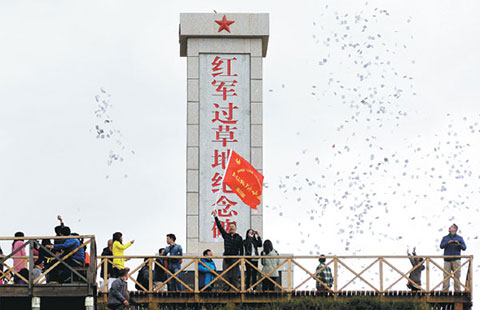
Eighty years after the end of the Chinese Red Army's epic expedition, the mass migration is still capable of stirring the hearts of millions across the globe, Liu Jing reports from Huaihua, Hunan province.
In October 1934, hundreds of thousands of Red Army soldiers set out on the Long March, a strategic shift from the forces of the Kuomintang, or Nationalists.
After two grueling years spent trekking through inhospitable countryside, the troops and their followers arrived at Yan'an in Northwest China's Shaanxi province, which would be their base for the next few years.
The world largely got a glimpse of the Long March and the Communist Party of China in 1936 thanks to Edgar Snow, a journalist from the United States who spent months with the Red Army in the northwest and later wrote Red Star over China, the definitive account of the CPC's travails at the time.
Setting out
Since August, four China Daily reporters from overseas have been part of a larger group of journalists from more than 40 national and local news portals and platforms invited to retrace the Red Army's 12,500-km route to bring a fresh perspective to the historic event for readers worldwide.

"Before going on this trip, my knowledge regarding the Long March was no more than a few general issues," said Tyler O'Neil, during a trip to Hunan province, from where the Second Front Army of the Red Army departed for the Long March.
"Now, I have come to realize that the details are very important. I appreciate the opportunity very much," said the United States national, who also visited Long March sites in Gansu province in China's far northwest.
The foreign reporters' tour is not only designed to mark the Long March, but also to record the progress achieved by local people in recent decades. It is hosted by the Cyberspace Administration of China, the nation's internet watchdog.
By Sept 30, the group will have visited Jiangxi, Hunan, Guizhou, Sichuan, Gansu and Shaanxi - six of the 15 provinces, municipalities and autonomous regions the Red Army traversed during the march.
In addition to the six provinces featured in the main tour, the remaining nine provinces, municipalities and autonomous regions organized their own media visits to retrace the marchers' route.
"(We invited the foreigners) to inherit 'Red Genes'. Eighty years ago, there were foreigners such as Edgar Snow, who recorded the Long March, or Rudolf Bosshardt from the United Kingdom, who participated in the march," said Jiang Jun, director of the Bureau of Internet News and Communications at the Cyberspace Administration of China.
"We invited our foreign friends to join this press tour to experience the Long March spirit, to witness the dramatic changes taking place along the route and, through their experiences, to tell China's stories," Jiang said.
Arduous progress
Briton Greg Fountain visited Sichuan from Sept 9 to 14. The snow-clad mountains and barren grasslands made the province one of the most arduous sections for the original Long March participants.
Even today, the route is grueling. Fountain had to rely on thick clothes and bottled oxygen to avoid feeling light-headed at the 4,600-meter summit of Jiajin Mountain, the first snow-capped peak the Central Red Army encountered during its mammoth trek.
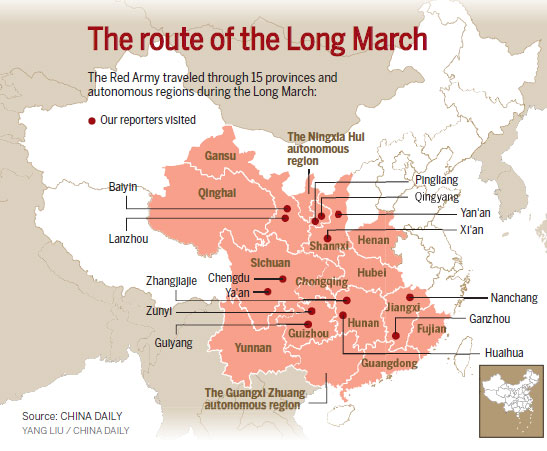
During a visit to Guizhou province, Indian journalist Faisal Kidwai said the Long March is defined by the selfless spirit of the participants, even in the face of daunting difficulties. After their two-year struggle, barely a quarter of the 200,000 soldiers who began the trek made it to the end.
"Most of China, especially the western part, was underdeveloped 80 years ago. To put it mildly, the infrastructure was not world class and the army wasn't the strong force it is today. Finding even essential items was not easy. Given all those factors, it's truly remarkable that such people volunteered to face the sacrifices, suffering and heartaches just for love of their country," Kidwai said.
Fountain and Adam Hegarty, an Australian national, echoed that sentiment. In Jiangxi province, the starting point of the Long March, Hegarty spoke with a 101-year-old Red Army veteran and found inspiration in the hardships he recalled.
The reporters have been impressed that the Long March spirit has been inherited and adopted by local people in their "New Long March" to shake off poverty.
"One of the things that impressed me the most is the transformation that happened in Shibadong village in Hunan, where the people worked really hard for a better life. This is such a dynamic way of showing the intrepid character of the Chinese people," O'Neil said.
In the village, hidden in the mountains, O'Neil was deeply moved by the story of 76-year-old Long Decheng, whose family was mired in poverty until 2013. Shortly after President Xi Jinping raised the concept of "targeted poverty alleviation" in the village, the family began to prosper from the development of local tourism.
"She (Long Decheng) must have an incredibly hard life living in these remote mountains, but she still has this great positive energy. This is the greatest testament to the Long March spirit - resilience," O'Neil said.
Recent achievements
Kidwai observed the same spirit in Guizhou. He said he was struck by how far the province has come in such a short time. In 1978, its per capita GDP was less than one-half the national average, but now the southwestern province is posting double-digit growth and cruising on the information superhighway.
The press tour has been trending online since it began. As of Monday, 116,195 related entries had been published online, and there have been 74,107 posts on Sina Weibo - China's Twitter-like service - alone. The two official articles about the event garnered 640 million views.
China Daily's foreign reporters have written a number of articles to record their journeys, which can be found on chinadaily.com.cn.
"I hope to provide an outside perspective on a part of history that my Chinese counterparts have known all their lives. I believe I can shine a different light on issues we encountered that have already been framed in a certain way by the media that came before us," O'Neil said.
Contact the writer at liujing-4@chinadaily.com.cn




Copyright 1995 - . All rights reserved. The content (including but not limited to text, photo, multimedia information, etc) published in this site belongs to China Daily Information Co (CDIC). Without written authorization from CDIC, such content shall not be republished or used in any form. Note: Browsers with 1024*768 or higher resolution are suggested for this site.
License for publishing multimedia online 0108263 Registration Number: 130349