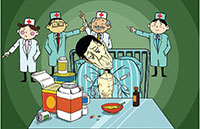
Trial is an attempt to deal with the growing problem of drug resistance around the globe
All top-level hospitals in Jiangsu province will stop treating outpatients with antibiotic drips from July 1 next year.
Prescription antibiotic drips will be prohibited in all of the province's level-three hospitals, the highest level in China, according to the Jiangsu Health and Family Planning Commission.
The pilot scheme is an escalation of China's campaign to overhaul the clinical use of antibiotics.
Outpatient departments in these hospitals will stop providing such treatments altogether by the end of next year. Only inpatient and emergency departments will continue the use of antibiotic drips for adults.
Level-3 pediatric hospitals will be exempt from the new regulation, according to the provincial commission.
"This confirms the national health authorities' determination to crack down on clinical antibiotic abuse that is leading to rising levels of antibiotic resistance across the country," said Peng Qingyu, professor of health economics at Shandong University.
In Nanjing, Jiangsu's capital, about 200,000 patients receive antibiotic drips annually in level-3 hospitals, accounting for 10 percent of all inpatient treatments, according to Xinhua News Agency.
A recent multicountry survey from the WHO shows people are confused about the threat posed to public health by antibiotic resistance and do not understand how to prevent it.
"The rise of antibiotic resistance is a global health crisis, and governments around the world now recognize it as one of the greatest challenges for public health," said Margaret Chan, director general of the World Health Organization, in the survey report.
"Antibiotic resistance is compromising our ability to treat infectious diseases and undermining many advances in medicine."
In China, the survey, which polled 1,000 people, showed that 57 percent had taken antibiotics within the past six months and 74 percent of those were prescribed or provided by a doctor or nurse.
More than half wrongly believed that they should stop taking antibiotics when they feel better, while 61 percent of respondents thought, incorrectly, that colds and flu could be treated by antibiotics.
"Antibiotic drips have been very popular since I was a child," said Luo Changyuan, 52, director of a county-level clinic in Anhui province. "It takes effect much sooner than pills. People cared more about how fast they could get recovery, rather than the side effects of the antibiotics."
The Anhui provincial health department released a list of 53 diseases that do not need to be treated with antibiotics in August last year. The authority asked all clinics and hospitals to reduce the number of drips used on inpatients by 25 percent within the year, which they have achieved.
Luo said reducing antibiotic drips was more challenging in rural areas because most patients were not severely sick but still wanted a fast recovery.
The National Health and Family Planning Commission estimated that an average of 138 grams of antibiotics were used per person on the Chinese mainland in 2010. That is nearly 10 times the amount used in the United States.
The commission's statistics also show that 70 percent of inpatients and 50 percent of outpatients in China are given prescriptions for antibiotics. In August last year, the commission launched a nationwide system to document cases of antibiotic-resistant bacteria at 1,349 large public hospitals nationwide.
"Hopefully, when large hospitals are able to successfully control the use of antibiotics, they will set an example for grassroots institutions," Peng said.
Contact the writers through yangwanli@chinadaily.com.cn


Copyright 1995 - . All rights reserved. The content (including but not limited to text, photo, multimedia information, etc) published in this site belongs to China Daily Information Co (CDIC). Without written authorization from CDIC, such content shall not be republished or used in any form. Note: Browsers with 1024*768 or higher resolution are suggested for this site.
License for publishing multimedia online 0108263 Registration Number: 130349