Comments
  Print
Print  Mail
Mail  Large Medium Small
China's economy will become twice as big as that of the United States and larger than both the US and the EU combined within just 17 years, according to one of China's leading economists.
Hu Angang, dean of the Institute for Contemporary China Studies, one of China's leading think tanks, makes the prediction in his new book, China 2030.
 |
| A child takes a self-portrait near skyscrapers in Shanghai's Lujiazui area. Provided to China Daily |
The book, already out in Chinese and to be published in English next month, is likely to attract major interest around the world.
His forecast - which also sees China becoming the biggest economy by 2020 - is the boldest and most optimistic prediction yet about China's economic future.
It also comes at a time when there are concerns about China's short-term prospects with GDP growth slower than expected in the first quarter at 7.7 percent, down from 7.9 percent in the final quarter of last year.
China still has a hurdle to cross just to overtake the US, with China's $8.23 trillion nominal GDP being just over half (52 percent) of the US' $15.68 trillion in 2012, according to the International Monetary Fund.
However, the likelihood of matching the US sooner rather than later has certainly increased since Goldman Sachs made its forecast in 2006 that China will be the biggest economy by 2025.
That too was also considered optimistic at the time but the financial crisis has hit the US hard and might now even be considered a conservative estimate.
Since then, China has emerged in pole position when it overtook Japan to become the world's second-largest economy in February 2011.
Hu, who is a professor of economics at China's elite Tsinghua University and the author of no fewer than 60 books, is raising the stakes with his own prediction, going further than any forecast either in China or overseas.
He believes China will be driven forward by what he terms five engines: accelerating industrialization, its major role in a new globalized world, its dominance in information technology, the rapid modernization of its infrastructure in areas such as electricity supply and high-speed railways, and the growing internationalization of its own economy.
He points out that China's workforce of 780 million is five times larger than the US' 153 million and that it now devotes 3 million person-years to research and development, twice the deployment of the US, both adding to its growth momentum.
Goolam Ballim, group chief economist of Standard Bank Group based in Johannesburg, said it is not inconceivable the Chinese economy will be double the size of the US' by 2030. His own forecast is that it will achieve that position by at least 2040.
"To some extent it is like the old adage that it is easier to make your second million dollars than your first. Once China has caught up with the United States in terms of GDP, it will be easier for it to progress from there to become twice as big."
He said he expects the US to remain a dominant economy but that the world of 2050 could look very different.
"The United States is likely to retain a strong global influence, even if it does not have a podium place in the top three. By 2050, the three largest economies in the world could be China, India and Brazil and after the United States, the fifth spot might be taken by Nigeria, as bizarre as that might sound now."
Miranda Carr, head of China research at London-based investment research firm NSBO, is more conservative than Hu, predicting China will become the biggest economy between 2025 and 2030 and double the size of the US by 2050.
"In some sense, it is entirely plausible that China could become twice as big as the US by 2030," she said. "There is phenomenal room for growth in China, space for major industrial development, and once China gets its own world-class companies, they have a huge domestic market as well as an international market to serve."
She points out, however, that for China to make such progress, it will have to achieve near double-digit growth for a continuous period of nearly 40 years, which would be almost unprecedented in economic history.
"There are really few examples of that. You would expect some hiccups along the way."
George Magnus was one who forecast such a hiccup in his book Uprising: Will Emerging Markets Shape or Shake the World Economy? published two years ago.
He anticipated a so-called "Minsky moment", a phenomena named after the US economist Hyman Minsky who warned economies faced an investment bust if they became over-leveraged.
One possible crunch time for China could be around 2015 and 2016 when a lot of local government debt - where China's overall debt has become centered - has to be repaid or rescheduled.
"People have kept reminding me since I wrote the book that the investment bust hasn't happened yet but there is always a risk of it and that would slow growth."
Magnus, senior independent economic adviser at UBS in London, believes it is possible China could become the world's biggest economy by 2018 and twice as big by 2030, but they are more like "spreadsheet" calculations.
"There is a danger of it being just a mathematical exercise. You could have a scenario where China grew by 8 percent one year and then by 4 percent in four successive years or smoothly by 5 percent in five successive years. You would get the same outcome but it would be a very different type of growth since the first type would involve a significant slowdown."
The quality of China's growth is something that concerns Gary Liu, executive director of CEIBS Lujiazui Institute of International Finance in Shanghai.
"The problem is not about how big the Chinese economy can become but the quality of that growth.
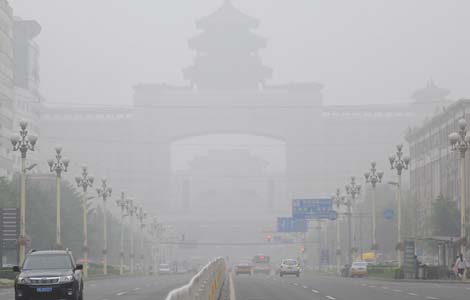
"I believe that quality is bad in China and it has been at the cost of people's health. You can feel how bad the air and water quality are. I am afraid in the coming years we will see more people get serious diseases - even cancer - in China. This is not a small issue."
Liu believes Hu's prediction of China becoming double the size of the US is off the scale, and he doesn't expect China to even get to the same level until 2033.
"There is a danger of underestimating the strength of the US economy and its ability to innovate. It will probably begin to grow again by 3 or 4 percent or even higher. If that happens and China slows down, it is going to take a while to catch up."
Duncan Innes-Ker, senior China analyst for the London-based Economist Intelligence Unit, argues that there would have to be significant improvements in China's business environment before China could make such a rapid advance.
"There needs to be major reform of the legal system and regulatory environment to put China on a level with developed countries."
He believes the Chinese economy faces significant future headwinds, particularly with its labor force shrinking by 11 percent from 798 million in 2013 to 718 million in 2030. He expects China to catch up with the US by 2023; but as to when it is double the size, he said is out of his forecasting range.
"Growth won't be easy in the coming two decades and I expect it to slow to 3.7 percent in the 2020s as the labor force shrinks. China has experienced the classic catch-up when it was easy to grow by just catching the low-gathering fruit. It now needs to up its game."
In China 2030, Hu takes the view China's State-owned enterprises, which dominate the major sectors of the economy, are a strength and not a weakness. He points out that 64 of the Fortune 500 companies are now Chinese State-owned enterprises and remain a driving force of the economy.
But Xu Bin, professor of economics and finance and associate dean at CEIBS in Shanghai, insists China's SOEs are actually a barrier to growth and that many ought to be privatized.
"There is little doubt that the success of the Chinese economy will be closely associated with the reform of the State-owned sector. Without a vigorous private sector, there is no future for the Chinese economy.
"It needs to be driven by innovation and there is no way that this can be accomplished by State-owned enterprises."
Xu, who nonetheless believes China's GDP will overtake that of the US by 2018, believes growth could fall below 4 percent in the 2020s as the economy suffers from the "convergence effect" - the nearer it gets to the world's technology frontier, the slower its growth rate becomes.
"The export-led model has come to an end for China. China is already an upper-middle-income country, and the room for catch-up is significantly smaller than 30 years ago."
Copyright 1995 - 2010 . All rights reserved. The content (including but not limited to text, photo, multimedia information, etc) published in this site belongs to China Daily Information Co (CDIC). Without written authorization from CDIC, such content shall not be republished or used in any form. Note: Browsers with 1024*768 or higher resolution are suggested for this site.
License for publishing multimedia online 0108263 Registration Number: 20100000002731