|
|
|
 |
|
|
|||||||||
 |
|
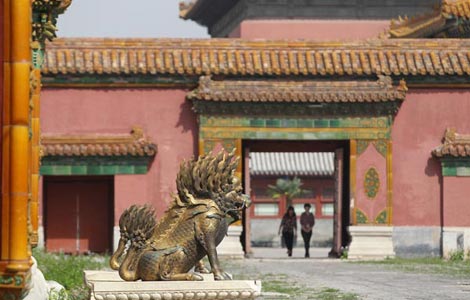
The Palace of Benevolent Peace (Cining Gong) used to be the living area for empress dowager Cixi. After 1687, when empress dowager Xiaozhuang died, it was used for ceremonies until the end of the Qing Dynasty (1644-1911). Xu Jingxing/ China Daily |
Once a fortress that no one could enter or leave without the emperor's permission, the Forbidden City is set to welcome visitors to another of its secluded zones. Our editorial team comprising Qu Yingpu, Zhao Huanxin and Yu Yilei gets a peek at what awaits.
With the opening of the secluded residence of empresses and imperial concubines, which lies to the west of Longzong Gate, visitors will enter into some of the crucial quarters of the Inner Court - once prohibited and punishable by death.
The decision to open up parts of the Inner Court to tourists is part of efforts by the world's largest palace complex to cater to the interests of the increasing number of visitors, curator Shan Jixiang said on Thursday.
The Forbidden City was declared a World Heritage Site in 1987 and listed by UNESCO as the largest collection of preserved ancient wooden structures in the world. It has been known as the Palace Museum since 1925, soon after Puyi, the last emperor of the Qing Dynasty (1644-1911), was evicted from the Inner Court.
"We received 14 million guests last year and expect to have 1 million more than that figure this year," Shan, former chief of the State Administration of Cultural Heritage, told China Daily in an exclusive interview.
"We plan to expand the visiting zones from nearly half to two-thirds (of the Forbidden City) in the near future."
Located near the halfway point of the central north-south axis, Longzong Gate was the main entrance to the Palace of Benevolent Peace (Cining Gong) as well as the Palace of Longevity and Good Health (Shoukang Gong), on the western side of the museum.
The two palaces were formerly the residence and venues for entertainment and rituals for empresses and concubines in the Qing Dynasty.
What's in store has aroused as much curiosity as historical evidence of two arrow heads stuck on the gate since 1813 when rebellious farmers attacked the Forbidden City.
Reparation and restoration of the two palaces have been completed and workers are putting final touches to the adjoining Garden of Benevolent Peace. The palaces will open to the public along with the garden after renovation of the garden is completed at the end of this year, Shan said.
"The Palace of Longevity and Good Health will be presented as it would have appeared in dynastic times, while the Palace of Benevolent Peace will showcase a rich collection of sculptures," he added.
After being the home of 24 emperors - 14 during the Ming Dynasty (1368-1644) and 10 during the Qing Dynasty, the site that is now the Palace Museum is laden with legends and anecdotes, said Lin Shu, a researcher with the museum's department of palatial life and imperial rituals.
A one-story building in the Garden of Benevolent Peace, for instance, will tell the filial story of emperor Qianlong, who left his residence to stay there through the night to wait on his ailing mother. According to Lin, the emperor apparently made frequent visits for a month until his mother recovered. At a time, it was very rare for an emperor to leave his official residence.
More safety and exhibits
Nearly nine times as large as the Metropolitan Museum of Art in New York, the Palace Museum welcomes the majority of visitors to its central north-south axis and southern Outer Court, where its ceremonial palaces are concentrated.
Besides the Palace of Benevolent Peace and the Palace of Longevity and Good Health, most quarters on the western and eastern sides of the imperial site are inaccessible to visitors, though an array of halls on both sides are open to showcase a fine collection of rare and valuable works of art.
The out-of-bounds zones are either under repair or used as offices, stores or for research purposes, according to museum sources.
Shan and his team vowed to change the situation.
"The research and office facilities have occupied a good part of the walled enclosure of the Palace Museum," said Shan. "They must move out and make room to exhibit our cultural relics."
The Palace Museum now holds a total of 1.8 million artifacts, of which over 93 percent are designated as nationally protected "valuable cultural relics", Shan cited from the museum's latest audit findings.
The area within the 8-meter-tall red walls accounts for two-thirds of the entire complex of the Palace Museum. If all the research, office and service personnel as well as materials within the walls are removed as planned by 2016, authorities could install better security measures to prevent thefts and fires, the curator added.
A notorious incident last May in which a 27-year-old farmer stole art from the museum has sparked public concerns over security loopholes in the Forbidden City.
Shan, appointed curator in February, pledged to employ "the world's most advanced security equipment and technology" and improve his employees' awareness of their responsibilities.
"Safety, especially fire prevention, is always our priority," Shan stressed.
To illustrate his point, Shan picked up a cigarette butt from the ground before entering the red walls that house the Palace of Benevolent Peace, and pointed to cameras hidden under the eaves of some buildings.
The fear of fire has been a constant threat for centuries and caused people to become superstitious. For example, almost all roofs in the Forbidden City are built with yellow glazed tiles symbolizing royalty, but the library at the Pavilion of Literary Profundity (Wenyuan Ge) had dark-colored tiles. The reason was that dark colors were associated with water, symbolic of fire prevention.
Better services
Standing near Longzong Gate, Shan said service booths selling food, drinks and souvenirs will be erected on the square for visitors once the gate is open. Currently, there is a temporary snack bar on the other side of the gate, which is less accessible to tourists, especially on windy days, Shan said.
He acknowledged that doing business in the museum had struck a raw nerve among some Chinese, who have a special attachment to the Palace Museum.
For example, the stall that served delicious but expensive beef noodles was shut down, and a Starbucks outlet that opened in 2000 was eventually closed after seven years due to a public outcry.
"Starbucks, McDonald's and other brands are considered sensitive (to many people), but their presence is not uncommon in museums in other countries," Shan said. "We have hordes of visitors from all over the world every day, often spending several hours in the museum, and they need different kinds of food and drinks."
The important thing for the museum is to ensure the needs of the visitors are well addressed, and the food served is healthy and diverse, Shan said. "We will not specify the brands. We care more about the variety and quality."
A former tour guide in Beijing, who identified herself only as Lu, said whenever she led tour groups from the southern entrance of the Meridian Gate (Wumen), all the way up to the northern exit of Gate of Divine Might (Shenwumen), many sang the praises of the spectacular palaces. But there were also others who complained of the lack of "priceless relics".
Shan said an exhibition hall spanning nearly 3,000 square meters will be created by using the space on the Meridian Gate and its two protruding wings.
Together with the Hall of Military Prowess, which houses a large collection of paintings and calligraphy works, and the Hall of Literary Glory which contains precious ceramics, they will serve as a cluster of mini-museums for visitors before entering the heart of the Forbidden City.
Shan also said the Palace Museum will open 28 ticket booths on the square between the Meridian Gate and the Upright Gate (Duanmen), to significantly cut short the waiting time for visitors.
Some of the booths will begin operation during the May Day holiday.
Contact the writer at zhaohuanxin@chinadaily.com.cn
|

|
|

|

|

|