|
|
|
 |
|
|
|||||||||
China will build 10 traditional Chinese medicine trading centers worldwide by 2015 to develop TCM services in Southeast Asia, Europe, the Middle East and North America.
The State Council Information Office held a news conference on Thursday to discuss advice given by 14 administrative departments on measures to develop the TCM industry. Building trading centers was one of the eight key tasks announced at the news conference.
|
 |
|
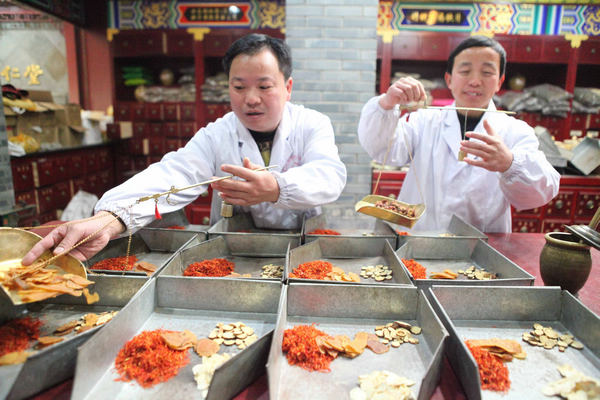
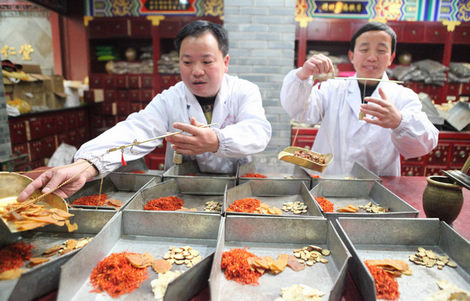
Medical workers prepare Chinese herbal medicines for customers at Huatuo Chinese Medicine Hospital in Bozhou, in East China's Anhui province. Liu Qinli / for China Daily |
According to a written reply from the State Administration of Traditional Chinese Medicine to China Daily, the government departments have not issued specific plans for the construction of the 10 trading centers, but the administration is already carrying out market research and seeking support to start a special campaign for the centers.
Other key tasks include fostering TCM talents, supporting scientific innovations and developing a statistics system for TCM trade.
Currently, China exports its TCM services, such as TCM training and medical treatments, to 160 countries and regions worldwide.
The services are provided mainly through the following channels - foreign tourists visiting China to gain TCM services, Chinese doctors providing remote service through the Internet and Chinese TCM doctors going abroad to practice medicine or to open clinics.
Statistics show that the total trading volume of TCM services is nearly 2.5 billion yuan ($397 million), said Wang Guoqiang, director of the State Administration of Traditional Chinese Medicine.
"The whole health industry will see favorable development in the coming years, both at home and abroad, and I believe TCM will have a large part to play," Wang said.
Wang also said that TCM services are facing challenges in the international market.
"The Chinese culture is so different from Western culture, so TCM still does not have high approval in some Western countries.
"At home, our understanding about international trading is not enough, and we do not have globally recognized TCM brands," Wang said.
He said funding for the industry should be boosted, and legal affairs and talents improved.
"TCM has a long history in China, and is an industry that China owns completely independent intellectual property rights," said Qiu Hong, assistant minister of commerce.
"As a result, developing TCM trading will accelerate spreading the Chinese culture to the world, enhance the TCM industry worldwide and benefit China's own TCM industry," Qiu said.
So far, several companies and institutions have presented successful overseas business models, such as Nanjing University of Chinese Medicine, Tongrentang and the chemical company Tasly Group, according to the State administration of TCM.
China has 36,000 institutes involved in TCM medical services, researching and training, 803,000 certificated TCM teachers and 15,000 people involved in new technology research and development of TCM.
Contact the writer at chengyingqi@chinadaily.com.cn
Unlike Huaxi, Changjiang keeps low profile as it spreads the wealth
As China still marvels at a small oasis of prosperity and comfort created by its richest village of Huaxi, a powerful competitor has unintentionally stolen the limelight by giving each villager two 100-gram bars of gold and silver.
In mid-March, Changjiang, several hours by car northwest of Shanghai, fulfilled a promise made in 2009 to hand out the valuable metals, worth more than 40,000 yuan ($6,350), to each of its 2,858 permanent residents.
|
 |
|
Rows of villas line the street in Changjiang village, Jiangyin, East China's Jiangsu province. Weng Lei / for China Daily |
The gift, made in celebration of the 40th anniversary of the village-owned Jiangsu Xin Chang Jiang Group, drew enormous attention at a time when China's widening income gap and unfair wealth distribution increasingly cause social problems.
Recent polls by major Chinese news organizations showed that narrowing the income gap is seen as the highest priority topic that must be addressed by the country's leaders.
Yet Changjiang, a 6.5-square-kilometer village not far from the urban center of Jiangyin, seemed untouched by the problem and to be moving toward a utopia where residents share in the common prosperity.
Apart from the gift of gold and silver, residents said they have enjoyed a long list of benefits, including subsidized villas that were sold for 68,000 and 198,000 yuan starting in 2000.
 |
|
A Changjiang resident shows a 100-gram silver bar, one of many given to villagers recently by the village authorities to celebrate the 40th anniversary of the village-owned Jiangsu Xin Chang Jiang Group on April 3. Weng Lei / for China Daily |
"How is that different from a free handout?" asked Zhang Rongxian, a resident, showing the strikingly similar two-story villas with spacious courtyards.
Other benefits have included occasional handouts of cash, shares in village companies and annual dividends, as well as a quota of free water, electricity, gas and food coupons every month.
But unlike the high profile Huaxi, which also falls under the jurisdiction of Jiangyin in Jiangsu province, village heads stay low-profile about the riches of Changjiang and have turned down almost all interview requests since the village was catapulted to fame when it issued two 100-gram bars of gold and silver to every household (rather than each person) in a preliminary celebration in 2010.
In a 2010 interview, Li Huixia, a public relations official with the Xin Chang Jiang Group, said the gold and silver were given to residents as tangible benefits of the village's prosperity and the value of the metals would appreciate every year, making them even happier.
Due to its low profile, the village sees hardly any tourists on a typical day. It is a modern area where industrial plants and modern dwellings have long replaced farmland, unlike the common notion of what a Chinese village should look like.
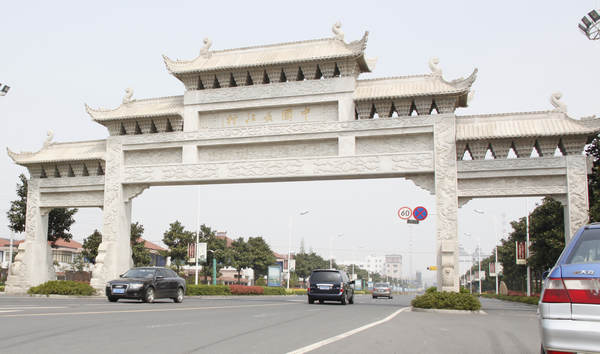
In its southern parts stands a gigantic stone gate with five gilded Chinese characters that read "Changjiang Village of China", easily visible from a distance. A major boulevard, flanked by 818 villas in neat rows, divides the village in two.
Utility companies and steel, pipe and ship recycling factories are among the enterprises in the north and far east and west of the village, which is green with plants.
The hospitality common in rural homes is not obvious in Changjiang, where each household locks itself behind bronze gates forged by the village as another gift to residents.
The people go to the village's central park after dusk, said two women from a nearby village.
Busy taking care of their children, they are the only visitors in the morning to the park that has luxury facilities such as tennis courts.
Village patriarch
Like Huaxi, Changjiang was led to prosperity by a revered patriarch, Li Liangbao.
When China embraced reform and opening-up in the 1980s, Changjiang was an agrarian hovel reachable by dirt roads.
 |
|
A stone gate, in the shape of Chinese paifang (memorial archway gate), stands in the south of the village. Wang Zhenghua / China Daily |
Li, then the local Party chief, seized on the new market freedoms to shift its economy from farming to manufacturing, with an initial investment of 700 yuan of collective funds in 1972.
After years of hard work, the diligence of Li and his team is paying off. His two small brick kilns have grown into a conglomerate diversified in iron and steel, fasteners, chemicals, steel tubes and plates, as well as hotel, real estate, logistics, investment and import and export businesses.
In 2011, the Xin Chang Jiang Group, comprising 17 subsidiaries, had 48 billion yuan turnover, placing it 195th among the top 500 businesses in China. By 2015, the group plans to generate 120 billion yuan in sales revenue.
"Only ponder the path to success, and don't seek pretexts for failure," Li said in a slogan, which is printed on the back of a monument in the village's central park, along with more of his beliefs, such as "care about common people and reward society".
Under his leadership, Changjiang has clearly prospered. The villagers get lavish annual stipends, live in spacious single-family homes instead of the country's usual cramped apartments, drive imported cars, and get basic insurance and education.
Everyone owns a piece of the conglomerate, bringing every resident dividends in recent years.
"Compared with Huaxi, the benefits in Changjiang are pretty practical," said Gu Weiming, a local restaurant owner.
The 72-year-old Li Liangbao is honored in the community but is scarcely known to the outside world. Introductory material given by local publicity officials indicate that Li was a workaholic in the past decades.
"To fulfill his promise, he always gets up at around 4 or 5 o'clock in the morning," the material said. "He left footprints at every corner of the village as he inspected factories and construction sites to ensure the scheduled progress and quality were achieved.
"His head was like a computer, his brain as useful as a database."
Safe and sound
Almost every resident approached by China Daily bubbled with joy talking about life in Changjiang. Villagers said they feel safe and live comfortable and leisurely lives.
According to the local police station, in the half month ending March 31, the community saw a total of six thefts and no other crimes.
|
 |
|
A villager and her daughter enjoy themselves on a footpath in the village. Li Gen / for China Daily |
Liu Li, an auxiliary police officer at the community police station, said Changjiang is safer than most other areas in Jiangsu.
"Security guards patrol the village three times a day and residents feel safe here," she said.
But in the pursuit common prosperity, individuality and personal choice can suffer.
Families said they could not say no when the village proposed installing identical bronze gates at every household.
Villagers are not allowed to sell the gold and silver bars they were given because they are meant as commemorative items honoring Li, the village patriarch.
A slogan seen around the community reads: "Win honor for the government and don't bring it trouble."
On the political rights of local residents, the latest issue of the group's newspaper suggests that the sessions of workers' congress were held regularly, and Fan Xinglong, the village head, made a work report at the latest session on Feb 20.
"The election of village officials were held regularly," said Cao Jinqing, 66, a retired veterinarian.
"But only those making outstanding contributions to the village and who have a certain prestige could be chosen as candidates for village chiefs," he added.
The prosperity is closely linked to the village-owned group, a family business where Li's three children head a number of its subsidiaries. But few in the village have a clear idea of the share structure of the group.
Along with sharing in the success of these profitable industries, residents have to put up with the potential pollution.
In the west of the village, the Changjiang Steel Pipe plant owned by the group, separated from the living quarters simply by a wall, gives off a pungent odor.
Dividends paid out
Professionals in rural area studies said that the handout of gold and silver bars in Changjiang is just another form of distributing the dividends to involve everyone in the profit and success.
The success stories of the rich villages in East China are similar, they said. These villages seized golden development opportunities, had a capable leader and a management team full of family business features.
"More attention should be given to how to improve the wealth distribution and let the residents have a clear idea of how large a share they own in the collective assets so that they can anticipate such distribution," Du Zhixiong, a rural development institute professor at the Chinese Academy of Social Sciences, said in a recent interview.
Contact the writer at wangzhenghua@chinadaily.com.cn

|
|
|

|

|

|