Chasing the Dragon...and the Monkey and the Rooster
Updated: 2012-01-29 08:18
By Han Bingbin (China Daily)
|
|||||||||


"For the price to go up to 500 yuan is a piece of cake," says Yu Yanping, a senior stamp dealer at Madian. He says the dragon stamps from the last two cycles have performed really well in the market. (The zodiac cycle is 12 years, so the last two Dragon years were in 2000 and 1988.)
A set of 80 dragon stamps from 1988 sells for about 3,000 yuan now, while a set of 32 stamps from 2000 is valued at more than 5,000 yuan.
Geng Shouzhong, author of the international award-winning Encyclopedia Knowledge of Chinese Philately, explains that in 2000, the Year of the Dragon coincided with a significant year in the Gregorian calendar, and many Chinese used the dragon stamps to post letters to mark the occasion. That left a limited number of mint-condition stamps, those valued most by traders and collectors.
Geng, with his 60 years of stamp-collecting experience, believes the price hike of the newly released dragon stamps is a mirage, as it is still untested by time.
Above all, Geng says the ultimate value of the stamp depends on how many were produced and how many tradable units are left over time.
These are the two main factors that help create valuable "legendary" stamps.
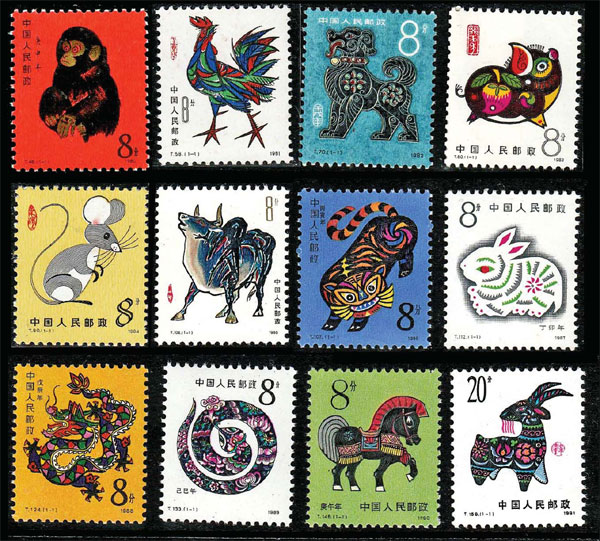
The monkey zodiac stamp released in 1980 was the first in the series released in China. Each monkey stamp can now fetch more than 10,000 yuan, and a complete set of 80 stamps will easily cost more than one million yuan.
|
 |
|
This monkey stamp with its red background is one of the rarest zodiac stamps from China. A single stamp can retail for as much as 10,000 yuan. Xu Zhuoheng / for China Daily |
It was at a time when the country was recovering from a "cultural revolution" (1966-76) and stamp collectors were only beginning to start up their hobby again. For that reason, the print-run was kept conservative and was to be only 6 million.
However, printing ink ran out sooner than expected and as a result, only 5 million monkey zodiac stamps were printed, Geng remembers. After further eliminating stamps that were of poor quality, the number of monkey zodiac stamps that finally showed up on the market was only about 4 million - the lowest number in the zodiac series to this day.
Since then, as public demands for these annual collectibles increased, the print numbers went up in response.
Between 1986 and 1991, the number stayed at around 120 million pieces. In 1992, the start of the second cycle of zodiac stamps, it increased to more than 200 million. In 1993, the Year of the Rooster, 250 million stamps were produced, effectively making that zodiac stamp the least valuable in the market today, according to Geng.
As public interest in zodiac stamps cooled, less stamps were printed in subsequent years, right up till 2003, the Year of the Goat. Only 38 million stamps were issued that year.
Yu from Madian Memorabilia Market says a set of 2003 Goat-Year stamps has now risen to about 1,700 yuan, appreciating from 80 yuan just two years ago.
Geng says that for those who collect stamps as an investment, there are still ways to observe the rise and fall of the market value. But the old collector frets that the monetary drivers overshadow the artistic intentions.
Stamp collecting is ultimately for the art, rather than for the money, he muses.
China Post seems to agree and each year, it invites renowned Chinese artists to submit designs for the zodiac stamps. Their contributions are assessed by a committee of experts and officials.
|
 |
|
The 12 stamps of the first set of Chinese zodiac signs from 1980 to 1992. |
In the early years, it was a sacred task when an artist was asked to design the zodiac stamps. Early designers of the first zodiac stamps included prominent names such as master painter and sculptor Han Meilin and Zhou Lingzhao. The latter is the artist who created the third version of Chairman Mao Zedong's portrait, which was used for the founding ceremony of the People's Republic of China on Oct 1, 1949.
In the early days, too, it was more art than technology. Stamp printing used a technology that combined engraving (where the image was first incised by hand and then printed onto the stamps) and heliography. One advantage of that technology, Geng says, is that the image came out really vivid and stereoscopic.
For example, you can clearly see the detailed lines on the monkey fur. The monkey's facial expression was equally detailed and true to life, with the gilded eye a particular highlight.
For Yang Yao, a young but experienced stamp collector who works at China Post's Jiangsu Branch, this old-fashioned technology is what distinguishes the zodiac stamps from those issued by other countries.
In 1950 Japan was the first country to issue zodiac stamps, and now more than 90 countries regularly issue zodiac stamps. Many of these, especially Western countries, commission Chinese artists for the designs.
China's unique stamp-making technology still sets its zodiac stamps apart, for their "authentic Chinese flavor", Yang says.
But Geng grows nostalgic. The latest and current series of zodiac stamps has already abandoned part of the old method and uses only a heliographic (photographic) process, to minimize damage to stamps during printing.
Geng is updating his philatelic encyclopedia, and he notes that all the background knowledge about art and history is what makes it fun for the stamp collector. It requires an investment of time and patience to read and study, something he and his wife have been doing for decades.
"As the old adage goes, stamp collecting increases knowledge. This little postage stamp is truly a small encyclopedia," he says.
You may contact the writer at hanbingbin@chinadaily.com.cn.








Hot Topics
Kim Jong-il, Mengniu, train crash probe, Vaclav Havel, New Year, coast guard death, Internet security, Mekong River, Strait of Hormuz, economic work conference
Editor's Picks

|

|

|

|

|

|