|
|||||||||||


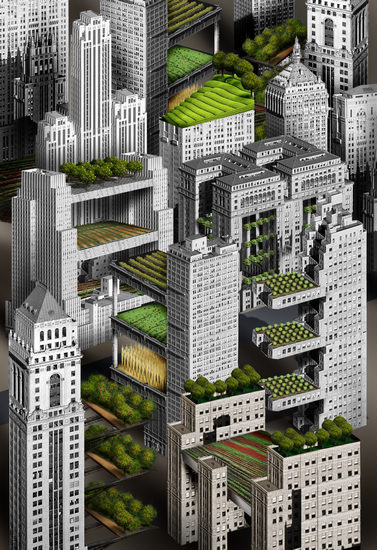
As China becomes increasingly urbanized, it has to find space for its urban and rural citizens as both groups become increasingly integrated. Experts suggest a possible model may be "re-inventing" a "garden city". Liu Yujie explores the concept.
China's mega-cities are bursting at the seams. The country is now undergoing the quickest and biggest urbanization in the history of mankind. It is estimated that by 2025, China will have 400 million more people living in its cities, raising its urban population to 900 million. Its current population already numbers 1.37 billion.
|
 |
|
Guillermo Munro / China Daily |
To cope with changing demographics and psychographics, experts say future urban development requires the rural and city relationship to change from the rural-serving-urban mode to a cooperative brotherhood.
The situation is still immensely fluid, and China's cities are changing constantly, both in size and character. As they say, "it's changing every year, with a transformation every three years".
New satellite towns are mushrooming on the urban fringes while city ring roads are rippling outwards into the countryside at amazing speed. In Beijing alone, traffic congestion has already mired the fourth and fifth ring roads, once considered countryside.
The problems are also cropping up with equal speed.
Satellite maps collected by Professor Joshua Bolchover at the University of Hong Kong bring the problem sharply into focus. They track the changing rural-urban framework in the past 30 years, and suggest that cities are brutally devouring surrounding rural land, and rapidly reducing the amount of arable land.
Where has it all gone? New residential blocks, new industrial zones, new financial centers and the other inevitable signs and signatures of economic growth have sprung up almost overnight.
This is not a sustainable growth pattern, especially when China has the world's largest population to feed.
Concerned urban planners are also starting to note the social and physical effects of the diaspora when displaced rural communities are forced into the cities.
A trend of thought is gradually taking shape, and this is the concept of the "garden city", an amalgamation of country and city that is being mooted by architects and city planners.
Already, some experts have criticized current building policies that demand a certain percentage of land to be put aside for "picturesque" greenery belt. They feel this merely caters to the sensitivities of China's emerging petite bourgeoisie. The land, they say, is completely unproductive, "useless" and ignorant of the crisis of diminishing arable land.
Hua Li, from Tao Architects, is among the many professionals with such a voice. His argument is supported by a long-term study on this subject. He says the answer is to preserve patches of "productive farmland" within urban boundaries.
This will not only bring work and purpose for displaced farmers, but also reduce food miles. As Hua says, "less transportation means we have fresh agricultural products at lower costs and less carbon emission in the city". Urban farmland can also be showcased for "agricultural tourism" and education.
Hua is not grabbing at ideas in the air. The concept is already practiced at the grassroot level.
Zhang Guichun, a 55-year-old Beijinger, has astonished the local community with his organic "hanging garden" on the roof of his traditional courtyard home north of Tian Tan, or the Temple of Heaven in southern Beijing.
"Even if we don't have enough land in the city, agriculture can go vertical, up to roof and balcony," Zhang notes.
Zhang, a traditional Chinese medicine practitioner, began creating his "hanging garden" five years ago, and now it is home to some 30 kinds of vegetables and fruit, including tomatoes, cucumbers, sweet bell peppers, melons and watermelons - all enough to feed his family.
For Zhang, the rooftop project translates to tangible benefits, such as safe, nutritious vegetables, a cooler home in summer, fewer mosquitoes (thanks to the tomatoes, which are natural insect repellents) and better bonding with neighbors.
"Neighbors enjoy dropping by for a relaxing chat or just to see how well the lovely vegetables and fruit are doing."
People like Zhang are still rare. The greening of roof space with vegetables and fruit takes skill and energy.
"But with more positive media exposure and advanced technology, I believe my experiment has the prospect of becoming common practice in future. By then, our cities will no longer look so gray when seen from the satellites."






Hot Topics
HIV/AIDS, Egypt protest, Thanksgiving, climate change, global economic recovery, home prices, high-speed railways, school bus safety, Libya situation, Weekly photos
Editor's Picks

|

|
|

|

|

|