Christmas chill hits manufacturing hub
Updated: 2011-12-17 07:58
By Alexis hooi and Qiu Quanlin (China Daily)
|
|||||||||||


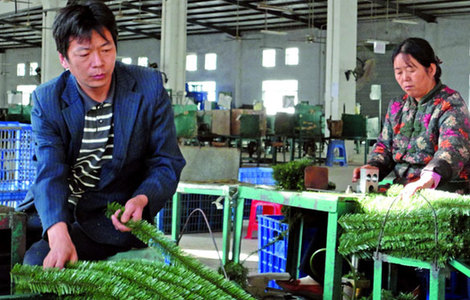
SHENZHEN, Guangdong - Peng Hua watches two factory workers as they string up a bunch of plastic pine needles on a wire before twirling them into a branch in a largely empty warehouse.
|
 |
|
Workers process plastic Christmas tree branches at the King Tree Handicrafts Company's factory in Shenzhen, Guangdong province, on Dec 2. Alexis Hooi / China Daily |
It is the beginning of December in the outskirts of the southern Chinese city of Shenzhen and the air is a comfortable 20 C. But Peng, the 41-year-old general manager of King Tree Handicrafts Company, a leading Christmas tree maker in the manufacturing hub, is starting to feel the chill of winter in the West.
"We are already experiencing the effects of the economic crisis. Things are probably going to worsen for our industry," he said.
King Tree is one of about 200 businesses in the area that help the country churn out 90 percent of the plastic Christmas trees used in the world, Peng said. His company started making the trees in the late 1980s and rakes in about $20 million a year. The US market accounts for about 70 percent of the demand for the trees, and European buyers take up most of the rest, he said.
The busiest times for Christmas tree manufacturers in the area start between March and September every year, when orders for products ranging from desktop ornaments to enormous displays more than five-stories high are filled and factories move into full gear to churn out the goods before shipping them out. In the few months before Christmas, King Tree actually enters a lull period when less than one-quarter of its 400-strong workforce remains in its 50,000-square-meter factory, mostly to produce trees to meet domestic demand, which accounts for less than 5 percent of its business.
Peng said amid this year's bleak global economy, demand is expected to decrease and quite a few smaller businesses have already folded. Still, orders have not plunged as many expected, even though customers in the West already seem to be "downsizing" to simpler and cheaper products."A family that bought a tree with all the trimmings might now look for one without those for half the price," Peng said. "Many are also going for cheaper do-it-yourself products."
The full brunt of the slow US economy and Europe's debt crisis can only be felt when orders for next year's trees are received in the coming months, he said. But King Tree is bracing itself for lower profit margins.
"We were slowly recovering from the 2008 global financial crisis when business fell by up to 30 percent. But now, with the latest economic woes, we might see less growth, of about 15 percent. That space is getting smaller and smaller," he said.
"Like many other industries here in Shenzhen, we also have to deal with other economic challenges like the rising cost of labor and raw materials."
Shenzhen has become one of China's richest cities since it became a special economic zone in 1980 following the country's reform and opening-up. The city is in Guangdong province's Pearl River Delta (PRD) region, a main engine of China's economic development fueled by low-cost manufacturing and export-oriented industries, including textiles and electronics, mostly with initial investment from Hong Kong, that help make the province churn out a quarter of the country's exports.
Growing challenges
Chinese exports continue to increase every year, but they are doing so at the slowest pace since December 2009, figures from the General Administration of Customs show. Exports increased almost 16 percent year-on-year to more than $157 billion in October but that was the slowest growth in eight months. The total figure actually dropped from September's $169.7 billion, amid economic troubles in the US and Europe.
Similarly, currency appreciation and rising costs are squeezing the profits of many Chinese exporters. The yuan has gained about 10 percent against the US dollar since China ended a two-year peg to the dollar in June last year.
Labor, one of the main factors behind economic success in the PRD, is also threatening development in an area known for its inexpensive workforce. Many areas in the PRD are raising minimum wages along with rising inflation and labor shortages, as workers are less drawn to work in the region compared to their home provinces, where the cost of living is lower.
By the end of September, 21 local governments had raised the minimum wage by an average of 21.7 percent, the Ministry of Human Resources and Social Security reported.Earlier this year, Shenzhen authorities said they would raise the minimum wage by 20 percent to 1,320 yuan ($208) a month - the highest in the country. There are now plans to increase that to 1,500 yuan a month next year. Wages in many areas in the PRD have risen more than 30 percent and pay for ordinary workers averages nearly 3,000 yuan a month. Peng said he expects his wages to continue rising.
"For the West, Christmas trees are a necessity during this time of the year. So mid-sized businesses like us will always be able to survive in one way or another. But the smaller players and the ones that make the ornaments and the decorations, already hit by rising costs, might feel any cutback in Christmas buying more severely," he said.
Chen Guanghan, an economics professor and director of the center for studies of Hong Kong, Macao and the Pearl River Delta at Sun Yat-sen University, said the smaller manufacturers in the PRD will most definitely suffer from decreasing orders for Christmas goods in the West.
"The small players will have no room to maneuver or upgrade and many of these will probably be the casualties of the economic downturn. The bigger players might be able to cope and many low-cost producers are already moving to even cheaper places overseas, such as Vietnam, even as they try to develop new markets away from the US and Europe," Chen said.
Zhang Yuge, director of the center for public policy at the Shenzhen-based China Development Institute, said that while the authorities have been making a pronounced push for PRD enterprises to upgrade and move away from the low-cost manufacturing model, it will not be easy to do so in the short term.
"Such manufacturing is certainly not sustainable for the long term. But for the moment, our export-oriented businesses still provide jobs for a large number of workers who would otherwise make much less in the countryside," Zhang said.
"The slow Christmas market has also reiterated how precarious it can be for businesses here to depend too much on exports."
"The rising wages are a very big challenge for us," Peng said.







Hot Topics
HIV/AIDS, Egypt protest, Thanksgiving, climate change, global economic recovery, home prices, high-speed railways, school bus safety, Libya situation, Weekly photos
Editor's Picks
|

|

|

|

|

|