Taking Chinese culture to the world
Updated: 2011-09-20 08:27
By Chen Jia (China Daily)
|
|||||||||||


Confucius Institutes not only teach language but also provide a clearer view of the emerging nation
BEIJING - With the aim of promoting international cooperation, since 2005 Beijing Foreign Studies University (BFSU) has joined with 17 foreign universities to set up overseas Confucius Institutes in 14 countries.
"We're the first university in China to set up a management administration of Confucius Institutes," said Zhang Xiaohui, director of the Office of Confucius Institutes, BFSU.
Zhang said the university plans to establish eight more Confucius Institutes then settle at those 25, according to its 12th five-year plan (2011-2015).
"BFSU is one of the few major universities in the country that have the resources to teach less commonly taught languages, so it can help set up Confucius Institutes in countries such as Hungary, Bulgaria, Czech Republic, Poland and so on," Zhang said.
Since 2004 Confucius Institutes have been financed by Hanban, a non-profit organization affiliated with the Ministry of Education, with the cooperation of local universities, organizations and institutes around the world.
The institutes are frequently compared to language and culture promotion organizations based in European countries such as France's Alliance Francaise and Germany's Goethe-Institut. According to research, in 2006 fewer than 200,000 foreigners came to China to study Chinese, while about 20 million people studied Chinese languages abroad, Zhang said.
The finding highlighted the need to promote Chinese teaching overseas, not just in China. Therefore, the strategy of actively spreading Chinese language teaching around the world began in 2006, according to Zhang.
As China is now playing an increasingly important role on the international stage, Zhang said more foreigners want to study Chinese.
|
 Jacques Rogge, president of the International Olympic Committee, talks with a BFSU student during the Beijing Games in 2008. |
By July 2011, 350 Confucius Institutes and 430 Confucius Classrooms had been established in 103 countries and regions, Wang Yongli, deputy director of Hanban/Confucius Institute Headquarters, said.
At present, BFSU has more than 200 teachers and volunteers involved in programs at Confucius Institutes.
Apart from teaching language, Confucius Institutes are also helping the world to better understand China.
Ding Anqi, deputy dean of the School of Chinese Language and Literature under the BFSU and former Chinese director of the Confucius Institute at Nuernberg-Erlangen in Germany, said the institute helped to promote a positive image of China among typical Germans who formerly had to rely on local media to get a vague and usually negative impression.
"They did not know much about China except Chinese food and kungfu," Ding said. "Through our institute, they encounter a more vivid view of life in China than the newspapers give them," she said.
The institute in Germany attracted only two students in the beginning when many local people thought it was a missionary organization spreading Confucian thought. A year later, more than 100 students were taking classes there.
"Some people who didn't know who I was even recommended our institute to me as a good place to teach and learn Chinese," she said.
Ding, who was the only Chinese person at the institute, said the most difficult part of establishing a Confucius Institute overseas is to understand local rules and customs so the institute can accommodate their requirements.
"It is very hard for foreigners who are unfamiliar with local laws and institutions to set up an educational organization," she said.
"To promote our institutes, we have to contact and cooperate with local media, government and universities. Any oversight can cause problems."
Cheng Shuying contributed to this story.
|
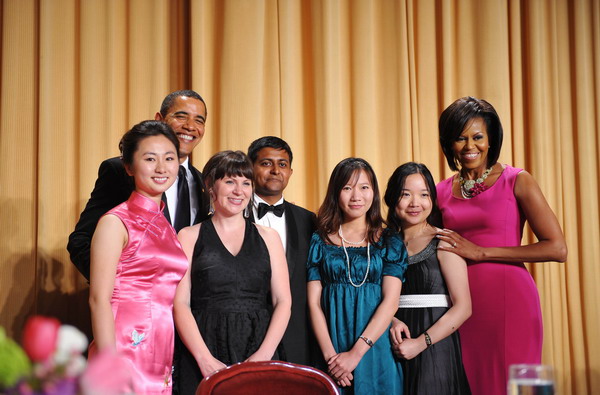 Li Mu, (second right) a journalism student at BFSU, joins the US first family at a party organized by the White House Correspondents Association in 2009. |
|
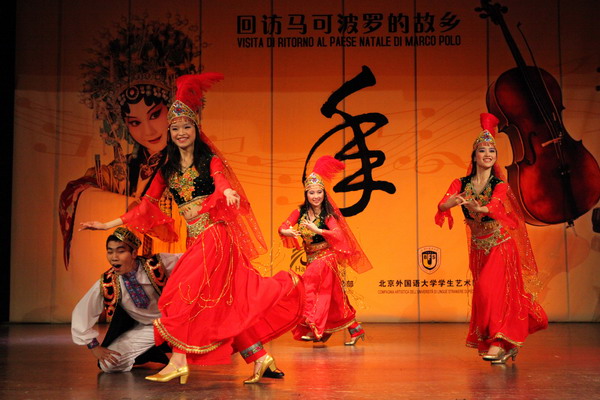 BFSU Art Troupe performs during a world tour of Confucius Institutes this year. |
|
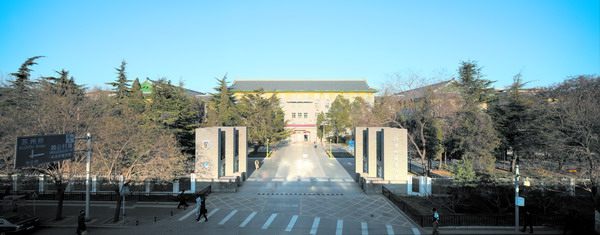 The east gate of Beijing Foreign Studies University. |









Hot Topics
Organ transplant bonds mother and son
Editor's Picks
|

|

|

|

|

|

