China's railway taking time to regain safety
Updated: 2011-08-17 08:12
By Xin Dingding (China Daily)
|
|||||||||||


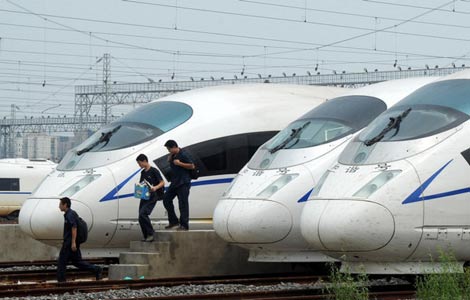
BEIJING - China's railway system, after increasing the speeds of trains six times since 1997 and opening more high-speed rail lines in recent years, has hit the brakes.
That reversal of a long-standing trend is meant to give railway officials time to "accumulate safety management experience", according to Railways Minister Sheng Guangzu.
The ministry published a new railway schedule, reflecting the decision to slow down trains, after one bullet train rear-ended another on July 23 in East China, killing 40 passengers and injuring nearly 200 others.
It also came about six weeks after the adoption of the previous schedule on July 1. That one had already reduced the speed of some trains from 350 km/h to 300 km/h and had bullet trains operating at two speeds to give passengers more choices.
The new schedule slows down two high-speed railways that were to be left untouched by the previous plan. The Beijing-Tianjin intercity railway and the Shanghai-Hangzhou intercity railway will both slow to 300 km/h from 350 km/h.
Meanwhile, eight rail lines that had operated at 250-km/h will now go at 200 km/h, and bullet trains that used to run at 200 km/h on old lines will go at 160 km/h.
The new schedule will take effect in two steps.
The first will affect four high-speed railways starting on Tuesday, the ministry said.
It will cause trains to run at slower speeds on three high-speed railways - the Beijing-Tianjin intercity railway, the eastern section of a hoop railway on Hainan island, and the Guangzhou-Zhuhai intercity railway.
The Beijing-Shanghai high-speed railway, for its part, will not slow down. But the number of trains running on the prominent line will decrease from 88 pairs a day to 66 pairs a day, starting on Tuesday. That change comes in part because China CNR Corp Ltd, one of the two largest train manufacturers in China, has recalled 54 bullet trains from the line for safety checks, the ministry said.
The second step will have more high-speed railways running at slower speeds, starting on Aug 28. Then on Sept 1, the ministry will resume the operation of bullet trains that had once left at night and arrived in the morning at places between Beijing and Shanghai. Those trains had been popular but were brought to a halt after the new Beijing-Shanghai railway had gone into operation.
Sheng said on Tuesday that the high-speed trains have slowed down "to increase safety redundancy and accumulate safety management experience".
The ministry also acknowledged recently that flaws exist in the way railway projects are managed.
"Some units have not paid enough attention to operations meant to ensure the safety of high-speed railways," said a report on the ministry's website.
On Sunday, Sheng admitted that flaws exist in the way that the safety of the railway system is ensured. He said those flaws can be eliminated.
"We need to see that the existing problems in railway safety came up in periods of rapid development and that these problems can be solved," he said.
Twelve teams have been sent by the State Council, China's Cabinet, to inspect the railway system for flaws.
So far, China has put 5,903 newly built high-speed railways into operation, Xinhua News Agency reported on Tuesday.
The country took only four years to increase the speeds of its trains from 160 km/h to more than 300 km/h. In comparison, Japan took 47 years to raise the speeds of its trains from 210 km/h to 300 km/h, and Germany took 20 years, said Sun Zhang, a transport professor at Tongji University.
"China can learn lessons from others," he said. "Some things, though, such as pre-operation tests and examinations, should admit no shortcuts."
"Using just a few months to test and adjust new lines is not enough. It is better to put a new line under inspection for four seasons in a row to find any problems."
Many passengers said they are happy to see that a priority is being placed on safety and said the longer trips they are taking are not bothering them. Others, meanwhile, complained that tickets for the Beijing-Shanghai high-speed railway have become scarcer now that there are fewer trains running on it.
A micro-blogger going by the name "Linglijiang" said she stood in a long line for a ticket to go from Beijing to Shanghai.
"People are cursing all of the time at the Beijing South Railway Station because tickets are so difficult to buy there now after the train services were reduced," said the netizen, who eventually got a first-class ticket for a train that left at 5 pm.
Related Stories
Ministry unveils new plan for bullet trains 2011-08-12 06:43
Bullet trains told to reduce speed 2011-08-11 07:24
China's biggest bullet train producer revenue top of the world 2011-08-04 17:33
After crash, bullet train rail lines fare worse than expected 2011-08-02 07:49





Hot Topics
Rainstorms cause flooding in Gannan Tibet autonomous prefecture, Gansu province, on August 15, 2011.
Editor's Picks
|

|

|

|

|

|