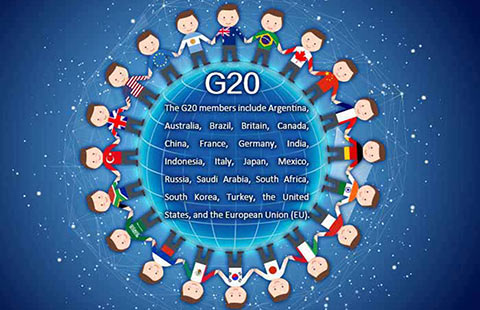
On the sidelines of the G20 Summit in Hangzhou on Sept 4-5, President Xi Jinping will host an informal meeting of his counterparts from Brazil, India, Russia and South Africa, or a BRICS meeting. Since all BRICS nations are members of the G20, their leaders, or representatives, have been sharing notes and coordinating their policies and strategies at various global forums, including the G20 Summits.
But the BRICS meeting in Hangzhou will be special for several reasons.
First, the meeting will give BRICS leaders a chance to discuss their major decisions and fine-tune them before announcing them at the 8th BRICS summit in mid-October in Goa in western India. About 900 delegates are expected to attend it, including 300 from China.
Second, the two summits put special focus and onus on China and India, which are seen today as locomotives of the global economy, which has been struggling for the last eight years. Indeed, the World Economic Outlook of the International Monetary Fund has lowered the global growth estimate from 3.1 to 2.9 percent for this year.
Third, the two summits will give China and India the opportunities to push developing countries' agenda of democratizing global financial governance, and put the BRICS house in order as it has been attracting criticism for its geographical and structural disconnects.
And fourth, given that for some time, the Brazilian, Russian and South African economies have been facing downswings, China and India have to play the lead roles and thus get the chance to reset their bilateral ties that have hit a hump since the beginning of this year.
On the positive side, the new-found bonhomie between China and India has resulted in two sides signing contracts worth about $50 billion for Chinese investments in India in the next five years.
Conscious of their developing relations, however, the two sides have treaded cautiously, with India responding in a measured manner to the July 12 ruling by an arbitral tribunal in The Hague. In return, Foreign Minister Wang Yi visited India last month.
In fact, the China-India bonhomie has extended to global financial governance, too, as the BRICS New Development Bank was established in record time of three years and has already announced its first tranche of funding for green and sustainable projects for all five BRICS members in social sectors such as healthcare, education and population matters.
Besides, the China-led 57-member Asian Infrastructure Investment Bank has India as its second-largest stakeholder. This means the two countries are aware of their inordinate responsibilities to strengthen BRICS as a platform to achieve innovative structural adjustments in global financial governance, including in the G20.
Led by China and India, BRICS leaders have already been debating how to develop their own commercial arbitration mechanisms to reduce their dependence on redress centers in developed countries, whose awards tend to be loaded against developing countries.
Similarly, to strengthen their competitiveness in trade and investments, BRICS leaders have been debating about setting up a rating agency for the five-member bloc. And to encourage intra-BRICS trade, they have been discussing the possibility of issuing "BRICS visas" for businesspeople and visa-on-arrival for other visitors. All this not only raises their clout in G20 deliberations, but also strengthens their drive to restructure the outdated Bretton Woods institutions such as the World Bank and the International Monetary Fund and help emerging economies get larger representation and greater say in global financial decision-making.
The author is professor of diplomacy and disarmament at the School of International Studies, Jawaharlal Nehru University, New Delhi.


Copyright 1995 - . All rights reserved. The content (including but not limited to text, photo, multimedia information, etc) published in this site belongs to China Daily Information Co (CDIC). Without written authorization from CDIC, such content shall not be republished or used in any form. Note: Browsers with 1024*768 or higher resolution are suggested for this site.
License for publishing multimedia online 0108263 Registration Number: 130349