Comments()
  Print
Print  Mail
Mail  Large Medium Small
Shortage of professionals, lack of funds are practical problems
The announcement of free admission to State-owned museums came as a shock to Wang Ziyong, owner of a private museum in Shijiazhuang, Hebei province.
Wang said the news is yet another setback to his snuff bottle museum, which depends on admission fees to make ends meet.
"They (the State-owned museums) enjoy subsidies above that of the total ticket revenue. We would have nothing if we decided to waive admission fees," said Wang.
 |
|
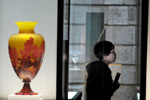
A visitor appreciates a piece of artwork at the private Liuli China Museum in Shanghai on March 4. The Shanghai municipal government is encouraging more private museums to offer free admission by allocating special funds and pairing them with State-owned museums. Six out of 16 private museums in the city are now free of charge. Provided to China Daily |
Increasing numbers of public museums have become free to the public since 2008, when the State Council encouraged museums to stop charging visitors.
"We have the practical problem of being unable to afford the more than 40,000 yuan ($6,310) monthly electricity bill for my museum during summer," said Wang.
Free museums would lure visitors to public museums and away from his, he said.
Zhang Mingbo, curator at the private Inner Mongolia Mingbo Grassland Culture Museum, said the industry’s problems are bigger than just electricity bills.
"There are so many things we need — money, recognition, and friendly tax policies — we are simply in a different league than State-owned (museums), we don’t have access to the resources they have, we don’t have the same support (from local government) as they have," he said.
China has witnessed a rapid increase in the number of private museums and art galleries over the past five years. The country’s 456 private museums, 13 percent of the nation’s museums, play an important role in China’s cultural life.
But compared with developed countries, cultural institutions in China struggle to stay alive.
According to the 2012 World Cities Culture Report by BOP Consulting and King’s College London, Shanghai has only 208 art galleries, less than one-fifth the number in Paris. The average number of art galleries shared by 100,000 Shanghai residents is 0.9, ranking Shanghai 11th among the 12 surveyed cities.
Shanghai boasts 477 libraries, second only to Paris, which has 830. However, Shanghai residents only borrow books from the library on average 2.5 times a year, greatly behind the figure in any Western country.
Newly opened museums and galleries face serious problems in remaining commercially viable.
"Quite a few museums closed their doors only a few years after opening," said Luo Xiaojun, the executive editor of 21st Century Business Insights.
Luo, together with Artron.net, one of the largest art and art trading websites in China, is working on a white paper titled The Ecology of China’s Private Museums. The paper will be released by the end of November, when a summit of private galleries and an art fair of works drawn from their collections, will be held by China Collectors’ Club in Shanghai.
"The main problems include lack of funding, academic help and public support," Luo said. "And some museums had questionable orientation in the first place."
Central and local governments are aware of the troubles facing private museums and are taking action to rectify the situation.
In Shanghai this year, 10 million yuan ($1.57 million) will be poured into the city’s 16 private museums that are not associated with any other enterprise.
"The upper limit for each museum is around 400,000 yuan this year," said Li Jing, a staff member from the Shanghai Municipal Administration of Cultural Heritage’s museum department.
Li said 11 of those 16 private museums were sponsored by the city’s administration of cultural heritage last year and shared funds of 10 million yuan between them.
In addition to financial aid, the State-owned Shanghai Museum also paired up with Liuli China Museum, which specializes in glass art, to share some of its expertise.
The Shanghai Museum tested the private museum’s temperature, humidity and formaldehyde concentration in an effort to prevent the glass from corroding.
"Our lab conducted a four-month assessment last year on the glass museum’s storeroom and exhibition hall, and we also sent experts to appraise their 262 exhibits," said Chen Kelun, deputy director of the Shanghai Museum.
Tang Sifu, curator of Liuli China Museum, said almost all of the staff members at her museum were not professionally trained or from an academic museum background, and the expertise offered by the Shanghai Museum turned her museum "from disordered to systematic".
State-owned museums in Sichuan and Shanxi provinces also paired up with local private museums last year to help them upgrade the exhibition quality and services. The help was greatly appreciated by private museum curators.
"It’s extremely tough for private museums to improve from a venue packed with personal collections to an educational public space — we don’t have resources, we don’t have professional backgrounds, we simply don’t know where to go," said Wang Dongli, curator of Liaoning’s Defu Museum, a private museum dedicated to cultural heritage from the New Stone Age.
"The expertise from those 30- or 40-year-old public museums would be highly appreciated."
Zhang Kun contributed to this story.
shiyingying@chinadaily.com.cn

 Michelle Obama addresses at Democratic National Convention
 Slides of Yanbian: place, people and prosperity
 Washington to remain focused on Asia-Pacific
 RQFII target blue chips amid bear market
 Australian recall for top two exporters
 China fears new car restrictions
Copyright 1995 - 2010 . All rights reserved. The content (including but not limited to text, photo, multimedia information, etc) published in this site belongs to China Daily Information Co (CDIC). Without written authorization from CDIC, such content shall not be republished or used in any form. Note: Browsers with 1024*768 or higher resolution are suggested for this site.
License for publishing multimedia online 0108263 Registration Number: 20100000002731