Comments()
  Print
Print  Mail
Mail  Large Medium Small
|
 |
|
A photographic equipment and technology show in Beijing. China's policy changes to spur domestic consumption are expected to bring business opportunities to Japanese companies. [Photo/China Daily] |
China's plan to have an increasing amount of its economic growth generated from domestic consumption opens opportunities to Japanese companies and encourages the Japanese to invest in the world's second-largest economy, former Vice-Premier Zeng Peiyan said on Thursday.
China resolved, during the recent global financial crisis, to change its sources of economic growth. As a result, the country is "turning into more of a global market and less of a global manufacturing powerhouse", Zeng said.
The policy change is "bringing fantastic business opportunities to Japanese companies", he added.
Zeng's remarks came during an opening ceremony held for the China-Japan Entrepreneurs Exchange Meeting of the Boao Forum for Asia, which took place in Japan's Yokohama.
China is Japan's largest trade partner, and Japan is the third-largest source of China's foreign direct investment, or FDI. By the end of 2011, Japan had $83 billion worth of accumulated investments in China.
For years, the majority of Japanese companies that have invested in China have done so because of the low-cost labor they found there. They set up factories and imported raw materials and components from Japan while exporting final products to overseas markets, particularly to developed markets.
As Chinese labor costs continue to rise, the world's second-largest economy is planning to have its growth depend more on domestic consumption and less on exports. Japanese companies, meanwhile, are "finding it necessary" to invest more in Chinese research and development and design and technology, similar to what a slew of international companies have done, Zeng said.
"This will help the two countries find new sources of economic growth and lead to more cooperation," he said.
China, as part of its plan to change its sources of economic growth, is concentrating more on attracting FDI. In new FDI industrial guidelines, China said it is welcoming investments into high-end manufacturing, services and research and development.
Among those that have heeded the call is Japan, which has been making large investments into China since it was shaken by a devastating earthquake in March last year.
A white paper initiated by the China-Japan Chamber of Commerce said China's amount of FDI from Japan increased by 50 percent in 2011 from a year earlier.
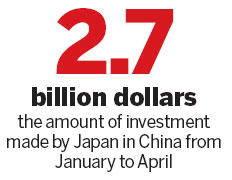
And the momentum has been sustained. From January to April, Japan invested $2.7 billion into China, up 16 percent from the same period a year earlier. During the same period, countries in the European Union invested 28 percent less year-on-year.
Zeng called on Japanese companies to invest more into Chinese bioengineering, new materials, information technology and equipment manufacturing, as well as modern service industries such as the cultural, medical care, cartoon and education and training industries.
China is also in the course of urbanization and is facing difficulties that come with having an increasingly elderly population. Japan has experiences in dealing with those issues and could help China with them.
The white paper said Chinese manufacturers outperformed companies in other industries. It also said the country's central and western regions are becoming increasingly attractive to Japanese companies.
Wei Jianguo, former vice-minister of commerce, said at the Eighth Beijing-Tokyo Forum held this week in Tokyo that "there are reasons to believe that a new wave of investment by Japanese companies into China is coming along", citing China's work to stoke domestic consumption.
"If more Japanese companies would like to invest in China to cash in on the Chinese consumption market, Japanese investments in China will increase by more than 70 percent," said Wei, a guest economist of China Daily.
This year marks the 40th anniversary of the normalization of diplomatic relations between China and Japan.
The past four decades have seen the countries' economic and trade relations improve, and Zeng called on them to consider more economic cooperation.
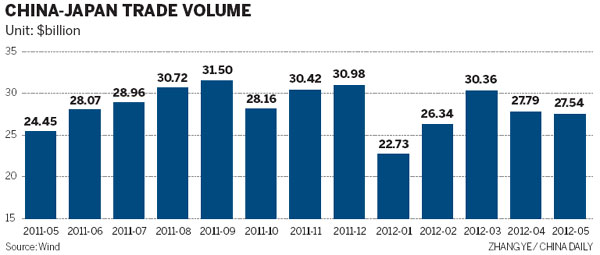
In 2011, the amount of trade conducted between China and Japan hit a record of $340 billion, 330 times the amount four decades ago. China is now Japan's largest trade partner and the second-largest destination for Japanese exports. Japan is China's fourth-largest trade partner.
In May, China, Japan and South Korea agreed to begin negotiating a free trade agreement by the end of this year. The trade pact, if it comes into force, is expected to give a boost to the three countries' economies. "We should wrap up the talks as soon as possible and start talking soon about forming a free trade agreement between China and Japan," Zeng said.
He also called on the two countries to cooperate more on "new energy and renewable energy" projects.
As the European debt crisis deepens, China and Japan are at a juncture where they can decide to lessen their dependence on European demand and work more closely together, experts and officials said.
Also at the opening ceremony on Thursday, former Japanese prime minister Fukuda Yasuo said China and Japan should cooperate more to lay the foundations of a green economy, promote regional integration in Asia, establish a free trade agreement among China, Japan and South Korea and contribute to Asian and global economic stability.
In June, an annual opinion survey showed that people from both China and Japan are "not satisfied" with the current state of the relationship. Zeng said that's partly why the two should strengthen their economic relations, which "have long been a stimulus to their bilateral relations".
dingqingfen@chinadaily.com.cn

 Michelle Obama addresses at Democratic National Convention
 Slides of Yanbian: place, people and prosperity
 Washington to remain focused on Asia-Pacific
 RQFII target blue chips amid bear market
 Australian recall for top two exporters
 China fears new car restrictions
Copyright 1995 - 2010 . All rights reserved. The content (including but not limited to text, photo, multimedia information, etc) published in this site belongs to China Daily Information Co (CDIC). Without written authorization from CDIC, such content shall not be republished or used in any form. Note: Browsers with 1024*768 or higher resolution are suggested for this site.
License for publishing multimedia online 0108263 Registration Number: 20100000002731