|
|
|
 |
|
|
|||||||||
1st time monthly inflation rate has fallen below 4% since October 2010
A fall in the rate of inflation in February has put an end to the "negative deposit rate" and will allow room for more measures to restore growth. However, massive policy easing may not be on the cards, as long-term pressures remain, said economists.
|
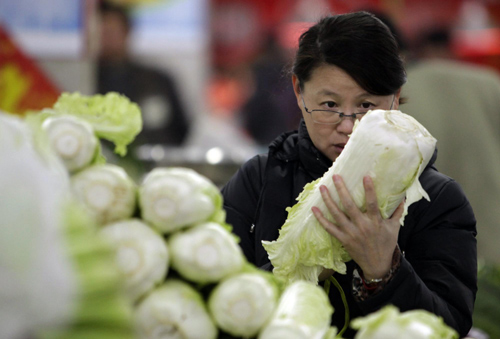 A woman looks at a Chinese cabbage as she buys vegetable at a market in Beijing, March 9, 2012. China's annual inflation cooled sharply to a 20-month low of 3.2 percent in February as food price pressures eased after the Lunar New Year holiday. [Photo/Agencies]? |
China's consumer price index, a main gauge of inflation, rose 3.2 percent year-on-year in February, the National Bureau of Statistics said on Friday.
The growth, down from 4.5 percent in January, hit the lowest level in the last 20 months. It was also the first time that the country's monthly inflation rate has fallen below 4 percent since Oct 2010.
Food prices were still the main driver of inflation, with an increase of 6.2 percent, while non-food prices rose 1.7 percent. The price of consumer goods gained 3.9 percent, and the price of services rose 1.5 percent.
According to the NBS, February's producer price index, a measurement of inflation at the wholesale level, was the same as the year-earlier reading.
The February CPI marks the end of the "negative deposit rate" era that's been in place since Feb 2010, as the inflation rate has finally fallen below the annual 3.5 percent rate for one-year fixed deposits.
"This is a landmark in China's efforts to control prices that started in the second half of 2010," said Jia Kang, a senior researcher with the Ministry of Finance.
Li Daokui, an adviser to the People's Bank of China, said he expected to see inflation ease to 2.5 percent in the middle of the year, and for annual CPI to be around 3 percent "as long as there is no extreme weather or an oil crisis in Iran, which could pose more inflationary risks".
Meanwhile, "the weaker CPI outlook leaves more room for the long-planned energy pricing reform", said Li on Friday.
The February data were released after Premier Wen Jiabao said on Monday that curbing prices will remain a major task this year, and vowed to bring full-year inflation to below 4 percent.
Although the inflationary pressure is lower this year, there are potential risks that will push up prices, and pose a threat to the economy if not contained, said Ma Jiantang, the head of the NBS, on Monday.
"The sharp decrease in the February reading was mainly caused by a higher base during the 2011 Lunar New Year, and retreating food prices after this year's festival," said Lian Ping, chief economist at Bank of Communications Ltd.
Lu Zhengwei, chief economist at Industrial Bank Co Ltd, said the CPI fall may have already undercut some future decreases, and will result in inflation not falling much further in the next three months.
Surging global oil prices and a rebound in the purchasing managers' index, a gauge of industrial activity, will slow the pace of monetary policy easing, said Lu.
Lian said the reserve-requirement ratio for lenders may be lowered at least twice, or possibly four times, this year to facilitate stable growth, but rejected suggestion that there may be massive reductions, because "time is still needed to digest excessive liquidity".
"As the pressure of long-term inflation remains, it's not necessary to reduce the benchmark interest rate," he said.
That comment was echoed by Jiang Chao, an analyst with Guotai Junan Securities Co Ltd.
"There is not enough motivation for the central bank to cut the interest rate at the moment," he said.
"Unlike in 2008, when the economy was in deflation, current economic growth is quite stable ... and the policy environment is one of de facto relaxation," he said
Apart from the price indices, other economic indicators released on Friday also indicated a slowdown.
China's urban fixed-asset investment climbed 21.5 percent in the first two months of 2012 from the same period a year earlier. Meanwhile, the growth of industrial value-added output slowed by 1.4 percentage points and retail sales by 3.4 percentage points.
Qu Hongbin, chief China economist at HSBC Holdings PLC, said the decreases suggest that the growth of the real economy, including manufacturing and services, might have already plunged below 8 percent.
Lan Lan contributed to this story
weitian@chinadaily.com.cn