China market retained auto sales crown
Updated: 2012-01-09 09:55
(China Daily)
|
|||||||||


Editor's note: It was another eventful year for China's auto industry as the market remained the largest in the world - but also faced a range of challenges, China Daily's Gong Zhengzheng and Han Tianyang report:
Incentives expire
After two years of explosive growth, China's auto market cooled in 2011 as government tax rebates for small cars, trade-in subsidies and incentives for rural buyers expired.
Full-year vehicle production and sales numbers will be released today by the China Association of Automobile Manufacturers. Both figures are expected to range between 18 and 19 million, increases of just 2 to 3 percent compared with the remarkable growth of 2010.
|
 |
|
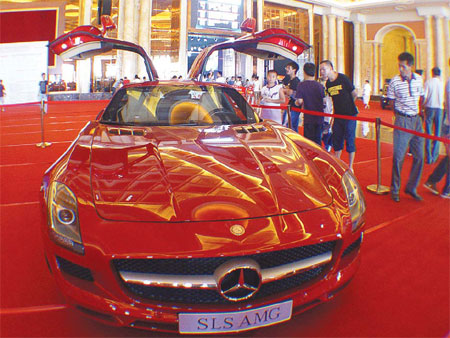
A Mercedes-Benz SLS AMG on show in Hainan province. [Photo/China Daily] |
|
 |
|
A lottery drawing for car license plates in Beijing started in January last year.[Photo/China Daily] |
Vehicle production and sales both hit 18 million units in 2010, a surge of 32 percent over 2009.
In the capital city Beijing, where restrictions on new car license plates took effect at the first of the year, new car sales plummeted to less than half of the 800,000 sold in 2010.
Premium boom
China's luxury car sales continued strong growth in 2011 despite increasing external market pressures.
Segment leader Audi sold more than 310,000 vehicles in China last year, breaking the 300,000 benchmark for the first time. The number for the first time outstripped the company's sales in its home market.
The carmaker plans to more than double its yearly output in China to 700,000 units after 2015.
German premium brands BMW and Mercedes-Benz also performed well last year. Both are building capacity for long-term development and adding new products to their local lineups.
In December they began small-volume export of long-wheelbase cars originally tailored for Chinese consumers and only built at their joint ventures in China. It was the first time China-made luxury vehicles were shipped abroad.
Failed bids for Saab
Efforts by Chinese companies to buy the cash-strapped Swedish brand Saab continued throughout 2010, but ultimately failed after the carmaker filed for bankruptcy on Dec 19.
Hawtai Motor, a small domestic manufacturer of SUVs and cars, first reached an agreement to buy a stake in Saab in May, but gave up after it was unable to gain approval from Chinese regulators.
Another automaker, Zhejiang Youngman Lotus Automobile Co Ltd, and car dealer Pang Da Automobile Trade Co then jointly bid for the failed carmaker, inking an non-binding agreement in June with Swedish Automobile NV, the parent company of Saab, to buy a majority interest.
Both buyers and Swan agreed in October to change the plan to 100 percent of Saab.
But the bid was rebuffed by General Motors, former owner of Saab, which still owns preferred shares and key patents. GM then stood its ground and refused yet another proposal, this time from Youngman and an unnamed Chinese bank that had replaced Pang Da.
Pang Da had already handed over 45 million euros to Saab as a deposit, while Youngman spent even more to pay Saab debts.
While the actual loss remained unclear pending the outcome of bankruptcy proceedings, analysts said Chinese companies should learn from the example and be careful of risks in overseas acquisitions.
New brands at JVs
Foreign carmakers are developing new, local brands with their Chinese partners to tap the potential of entry-level, low-priced cars in China.
In March Guangqi Honda Automobile Co rolled out the first model under an entirely new brand created for the Chinese market - the Everus - that went on sale at the Shanghai auto show in April at prices from 70,000 to 100,000 yuan.
In the same month, a small family car with the new nameplate Baojun developed at General Motors' three-way tie up SAIC-GM-Wuling also went on sale priced at less than 80,000 yuan.
Nissan's joint venture with domestic carmaker Dongfeng unveiled the first model under a new brand Venucia at the Guangzhou auto show in November. The product is set to hit the market this year.
Other carmakers, including Volkswagen and Hyundai, also have plans for local brands, with their projected new products expected to be electric vehicles.
The new brands by Sino-foreign joint ventures triggered debate inside the industry. Some noted the trend helps local carmakers deepen their involvement in design and engineering, but others claimed most models are based on outdated products without much technological innovation.
Due to their competitive pricing, the new brands will also likely squeeze the market share of domestic carmakers including Geely, Chery and BYD.
|
 |
|
New Venucia brand auto [Photo/China Daily] |
 |
|
Kumho Tires are factory fitted on many models. [Photo/China Daily] |
Warranty regulation
In October, the General Administration of Quality Supervision, Inspection and Quarantine held a public hearing on a draft regulation covering automobile warranties. If adopted, the measure would entitle car buyers to free repair, replacement and even return of faulty cars in the first two years or 40,000 kilometers of ownership.
The most controversial clause in the draft states consumers have the right to return a vehicle within 30 days due to serious quality problems such as severe cracking in the car body, non-functioning brakes or steering and oil leaks.
Under the current system, customers can in practice never demand a replacement or return a car once they buy it.
Representatives of both consumers and auto companies at the hearing agreed that a third-party agency is needed to inspect claimed quality problems and judge disputes.
Following the hearing, the General Administration of Quality Supervision, Inspection and Quarantine said it will take time to revise the draft and will release a final law, but did not give a timetable.
Duties on US-made cars
The Ministry of Commerce announced anti-dumping and anti-subsidy duties on some vehicles imported from the United States with engines larger than 2.5 liters starting from Dec 15 and lasting two years.
Affected automakers include General Motors, Chrysler, BMW, Mercedes-Benz and Honda.
GM and Chrysler face anti-dumping duties of 8.9 and 8.8 percent as well as anti-subsidy duties of 12.9 and 6.2 percent.
The US units of German automakers BMW and Mercedes-Benz will have anti-dumping duties of 2 and 2.7 percent imposed. Honda's US operations will also be subject to a 4.1 percent tariff. Other carmakers are also subject to the levies, but the ministry did not name them in its announcement.
The decision was seen as China's response to US tariffs on China-made tires.
Analysts said Chrysler will be most affected since it has no local production and relies solely on imports for sales in China.
But they note the impact is not likely to be big because Chinese buyers of large imported vehicles are not extremely price sensitive as they already pay a hefty 25 percent import duty.
Local R&D centers
As China carries more weight in the global auto market, foreign carmakers have opened local R&D facilities to better respond to domestic consumer demands.
In October, Toyota broke ground for an R&D center in Changshu, a city near Shanghai, its sixth and largest worldwide. Total investment in the facility that covers 2.3 million square meters is about $689 million.
Scheduled to be completed in the middle of 2013, the wholly owned R&D unit of Toyota will include several advanced testing tracks and laboratories for materials technology, electronics, the environment, safety and traffic systems.
One major task of the center is to realize production of hybrid vehicles and core parts in China.
General Motors also has a technical center under construction in Shanghai. When completed in the last half of 2012, the 65,000-square-meter center will have more than 300 employees, 62 testing labs and nine research facilities.
Luxury carmakers Mercedes-Benz and Audi both set up design facilities in China last year to better meet local preferences and use local inspiration in more global models.
Quake rattles sales
A devastating earthquake and tsunami hit Japan in March and forced most carmakers and component manufacturers to halt production, which in turn disrupted supplies to plants outside the country, including in China.
Only in July did Toyota and Honda's China joint ventures approach pre-earthquake levels of production. For the rest of the year, the carmakers worked hard to recoup sales lost in the previous months.
Toyota moved about 883,000 vehicles on the Chinese mainland in 2011, up 4 percent year on year. The company said in a statement that its sales target for this year will increase more than 10 percent to clear the 1-million benchmark.
Honda has yet to release full-year figures, but it is likely to report that sales fell from a year earlier.
Mazda registered a 10 percent decline in its 2011 China sales to some 215,000 vehicles. The company vowed rapid growth this year by expanding its product lineup and dealer network.
Nissan's China operations were the least affected of Japanese carmakers due to its highly localized vehicle content, open supplier system and quick maneuvering of global resources.
Though its whole-year tally has not been released, the carmaker reported 21 percent growth in sales by the end of November.
First national tire recall
South Korea's' Kumho Tires began a recall of more than 300,000 tires in China on April 15 after a China Central Television report said the company's Tianjin plant used excess recycled rubber in its products.
The company initially denied the charge and called the report "inaccurate", but later apologized on television and submitted notification to the national quality watchdog for a nationwide recall. It is the first-ever recall on auto tires in China.
One of the largest tire manufacturers in China, Kumho supplies many Sino-foreign car joint ventures including Shanghai GM, FAW Volkswagen, Beijing Hyundai, Dongfeng Yueda Kia and Dongfeng Peugeot Citroen, as well as domestic carmakers FAW Car, Chery Automobile, Great Wall Motors and Hafei Auto.
Three automakers - Dongfeng Yueda Kia, Beijing Hyundai and Great Wall Motors - then announced the recall of 75,800 vehicles equipped with affected Kumho tires.
Related Stories
China's auto industry needs innovation 2011-10-18 15:07
Shielding China's auto industry is a mistake 2010-12-15 11:05
Nation's auto industry moves into top gear 2010-11-17 11:01
Innovation key to China's automobile industry 2011-10-12 14:41
China's auto industry flourished after entering WTO 2011-10-13 16:09
- Regional free trade talks in the pipeline
- China market retained auto sales crown
- The right chemistry for pharma firms
- Yum! takeover proposal approved
- Financial regulators to minimise systemic risks
- No room at the inn for some test-takers
- Chinese tourists flocking to neighbor
- Nationwide rush for home kicks off