Coffee outlets brew up a recipe for greater diversity
Updated: 2011-09-26 10:35
By Zhu Wenqian (China Daily)
|
|||||||||||


|
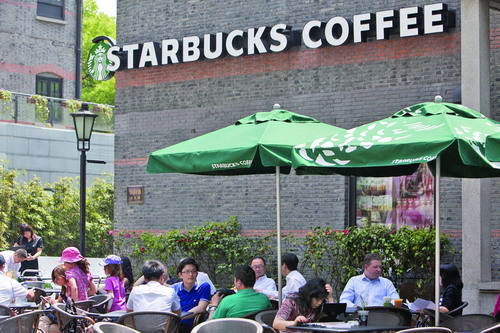 Customers outside a Starbucks Corp coffee shop in Shanghai. Starbucks Corp Chief Executive Officer Howard Schultz said the coffee-shop operator is developing a wider range of ready-made food and beverages after it sold more instant coffee than expected.[Photo/Bloomberg] |
BEIJING - Leading foreign coffee chain stores have seen great profits and potential in the maturing China market and plan to speed up their already rapid expansion in it.
Starbucks, the United States coffee shop chain headquartered in Seattle, has nearly 11,000 stores in North America and almost 6,000 elsewhere, including nearly 500 in 39 cities in China.
Starbucks said in early July that it would reorganize its top management structure to help international sales growth and globalization.
The company is currently composed of three sections: the United States, Europe, the Middle East and Africa, and the Asia-Pacific area. Originally it was divided into just the US and overseas.
Starbucks is planning to open another 1,500 shops in China by 2015, a three-fold increase, said Caren Li, senior communications manager at Starbucks (China) Co Ltd.
"The coffee market potential in China is huge. Starbucks launched in Hefei, in Anhui province, in early August, and will expand to more second- and third-tier cities," she said.
Prestigious British brand Costa Coffee sees a similar trend. It opened its first outlet in Beijing in the second half of 2008 and has enjoyed good sales.
Costa aims to take a third of the market share on the Chinese mainland. With its 100th outlet opening at Terminal 3 in Beijing Capital Airport, Costa now has more than 110 stores on the Chinese mainland, more than its target of 100 by the end of last month, said Paul Smith, Asia director and chief representative of Costa China.
Smith told China Daily that Costa considered opening another 100 shops around China next year as part of a big expansion plan.
"We are going to expand into some big cities in western china such as Chongqing and Chengdu in Sichuan province. Costa recently launched in Wuhan of Hubei province and will probably go to Harbin soon," said Smith.
As Starbucks attached more emphasis to its international market, it also developed cooperation programs with certain local institutions. Starbucks signed a co-partnership with Pu'er city, in Yunnan province, in November last year to plant and process coffee beans and conduct scientific research on cultivation.
"The partnership with Yunnan province will help China to develop the coffee industry and the upgrading of technology. The purpose is not to lower the cost but to promote the China market. Most coffee bean imports are still from South America," Li said.
Costa Coffee is also considering developing coffee plantations in Yunnan.
Costa will send a team of people to China at the end of this year to investigate the possibilities.
"Yunnan province is a great coffee-growing province. It's not only about the cost but also the high quality; coffee beans from China are very good," said Smith.
John Culver, president of Starbucks Coffee International, said the planting project in Yunnan will help to strengthen Starbucks' leading edge in China and contribute to sales growth in the China market.
Being traditionally a tea-drinking country, China still has plenty of scope to popularize coffee culture. According to a report provided by research company Euromonitor International, Chinese mainland people on average drink coffee 0.11 times a year, which is far from the 4.9 times in Hong Kong, 35 times in Taiwan, and 107 times in Japan.
The mainland is expected to see an increase of 35 percent in retail coffee consumption within four years, and the total consumption could reach 45,900 tons by 2014, said the report.
Starbucks changed its logo in March, removing the words "Starbucks" and "coffee", leaving only the mermaid image, indicating an intention to move beyond its core product.
On the competition issue between the two famous foreign coffee chains, Costa's Smith said it was significant Starbucks had been in China for more than 10 years and Costa was a relatively recent arrival.
He said: "People usually ask me: 'What are you going to do to beat Starbucks?'
"I don't want to beat Starbucks. What I want to do is to develop a great coffee business in China. Customers will make their own decisions. Healthy competition and differences are good signs in any area in any country."
Since 2000, Starbucks has been selling moon cakes. They also sell dumplings during the Dragon Boat Festival and they recently introduced a coffee drink called red beans latte. All are innovative and combine Starbucks traditions with Chinese elements, said Li.
Costa has similar derivative products to cater for Chinese customs.
While Smith said that Chinese customers don't particularly want special Chinese products, what they want is the global coffee shop experience but with a shift in the flavor profile.
"We know that people from eastern and western China like coffee less sweet, also they prefer it less sweet in the north and more sweet in the south. It all depends on what customers want in a particular market," said Smith.
Smith added that good locations attract customers, so the location is what spreads the word. The Chinese love to meet socially and they need public places in which to gather.
As the rapid expansion in China takes place, Smith said Costa will create thousands of jobs.
"China has got a lot of talented people who are keen to learn. We are very excited about the expansion," he said.