Calls for faster tax reform
Updated: 2011-09-26 09:47
By Wei Tian (China Daily)
|
|||||||||||


|
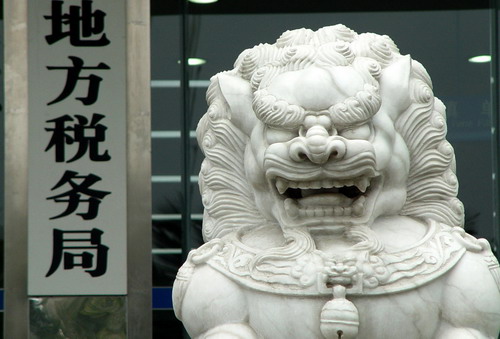
A stone lion sculpture in front of a taxation office in Haikou, the capital city of Hainan province. About 80 percent of China's fiscal revenue now comes from various taxes. [Photo/China Daily] |
China said to have high burden when measured against others
BEIJING - A table measuring the harshness of a country's tax regime in 2009, which ranked the Chinese mainland high at second place, has again aroused much debate, with experts urging faster reform of the system.
According to the 2009 Tax Misery and Reform Index released by Forbes Magazine, the Chinese mainland scored 159, following France which scored 167.9.
The list put Chinese citizens under the category with the heaviest tax burden in the Asia-Pacific region. By comparison, Hong Kong was considered the kindest in taxation in the region with a score of just 41.5.
The rank was raised again two years later when fiscal revenue and inflation continued to rise and little was done to help people save more money.
China's fiscal revenue in September was up 30.9 percent compared with the same period last year, according to data from the Ministry of Finance. Statistics also show that about 80 percent of revenue came from taxes in the first eight months of 2011.
Although a new law to raise the threshold of China's income tax took effect on Sept 1, freeing 64 million people from being taxed, the amendment was widely seen as having little effect on lightening the overall tax burden.
The tax levied on moon cakes allocated by employers to staff as a corporate benefit also aroused widespread anger.
Many netizens and scholars complained but the view that the Chinese mainland's tax regime is tough is not shared by all.
"China is in no way among the heaviest taxed countries in the world," Zhu Qing, a finance professor at Renmin University of China was quoted by People's Daily as saying.
Zhu argued that the figures Forbes used to reach its conclusion in 2009 were "not scientific and were unreasonable" because they focused on the maximum individual tax rate in China of 45 percent, "a rate that only applies to fewer than 0.2 percent of taxpayers on the mainland".
He estimated that China's tax burden as a percentage of gross domestic product was around 21.9 percent last year, which was lower than an average of 34.8 percent among 30 countries covered by the Organization for Economic Cooperation and Development (OECD) in 2008.
Zhu's opinion received an immediate response, with Zhou Jiangong, chief editor of Forbes Chinese edition, insisting the survey was conducted fairly.
"To calculate the index according to the highest marginal percentage in each locale is to establish a measurement by which the tax burdens of different countries or regions can be compared," Zhou said.
Zhou also emphasized that tax "misery" is different from a tax "burden", in that even if China's tax burden is lower than that of developed countries, the tax misery index may still be high if the government fails to use the tax revenues to provide high-quality and satisfying public services.
Zhou said the reason why the 2009 survey drew so much attention in 2011 is that taxpayers are more concerned about how their taxes are being used, especially at a time when China is speeding up its pace of tax reform.
Jia Kang, director of the Institute of Fiscal Science under the Ministry of Finance, said that China's taxation system has been dependent too much on indirect taxes, which were added into consumer goods prices.
To that extent, the lower-income groups are usually affected more by taxation and thus bear a heavier tax burden, Jia said.
"Personal income tax only accounts for a small portion of China's total tax revenue, but corporate taxes are the main sources of the tax revenues of most countries," said Xu Xiaonian, a professor of economics and finance at China Europe International Business School.
The high tax burden Chinese enterprises bear was also passed on to end-consumers by raising the prices of their products, Xu said.
CNS contributed to this story
Related Stories
State tweaks resource tax on oil, gas producers 2011-09-23 10:26
China will not tax local govt bond interest 2011-09-22 15:54
Raising tax threshold a progressive stepban 2011-09-01 15:16
60m free from personal income tax 2011-08-31 14:46
- Beijing's 2nd-hand home sales drop to 3-yr low
- Calls for faster tax reform
- A white knight riding to the rescue?
- Europe warned over its debt crisis
- China issues 1st evaluation report on SCO
- Video game arcades race ahead
- IHA protocol promotes sustainable hydropower
- Machinery production up 26.42% in first 8 months