China preparing to weather coming storm
Updated: 2011-08-15 11:34
By Shi Jing (China Daily)
|
|||||||||||


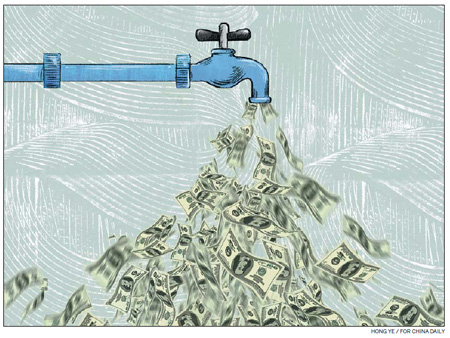
Nation faces hard choices if it's to avoid contagion from the financial turmoil
SHANGHAI - Who's afraid of the United States' credit downgrade and the worsening sovereign debt crisis in Europe?
That's the question many Chinese opinion makers, ranging from the People's Daily, to noted financial columnists and myriad bloggers, have been trying to answer since the ill wind of the Western economies blew across the Asia-Pacific region, wiping out many billions of dollars of asset value on August 8, on what has become known as "Black Monday".
"The bad news from overseas will not cripple people's confidence in the robust growth of the Chinese market," thundered the People's Daily in its Aug 10 editorial. However, in her column the previous day, Ye Tan, a well-known financial columnist, wrote in the National Business Daily that "the global economy is strapped stiff in the chariot of the US dollar".
"The United States adopted quantitative easing policies and successfully levitated the inflation level on a global scale. The country needed the world's help to solve its debt pressure. Its domestic economic growth can hardly free it from its debts," she concluded.
"The US has made other economies, including China, partly pay the bill for its recovery," Zhang Xiaoqiang, vice-minister of the National Development and Reform Commission, in quotes reported by the Xinhua news agency.
Meanwhile, bloggers were having a field day denouncing what they labeled as the "reckless" spending habits of the West.
As a result, China, as the biggest creditor nation of the US, will see its foreign-exchange reserves "negatively affected" as the dollar is likely to decline, according to John Ross, who was director of economic and business policy for the former mayor of London, Ken Livingstone, and now is a visiting professor at Antai College of Economics and Management at Shanghai Jiao Tong University.
Their conclusion, supported by some prominent economists in academia, is obvious: The Chinese economy has remained strong and is well-managed enough to face the new global economic changes, and the excesses of the West will have a minimal effect on these eastern shores. Since then, global stock markets have slumped while the Chinese market has stabilized. The leading indicator at the Shanghai stock exchange on Thursday closed at 2581.51, was up by nearly 6 percent from the lowest recent level of 2437.68 on Aug 9, with financial, real estate and commodity stocks taking the lead.
But behind the bravado lies deep concern about the specter of a second global recession that some economists have predicted could be worse than that of 2008. Bearing the brunt of any double-dip recession would be the many private sector manufacturers in the industrial heartlands of the Yangtze River Delta region.
As it is, the mood of the many merchants in Zhejiang, who have won a global reputation for their enterprising spirit and derring-do, is anything but sanguine. Their major concern is not so much a sudden contraction of overseas orders but the large potential foreign exchange losses that could arise from the expected further depreciation of the US dollar against the yuan, as most export contracts are settled with the greenback.
"More than 70 percent of our products are exported to the US while the rest all go to Europe. Therefore, the depreciation of the US dollar as a result of an economic recession will have a great effect on us," said Zhou Mingwang, the general manager of Yiwu Mingwang Jewelry Co Ltd. "The only solution we can think of now is to produce high-end products. Buyers of these goods usually care less about prices."
Shaoxing Jinyong Textile Co Ltd sells about 70 percent of its products to countries such as the United States, Spain, France and Italy, with an annual export volume worth some $4 million.
But this year orders have dropped by 30 percent. "The economic situation in the United States and Europe is not going to recover within two or three years, so we will probably reduce the proportion of exports to 50 percent," said Zhang Guanjin, the general manager of Jinyong.
Chen Xuebin, a finance professor at Fudan University, agreed that the country should transform its development mode from one orientated toward export demand to one led by domestic demand.
But for some, shifting the focus to the domestic market may also pose a risk. "It's like gambling - it's hard to secure substantial, long-term profits," said Chen Xi, manager of Wenzhou Dongyi Shoes Co Ltd.
"The only thing we can do is to transfer our factories to the inland regions to reduce costs."
The problems that the enterprises have encountered all point to China seeking a new path. "The economic development mode, which is highly dependent on high energy consumption, heavy pollution and resource exhaustion has reached its end in China," said Dong Dengxin, director of the Finance and Securities Institute at Wuhan University of Science and Technology.
Given that China is less dependent on overseas market demand in terms of economic growth, the country has to choose a new development model to accelerate its economic restructuring, according to Zhang Xiaojing, senior economist at the Institute of Economics at the Chinese Academy of Social Sciences.
"We cannot count on the US promise to ensure the security of our assets. We should rely more on domestic demand and become stronger by ourselves," said Zhang.
The Chinese government is attempting to combat the fluctuations. Zhang of NDRC said a must-do task is for China to push ahead its economic restructuring.
"Don't worry about any hard landing in China," he said.
Yu Ran and Qiu Yue in Shanghai and Xin Zhiming in Beijing contributed to this story.
- China's imported oil dependence warned
- China preparing to weather coming storm
- Concerns raised over food quality
- China's hurdles in the race for the future
- China to export first light rail train to Turkey
- China power shorage up to 70m kW in 2013
- China Mobile to set up finance unit
- Govt urges action on grasslands