Opinion
Debate: Workers' income
(China Daily)
Updated: 2010-11-08 15:43
 |
Large Medium Small |
Liu Junsheng
Raising workers' pay vital for country
People have welcomed the government's proposal to increase the proportion of workers' income in GDP. The proposal was first put forward in the report on the 17th National Congress of the Communist Party of China (CPC) and reiterated at the Fifth Plenary Session of 17th CPC Central Committee.
The focus should now be on two questions: how to understand the policy proposal and how best to implement it.
Let's deal with the first "how" first. To begin with, raising the proportion of salary in GDP will meet people's demand and help build a harmonious society.
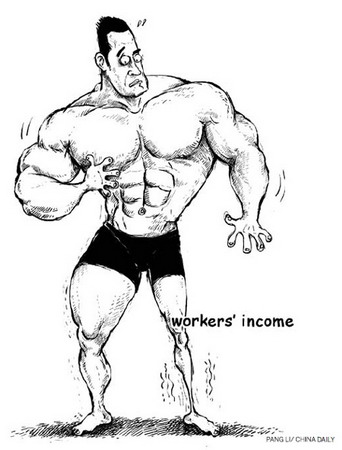
According to the All-China Federation of Trade Unions, workers' pay accounted for 56.5 percent of GDP in 1983. But by 2005, it had fallen nearly 20 percentage points to 36.7 percent. In marked contrast, the proportion of return on capital in GDP rose 20 percentage points from 1978 to 2005. The drastic decline in the income of workers, who comprise the overwhelming majority of the population, and the dramatic increase in the share of entrepreneurs in national income have, in more ways than one, widened the gap between the rich and the poor.
World Bank figures show that China's Gini coefficient (an indicator of inequality in income distribution) has stayed above the internationally recognized warning line of 0.4 since 2000, and is now above 0.48. This is certainly incompatible with China's aim of building a harmonious society.
According to available data, the cause of more than 65 percent labor disputes is low wages, insurance and/or welfare. The taxi drivers' strike in some cities, the strike in Nanhai, Guangdong province by Honda workers, and the Tonggang mass incident in Jilin province are examples of such disputes.
All these have made increasing workers' wages a priority. Only if their income is increased can workers lead a harmonious life, and lay the foundation of a harmonious society.
As the main contributors to the fastest continuing GDP growth in the world, China's workers should have a better life. Instead, quite a few of them live a hand-to-mouth existence. If this trend continues, most of the social wealth will be concentrated in the hands of a few people and, as former leader Deng Xiaoping said, the country will someday founder on disagreement.
Let's move to the other "how" now. To raise the share of workers' income in GDP, the government should upgrade its industrial structure on a priority basis, because it is one of the main causes of the low proportion of workers' income.
According to 2001 global figures, on average, primary industries in developed countries contributed 1.9 percent of GDP, secondary industries 28.6 percent and tertiary industries 69.5 percent. In developing countries, primary industries contributed 12.1 percent of GDP, secondary industries 35.5 percent and tertiary industries 52.2 percent. But in 2008, China's primary industries accounted for 11.31 percent of GDP, secondary industries 48.62 percent and tertiary industries 40.07 percent.


Take rural workers for example. In 2008, rural residents' per capita income was just 4,761 yuan ($712), equal to only 30.17 percent of their urban counterparts. Thus, it is essential to raise the wages of ordinary workers to increase the overall share of workers' income in GDP.
Efforts should also be made to raise workers' pay in some labor-intensive industries that face fierce competition, including manufacturing and construction, both of which were among the seven industries with wage levels below the national average in 2008.
The situation was worse for workers in the agricultural, forestry, animal husbandry and fishing industries, which had an average annual pay of just 12,958 yuan, accounting for only 44.33 percent of the national average. So, raising the wage levels in seven industries would help increase the proportion of workers' income in GDP, because they employ more than 48 percent of the country's working population.
Workers in private enterprises deserve similar attention. According to the National Bureau of Statistics, the average annual wage of workers in the private sector in 2009 was 18,199 yuan, barely 56 percent of that earned by non-private sector employees and 52 percent that of State-owned enterprises' employees.
Lowly paid frontline workers will also benefit if the policy proposal is implemented. According to a 2007 survey of frontline workers conducted jointly by five ministries, 71.5 percent of the respondents' income was lower than the local average.
Another way of increasing the proportion of workers' income in GDP would be to reduce the government's fiscal revenue and improve the mechanism of wage growth in enterprises.
Official data show that the share of government fiscal revenue in GDP grew from 10.39 percent in 1994 to 19.99 percent in 2008. But if we add up revenue from all sources, including social security and lottery, the government's actual revenue would be 30 percent of GDP a year. The result: a rich government with poor people. Hence, tax deduction is an effective way of cutting the government's revenue because taxes are the major source of its income. Among other things, the government should spare no effort to narrow the income gap through macro control, intensive efforts to raise minimum wages and a complete guideline for workers' pay.
The author is a research scholar with the Labor Wage Research Institute, affiliated to the Ministry of Human Resources and Social Security.