 |
|
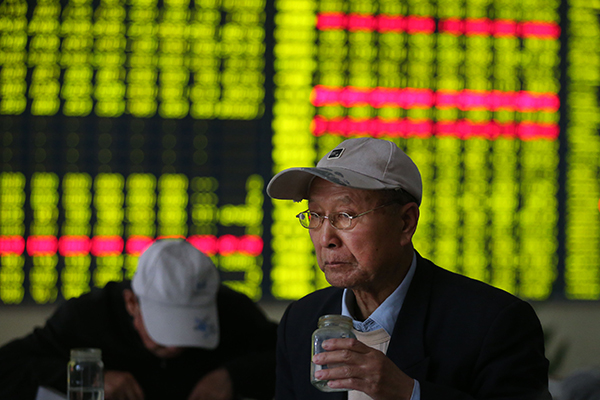
An investor at a brokerage in Nantong, Jiangsu province. [Photo for China Daily by Xu Congjun] |
At this time one year ago, the Chinese mainland's stock market was experiencing the final stage, or the crazy part, of its heyday.
The benchmark Shanghai Composite Index was hovering above 4,900 points on its way to reach the skies. Investors were talking about how many more months the bull would keep running.
The confidence stemmed from supportive government policies and the seemingly unlimited liquidity available in the market, as reflected in the explosive increase in the value of margin trading.
A friend of mine, who had invested heavily in A shares-and of course, was reaping handsome returns then-told me matter-of-factly one day a bull market had just started despite a more than 50 percent hike in the index over the past six months, citing an article in People's Daily. The market boom, the article claimed, had emerged as required by the country's macro development strategy and the need for deepening economic reforms.
It was widely interpreted as a government endorsement for bulls, and who would bet against it?
Yet less than two weeks later, the bubble burst after the market peaked at 5,178. What happened next in the following days would be remembered as a painful episode rarely seen in China's investment history, with thousands of stocks falling by their 10 percent daily limit repeatedly and trillions of US dollars in stock valuation having evaporated in a matter of months.
Today the benchmark Shanghai index stands just above 2,900, about 45 percent down from its peak, with few indications suggesting the market will soon bottom out.
A look into specific stocks can help you feel more precisely the degree of devastation inflicted.
Take high-speed train manufacturer CRRC Corp Ltd for example. Once a star pick among investors due to its presumed links with the government-backed Belt and Road Initiative, the so-called concept stock, which I happened to own, has seen its value wiped three quarters from its record high within a year.
During the time nothing significantly negative has happened with the company, which was formed last year after the merger of two major rolling stocks firms, which was believed to help avoid cutthroat competition and increase profit margins. High-speed rail networks are linking up more cities across the country. The Belt and Road national strategy aimed at boosting trade and connectivity between China and countries in Asia and Europe is still in full swing. Yet what a sea change CRRC's stock price has undergone.
Many have attributed the market plight to the worsening Chinese economy, which grew by 6.7 percent in the first quarter, the slowest in more than two decades. They cited the authorities as predicting that economic development will be L-shaped, meaning there will be a contraction, to be followed by a painfully slow and gradual recovery.
Others argue that China's stocks, even after a meltdown, are still overvalued. The price-earnings ratio, a major gauge of valuation, now stands at an average of more than 24 for stocks listed on the main board, and up to 70 for growth enterprises listed on the Nasdaq-style ChiNext, still considered much higher than globally accepted standards by some analysts.
Pessimists now expect the stock market will plunge further to around 2,200 in a year or two, before it takes a sustainable upward turn.
I am not that pessimistic. Having dabbled in stocks for 16 years, I have seen too many acts of insanity as a result of herd behavior in China's immature market still dominated by small investors.
Here, economic or valuation factors rarely affect people's decisions to trade stocks. It is greed or fear that calls the shots. And when extreme fear prevails, a chance to make profit emerges.
So I am not afraid of a doomsday scenario, as much as I am not convinced by reasons to justify it. Actually if the worst does come, I am ready to bet the farm on a stock market U-turn.
After all, as most people lose in the market, you have to do just the opposite of what others do if you expect to win this game of wealth.


Copyright 1995 - . All rights reserved. The content (including but not limited to text, photo, multimedia information, etc) published in this site belongs to China Daily Information Co (CDIC). Without written authorization from CDIC, such content shall not be republished or used in any form. Note: Browsers with 1024*768 or higher resolution are suggested for this site.
License for publishing multimedia online 0108263 Registration Number: 130349