 |
|
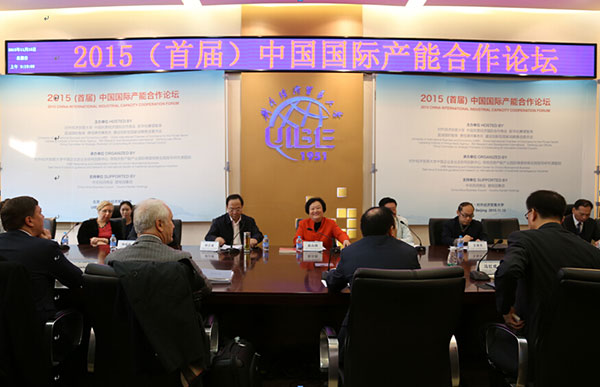
The China International Industrial Capacity Cooperation Forum 2015 is being held in Beijing, Nov 15, 2015. [Photo/chinadaily.com.cn] |
They exchanged on topics including how to promote international industrial capacity cooperation, effective ways and patterns of such cooperation, opportunities brought by "One Belt One Road", third-party intermediary service mechanism in carrying out the Initiative, construction of international industries relocating center and cooperation between countries along the Belt and Road Initiative region.
The forum aims to build a platform for international capacity cooperation, seek a new pattern for relocating China's competitive industrial capacity and promote the Belt and Road Initiative.
Addressing the opening ceremony were Zhao Baige, vice chair of the Foreign Affairs Committee of NPC and Chairman of RDI, CASS; Lin Guijun, vice president of UIBE; Hu Zhenmin, deputy director of the National Educational, Scientific and Cultural Committee of CPPCC; Wang Yanguo, chairman of China International Chamber of Commerce for the Private Sector, Wang Baodong, deputy head of the Department of Latin America and Caribbean in Ministry of Foreign Affairs; and Wang Li, founder of Beijing DeHeng Law Offices.
Zhao Baige explained the concept and significance of international capacity cooperation in her speech. She pointed out that the Belt and Road Initiative proposed by President Xi Jinping is a huge support of such cooperation.
There are currently 65 countries along the Silk Road Economic Belt and the 21st-Century Maritime Silk Road, with a population of 4.4 billion and a total GDP of $22 trillion.
There is an increasing demand for infrastructure construction, resource development and manufacturing capacity in these countries. International industrial capacity cooperation will integrate resources, policies and markets to develop these countries, enhance enterprises' competitiveness, boost industrial upgrading, optimize resources allocation and promote economic globalization.
Zhao believes that, firstly, industrial capacity cooperation is to export comprehensive production capacity, instead of inferior and excess products. The cooperation will focus on five areas, namely, policy communication, road connectivity, unimpeded trade, monetary circulation and understanding between the people.
These five areas lay a solid foundation for industrial capacity cooperation. The three principles of the Belt and Road Initiative, namely wide consultation, joint contribution and shared benefits, also facilitate the process.
Secondly, the present reconstruction of global industry and supply chain offers a great opportunity for international industrial capacity cooperation. For developing countries, by undertaking industrial transfer and utilizing advanced experiences, their development process will be accelerated.
For China, international industrial capacity cooperation will bring a larger global market and speed up its industry upgrading. For developed countries, it is a chance to explore the global market. Therefore, international industrial capacity cooperation centering on the Belt and Road Initiative is win-win for everyone.
China's capital, techniques and capacity can thus go global, creating new economic growth points for China's development.
As to how to effectively carry out international industrial capacity cooperation, Zhao's first suggestion is to specify the strategy of capacity relocation. During the cooperation, each country's political, economic, social, cultural and ecological situation should be considered accordingly. Profiteering, disorderly competition and opportunism should be avoided.
 |
|
Zhao Baige, vice chair of the Foreign Affairs Committee of NPC and Chairman of RDI, CASS |
Secondly, the industrial transfer should take the core technologies as the leading factor, instead of transferring surplus and obsolete industrial capacity. Thirdly, industrial divisions should be synergetic in going global while improving their ability and broadening their view, a process planned and guided as a whole.
According to Zhao, CASS-RDI, established by the Chinese Academy of Social Sciences in early 2015, not only provides suggestions for national policies and strategies as a think tank, but also serves as an important platform to help enterprises go global and participate in the Belt and Road Initiative by providing all-round support, concerning policies, industries, laws, standards, information, investment and financing, insurances, public relations, mass media and typical case analysis.
CASS-RDI has so far helped China develop many key bilateral cooperation projects with Pakistan, Kazakhstan, Russia and Indonesia with hundreds of Chinese enterprises involved. The coordination between Research and Development of International of CASS and China International Industrial Capacity Cooperation Forum will lay a solid foundation for the "go global" strategy and the Belt and Road Initiative.
Wang Li, director of DeHeng Law Offices, noted that China has always been an important participant in the international Industrial capacity cooperation. At the beginning of the reform and opening up, China's economy was at the bottom of the global industrial value chain and mainly "imported" industrial capacity, technology and capital from developed countries and the four emerging Asian countries, known as the Four Asian Tigers.
After 30 years' development, China's status in the global economy and industries has been greatly raised. China, the world's second-largest economy and largest trading nation with the largest foreign exchange reserves, is the third-largest investor and the most important trading partner of more than 130 countries.
The country has now entered into the mature stage of industrialization with abundant competitive industries and capacities, which are mostly needed by less developed countries. However, the international industrial capacity cooperation is by no means simply going out, or fighting alone, but should generate mutual benefits and win-win results.
Faced with the complexity of global economic recovery, countries, especially those along the Belt and Road regions, shall share, expand mutually beneficial cooperation and seek balance and development through collaboration and innovation.
For the above purposes, Wang introduced DeHeng Law Offices' legal support for the Chinese enterprises' going global and cooperative investment in the Belt and Road countries, as well as services for the international Industrial capacity cooperation and the Belt and Road Initiative.
DeHeng Law Offices has launched the service mechanism together with the China International Chamber of Commerce for the Private Sector, China-Africa Chamber of Commerce, Kazakhstan Chamber of Commerce and UIBE Networking and Collaboration Center for China's Multinational Business.
This mechanism depends on the "Belt and Road" Initiative, targets at the project demand, and is guaranteed by each country's industry policy and based on professional researches.
It has developed into a multi-layered resource allocation service mechanism in the market with a PPP organization pattern. As an international resource integration platform, it will definitely provide strong support for the international capacity cooperation and the Belt and Road Initiative.
Tan Xiaodong, director of the technology research center of Certification and Accreditation Administration of the People's Republic of China, shared his opinion on how to support and promote industrial cooperation, project undertaking and product trading between Chinese enterprises and those of countries along the Belt and Road region.
He pointed out that it's needed to upgrade quality and efficiency, form a high-quality import and export structure and gradually reach a new normal of China's deep integration into the world economy.
Firstly, as for the macro structure of the capacity demand, today's "Internet+" era and rapid productivity development call for integration of products, industries and enterprises. Macro recognition of the capacity demand can give us a clearer orientation for the upgrading of the quality and efficiency of capacity-supportive products.
Secondly, in terms of the micro structure of capacity regulation, the widely recognized "the concept of integrated quality", namely the certification of measurement, standard and qualification, is an effective micro foundation for regulating capacity. Under the principle of "national quality concept", the integration will promote the establishment and development of the internal Industrial management system in modern enterprises.
It is also an inevitable choice for reaching China's "2025 industrial development" goals. China must find an effective way with more innovations on implementation under the guidance of micro and macro concepts to seek for wider recognition and further development.

Copyright 1995 - . All rights reserved. The content (including but not limited to text, photo, multimedia information, etc) published in this site belongs to China Daily Information Co (CDIC). Without written authorization from CDIC, such content shall not be republished or used in any form. Note: Browsers with 1024*768 or higher resolution are suggested for this site.
License for publishing multimedia online 0108263 Registration Number: 130349