The gradual, progressive internationalization of Asian companies is probably one of the most important events of this century in the world economy.
Chinese companies are realizing that their current advantage in resources is not sustainable, and the country is reducing the role of export-driven manufacturing as its working population ages and wages rise.
Competitors are emerging just next door: China's free trade agreement with the Association of Southeast Asian Nations will come into force in 2015.
As China's market opens up, Chinese companies will be at a more severe disadvantage if they are confined to the domestic market.
Already, some have had to pursue price wars to maintain share, with a progressive erosion of margins. For some Chinese companies, "doing nothing" will mean the risk of being sidelined in the domestic and international markets.
The challenge for Chinese companies is to switch from a competitive edge based on resources and low-cost manufacturing to one that is not based on price.
The goal of Chinese companies going global cannot be just market expansion. It must be about technology, branding, innovation and sales channels. It has been widely reported that for a simple manufactured product, a Chinese company keeps less than 20 percent of the profits.
"Going global" means escaping the original equipment manufacturing trap and competing with foreign companies for the other 80 percent.
In my experience, pursuing these strategic factors is necessary to increase profits and become a global leader. Chinese companies should have as their top priority "corporate governance". Yet this task is often undervalued by these companies.
If you buy a sophisticated sportscar only to realize you cannot drive it, that is a waste of resources and opportunities. It is also very risky.
As a company becomes larger and more complex during its global expansion, top management and/or the owners need processes, structures and values to facilitate the best decisions. They also need clear accountability and transparent controls.
But for Chinese private companies, better governance means talking about their own history and culture, their leadership style and, sometimes even "face". Competing in the global market then becomes a test of the company's organizational capabilities.
Successful foreign international companies have learned to maintain a balance between global consistency and local responsiveness. But most Chinese companies are managed by people rather than processes.
This flexibility can be very efficient when a company is small, but as the company grows, this situation can limit growth and frustrate employees who have worked in international companies. For Chinese companies starting to create a more formal international organization, it would be important, as well, to avoid the mistake of leaving overseas offices or plants to operate in isolation.
Good governance leads also to a gradual separation by the professional management from the family's affairs, making it easier and smoother to make decisions related to succession plans, which are among the most critical issues for the existence and success of many private companies.
The core around which organizational capacity must be built, for the present and also the future, must be solid global governance that will allow the company to respect and incorporate the local cultural and socio-political factors as well as to retain the family commitment.
That is an important asset not only for the private firm's owners and employees but for the entire local community and national economy.
Western companies should encourage and share their experience and knowledge of this issue, as they should have nothing to fear from the global expansion of Chinese companies and much to gain.
The author is general manager of HG Europe. The views do not necessarily reflect those of China Daily.
|
 |
 |
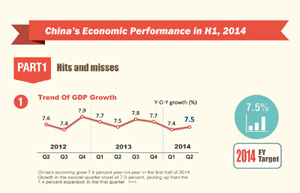
| Infographic: China's economic performance in H1, 2014 | China's economy to grow 7.5% in 2014: IMF |

Copyright 1995 - . All rights reserved. The content (including but not limited to text, photo, multimedia information, etc) published in this site belongs to China Daily Information Co (CDIC). Without written authorization from CDIC, such content shall not be republished or used in any form. Note: Browsers with 1024*768 or higher resolution are suggested for this site.
License for publishing multimedia online 0108263 Registration Number: 20100000002731