Comments
  Print
Print  Mail
Mail  Large Medium Small
Tang: Yes, I’ve heard of that. The new policy allows some collectively-owned land to transfer and trade at the farmer’s free will, which I think is another step forward in the city’s urbanization drive. For quite a long time, Shenzhen has been out of land for urban development. Once the land is subject to the market, land supply will increase, thus releasing more space for urban development. Meanwhile, a portion of profits generated from land transactions will be given back to farmers or collective land owners. This is different from the past when local governments would sell agricultural land and compensate farmers in proportion to the land output, which would often cost them little. However, the land would then be sold to developers at market prices, a huge profit which would be taken by local governments. What farmers would get was negligible. But things will change with the new policy. Farmers will be able to gain more from land profits and dividends, which will help them to live a better life in cities.
China Daily: China is an agricultural country. As the urbanization drive advances, more and more rural land will become uncultivated. On the other hand, migrant workers will continue to be confronted by various obstacles when living in cities. Is it justifiable?
Tang: Well to some extent, I would say not, but reasons behind the phenomenon vary. There are two main reasons. First, when local governments hinge on land finance, they will try to transfer as many land-use rights as possible. But the land may not be fully or properly used. The Ministry of Land and Resources has urged local governments to make full use of idle land, which would otherwise be a huge waste. Second, some land, if used for agricultural production, would generate very little profits for farmers. The statistics I saw the other day showed farmers are able to gain a profit of little more than 1,000 yuan for 1 mu land (0.07 hectares). That little money is for a whole year of arduous farm work. But if they work in a city, it is merely a month’s income. That’s why there are more and more migrant workers in urban areas. However, these migrant workers aren’t able to enjoy social insurance and public services as other urban workers. They are not able to stay long in the cities without a hukou, for only a hukou can ensure local social insurances including medical care, employment, pension, and schooling. Such interests have been deprived. So I think, to a certain extent, the current urbanization model is sacrificing the interests of rural residents.
China Daily: Let’s move on to the next issue, the urbanization rate. Here are some statistics on China’s urbanization rate.
In 1949, China’s urbanization rate was 10.6 percent. By the year of 2011, the year before last year, it reached 51.27 percent. And it is expected to reach 60 percent by 2020.
In other words, China’s urbanization rate grew 1 percent each year on average. Do you have any comment about these achievements?
Tang Liming: Over the past few years, China’s urbanization has made great contributions to the world and humanity, which has been well recognized all over the world. As we can see, the appearance of our cities has experienced great changes.
But if we look from a different perspective, the urbanization rate reflects another phenomenon.
The statistics you mentioned are provided by the National Bureau of Statistics, which is actually the ratio of permanent urban inhabitants in China’s total population. It is from the perspective of permanent urban inhabitants.
In fact, there is another calculation method, which is based on statistics from the Ministry of Public Security. That is from the perspective of home registration, which calculates the portion of nonagricultural population in China’s overall population.
As you mentioned before, the NBS’ urbanization rate reached 51.27 percent, or about 51.30 percent, in 2011, but the MPS’ result was around 35 percent.
There is a gap between the two, which is actually the gap of public services. Lots of people are making a living in cities, their lifestyle is totally urbanized. But they are unable to enjoy the public services, like education, medical care, and social insurance, which require massive government spending.
The government has to spend about 100,000 yuan for each new inhabitant in cities, and that’s quite a huge sum of expenditure.
So the statistics reveal that if China’s future urbanization is people oriented, local governments should not focus on selling more land, but spending more to minimalize the gap in public services.
 'Cat model' to dazzle Shanghai auto show 2013
 Models at Tokyo modified car show
 Shanghai Fashion Week focuses on domestic brands
 Angel-dress models at Shandong auto show
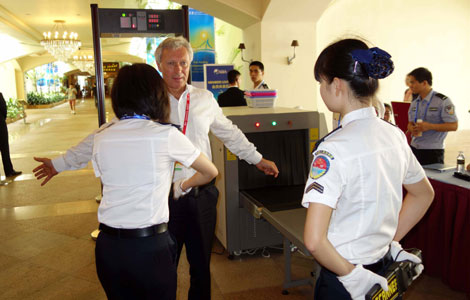 Safe and Sound
 Theater firms scramble for managers
 Premier pledges closer ties with Brunei
 Volkswagen's all-new GTI at New York auto show
Copyright 1995 - 2010 . All rights reserved. The content (including but not limited to text, photo, multimedia information, etc) published in this site belongs to China Daily Information Co (CDIC). Without written authorization from CDIC, such content shall not be republished or used in any form. Note: Browsers with 1024*768 or higher resolution are suggested for this site.
License for publishing multimedia online 0108263 Registration Number: 20100000002731