Comments
  Print
Print  Mail
Mail  Large Medium Small
China Daily: Hello there, welcome to our special program for the NPC and CPPCC. Today we are happy to have in our studio Dr Tang Liming, a senior research fellow with Anbound Group. Nice to meet you, Dr Tang!
You have been dedicated to studying China’s urban planning and real estate development in recent years, so what did you find out about the characteristics in China’s urbanization compared to that of western countries? And what should be the top priority?
Tang Liming: Well, your question cut right to the point. China’s urbanization is quite different from western models. In western countries, industrial and economic development naturally lures people to urban areas, thus pushing forward the urbanization drive. China’s urbanization is government-led, focusing more on real estate development to boost urban population and increase the urbanization rate. That’s different. Looking around, we would find all cities in China, regardless of the size, are following models that are pretty much the same. Local governments requisition land from rural or old-town residents, and sell it to property developers at much higher prices. Developers then build new cities or high-tech zones to draw investors. Once factories and companies are established, people flock there to make a living. It’s quite obvious that such an urbanization model is greatly dependent on land finance. But why so? It would come down to the top-level mechanism you just mentioned. Ever since the reform of the tax-sharing system, the central government has taken the major financial power, leading to the disequilibrium of local governments’ routine power and financial power. No money, no development. That’s why local governments have to sell land. With taxes attached, land finance thus became the main engine of the urbanization drive. Meanwhile in China, local governments’ performances will be appraised every year. And a main gauge will be the GDP growth. You see each five-year plan, like the 12th Five-Year Plan, has a GDP growth target. Therefore, local governments need to pin hopes on land finance. As mentioned before, I think reforms of the performance appraisal system, as well as routine and financial power distribution between central and local governments are highly necessary.
China Daily:Premier Li Keqiang has reiterated that urbanization should focus more on population. However in retrospect, real estate development seems to have taken the center stage of China’s urbanization drive. Would you explain what exactly this “population urbanization” is?
Tang: For local governments, real estate development is a short cut to boost GDP growth. The land requisitioned from rural residents costs very low, yet is sold at a much higher price. They profit a lot from the price differences and taxes attached. For them, real estate is a cash cow. So they spare no efforts to develop the industry. So it seems like urbanization is all about real estate development. Actually, it’s not. The ultimate goal of urbanization is to create a better life for people in the cities, and better cities for people to live and work. The new model requires the urbanization of the population, which is more comprehensive. That is to say, future urbanization no longer centers on urban construction, but focuses more on other issues, like whether people are able stay in the city, whether they can afford a house, whether urban transportation is convenient, or whether it is harmonious for nature and society to coexist. It is multi-faceted, because what people need is equally so. Our top priority now is to come up with a new household registration system that will draw people to work in cities and be able to stay there. Take Shenzhen for example, the city has been standing in the forefront of China’s reform and opening-up. Having gained a strong growth momentum, Shenzhen soon catapulted itself to become a global manufacturing base. Yet it hasn’t loosened up its household registration system along with its rapid development. It has thus become a typical city where non-residents outnumber residents. The latest data shows that out of a total 15 million population, non-residents in the city have hit 10 million.
China Daily: Speaking of Shenzhen, it has rolled out a policy that intends to subject the collectively-owned land to market forces. What do you think of that?
 'Cat model' to dazzle Shanghai auto show 2013
 Models at Tokyo modified car show
 Shanghai Fashion Week focuses on domestic brands
 Angel-dress models at Shandong auto show
 Safe and Sound
 Theater firms scramble for managers
 Premier pledges closer ties with Brunei
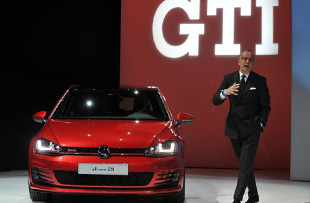 Volkswagen's all-new GTI at New York auto show
Copyright 1995 - 2010 . All rights reserved. The content (including but not limited to text, photo, multimedia information, etc) published in this site belongs to China Daily Information Co (CDIC). Without written authorization from CDIC, such content shall not be republished or used in any form. Note: Browsers with 1024*768 or higher resolution are suggested for this site.
License for publishing multimedia online 0108263 Registration Number: 20100000002731