Comments
  Print
Print  Mail
Mail  Large Medium Small
 |
|
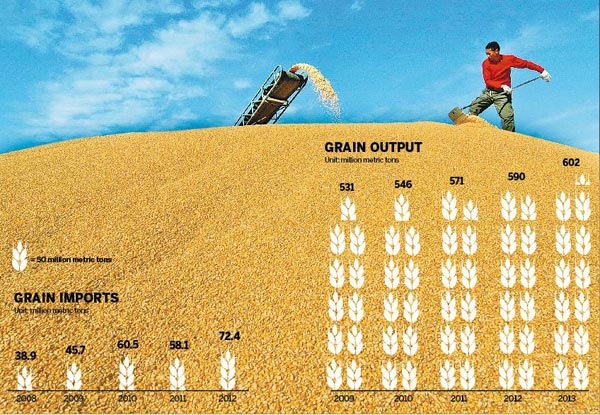
The government has pledged to maintain a "red line" for the minimum total area of arable land at 120 million hectares to ensure adequate grain production. Photo by LI TIECHENG / FOR CHINA DAILY, graphic by feng xiuxia and Li Yi / China Daily |
China is making unprecedented efforts to ensure grain security to feed the population of 1.3 billion, reports Zhong Nan
After enjoying a decade of stable growth for grain production, China will take decisive measures to ensure its self-sufficiency rate, with enough arable land and adequate overseas cooperation in 2014.
Even though China has achieved bumper harvest output, the nation has faced declining arable land amid urbanization, bad weather in recent years and pollution caused by fertilizers and pesticides.
"The rising grain output cannot catch up to increasing consumption and diversified food varieties. Two big users of grain are the modernized food supply chain as well as livestock," said Chen Jie, a researcher at the research center for rural economy of the Ministry of Agriculture.
To keep staple food supply and demand in balance, China imported 13.98 million metric tons of grain last year, while soybean imports reached 58.38 million tons, compared with 5.45 million tons of grain imports and 52.5 million tons of soybeans from abroad in 2011.
Chen said grain and soybean imports rose to 10 percent of the country’s total last year, including self-production output and foreign purchases.
As a major grain importer, China has a strong influence on global prices. Major corn and wheat purchases made by Chinese importers, usually giant State-owned enterprises such as the COFCO Group or China Grain Reserves Corp, are capable of pushing grain prices higher at the Chicago Board of Trade.
To prevent the risk of international speculation on grain in a poor harvest year, the Chinese government set a new goal earlier this week to keep a self-sufficiency rate of 95 percent for corn, rice and wheat. For rice and wheat, the rate should be even higher to ensure absolute safety of the domestic food supply.
"Therefore, improving the production capacity of low-yielding fields, optimizing the structure of grain imports, reducing the use of fertilizers and cutting the grain amount for industrial purposes will become the government’s new priorities next year," said Zheng Fengtian, a professor at the school of agricultural economics and rural development at the Beijing-based Renmin University of China.
Zheng said the current domestic grain price is higher than the international market price, the price gap and the surging grain imports being caused by China’s national minimum grain purchase prices, rising labor costs, farmers’ preference for growing cash crops and the excessive use of chemical fertilizers.
"The Chinese government should therefore adequately increase imports of non-staple grains and related products, such as soybeans, feed, meat, edible oil and deep-processed grain, which could allow China to concentrate on the production of rice, wheat and corn," Zheng said.
The country’s meat production rose from 72 million tons in 2005 to 84 million tons in 2012, while milk production increased from 24.53 million tons to 38.68 million tons, according to the National Bureau of Statistics.
Consumption of eggs and poultry also surged during the same period, which shows that the production of animal-based food products and consumption of grain-based animal feed have jumped along with Chinese people’s diversified demand for higher-protein food.
The government has begun to speed up the transfer of rural land and to offer more subsidies to family farms and farmers’ cooperatives in a bid to develop large-scale farming.
It also is raising incentives for farmers, intensifying agro-technology services and stepping up natural-disaster prevention and reduction measures.
The Central Rural Work Conference, which designed policies for the development of agriculture and rural regions in 2014, pledged this week to maintain a "red line" for the minimum total area of arable land at the current 120 million hectares to ensure adequate grain production.
Copyright 1995 - . All rights reserved. The content (including but not limited to text, photo, multimedia information, etc) published in this site belongs to China Daily Information Co (CDIC). Without written authorization from CDIC, such content shall not be republished or used in any form. Note: Browsers with 1024*768 or higher resolution are suggested for this site.
License for publishing multimedia online 0108263 Registration Number: 20100000002731