Comments
  Print
Print  Mail
Mail  Large Medium Small
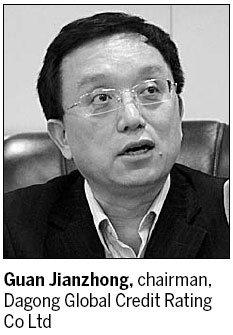
Scholars don't easily turn into businessmen. Luckily, Guan Jianzhong, the chairman of Dagong Global Credit Rating Co Ltd, is still able to give one-hour talks about his papers - those already published and those to be published.
The Beijing-headquartered Dagong, which has more than 600 employees, claims to be the only large independent Chinese credit ratings service after other rating agencies of a similar size were merged into international companies.
When Guan looks back into the history of his company since he became chairman, he doesn't see a history marked by major deals and leaps in revenue. For him, all the milestones, instead, were the papers he published to advance his theories.
The list of his publications is long.
"In 2006, I wrote an article calling for a rethinking of China's credit rating system, which marked the starting point of my theoretical quest," he said.
Right now, amid heated debates on how to regulate local governments' debt and informal ways of fundraising and borrowing, Guan said he is "halfway through" the writing of another paper.
"I told my colleagues that once this piece is published, I won't write any more," he said.
He considers himself a contemplative person. However, the managerial role in his firm allows him little time for contemplation.
"If I write, I write after everybody's gone home."
But the purpose of all his writing is not to earn a teaching tenure in a university, but to come up with a different theory to guide Dagong's credit rating services.
However, his theories and the true nature of his company are often buried by the politically tinged news reports surrounding it.
In July 2010, the company launched its international research services by giving the United States government debt a lower credit rating than that of China. In November of the same year, it downgraded the US rating on concerns over the consequences of the country's quantitative easing program.
In June this year, Dagong formed a consortium with Egan-Jones Ratings Co of the US and RusRating of Russia, to challenge the dominance of the "big three" ratings agencies: Moody's Investors Service, Standard & Poor's Ratings Services and Fitch Ratings, which together account for 95 percent of the world's credit-rating market.
All those moves earned Dagong a "nationalistic" image in some international media outlets, while in fact, Guan stressed, his firm is a private company which "has received little direct government support" all along.
"What can you do? Either you become a small local partner of a big US firm and shut up or, when you say something, people will regard you as doing this only for the Chinese government," Guan said.
But politics is beside the point. "Our theory is our core competence," he said.
Guan explains his theory as an antithesis to the "fundamentally flawed" and poorly integrated credit rating practices prevalent in the West. To sum it up: "They operate in a pro-cyclical way. My theory is essentially a counter-cyclical one."
By pro-cyclical he meant that the prevalent credit rating practices in the West not only follow, but may be guilty for deliberately chasing the business cycle.
In a boom cycle, they tend to inflate a debtor's credit standing and to encourage relentless borrowing. When many debtors' creditworthiness gets inflated, society then gets pushed to the brink of an overall breakdown, hence you get a crisis, he added.
But once there's a recession, the prevalent practice is to abruptly downgrade a debtor's credit standing and leave it in bankruptcy status, when it might have survived if only it could have borrowed just a little more.
Such practices tend to make the economy swing wildly between boom and bust cycles and jeopardize countries' attempts to follow a steady and sustainable development path, Guan pointed out.
"This was the reason behind many rounds of trouble in the world. And, paradoxically, the greatest harm it did was perhaps to the US economy in the disastrous 2008 crisis."
In the sovereign credit rating field, Guan is also critical of "ideologically biased" views that say that democracies, market economies and countries with a high per capita GDP are unlikely to default.
"Where's the causal relation between a country's repayment ability and its political system?" he asked.
So, Dagong doesn't want to follow those flawed assumptions, Guan said, but will take what he calls the "wealth-generating ability" as the basis for evaluation, a factor that often gets blurred in the West.
A debtor's wealth-generating ability directly determines its repayment ability. "A debtor can keep borrowing so long as it's able to generate a profit, no matter how much it has already borrowed and whether it's a democracy or not," Guan said.
Copyright 1995 - . All rights reserved. The content (including but not limited to text, photo, multimedia information, etc) published in this site belongs to China Daily Information Co (CDIC). Without written authorization from CDIC, such content shall not be republished or used in any form. Note: Browsers with 1024*768 or higher resolution are suggested for this site.
License for publishing multimedia online 0108263 Registration Number: 20100000002731