BEIJING - Since 2011, China has been working to reduce emissions of greenhouse gases, including carbon dioxide (CO2), through industrial restructuring, according to a report released Wednesday.
The report, "China's Policies and Actions for Addressing Climate Change, 2012," was published by the National Development and Reform Commission (NDRC).
The report says controlling greenhouse gas emissions is a key task in China's efforts to address global climate change. In 2011, the Chinese government issued the Work Plan for Controlling Greenhouse Gas Emissions During the 12th Five-year Plan Period, which assigns specific carbon intensity reduction targets to all provinces, autonomous regions and municipalities.
To transform and upgrade traditional industries, China has released the 2011 edition of the Guideline Catalogue for Industrial Restructuring, further underlining the country's strategic direction toward conserving energy and cutting emissions by optimizing and upgrading its industrial structure.
The government has stepped up energy conservation evaluations and examinations, environmental impact assessments and preliminary examinations of land used for construction projects.
It has raised the entry threshold for certain industries and strictly limited new projects in high energy-consuming industries, high pollutant emissions or excess capacity. It has also rigorously controlled the export of products with high energy consumption and high pollutant emissions.
The Chinese government has also disseminated the Plan for Industrial Transformation and Upgrading (2011-2015) to promote green and low-carbon industrial development.
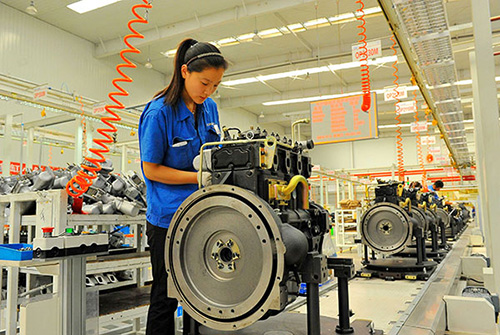
It has released specific development plans for the 12th Five-year Plan period (2011-2015) to boost industrial transformation and upgrading in a number of key industries, including iron and steel, non-ferrous metals, building materials, petrochemicals and chemicals, energy-saving and new-energy vehicles, industrial energy conservation, bulk solid waste and clean production.
In 2011, the government earmarked 13.5 billion yuan ($2.16 billion) in technological upgrade funds, which in turn generated investment totalling 279.1 billion yuan. Efforts to stimulate technological upgrading have become more targeted and effective and have yielded very positive results.
Furthermore, the government has issued the Development Plan for National Strategic Emerging Industries During the 12th Five-year Plan Period. It charts the road map for seven strategic emerging industries: energy conservation and environmental protection; new-generation information technology; biology; high-end equipment manufacturing; new energy; new materials; and new-energy vehicles.
Additionally, China has introduced a slew of measures to vigorously develop the service industry and speed up the elimination of outdated production capacity.
In 2011, China shut down small thermal power generating units with a total generating capacity of 8 million Kw and eliminated obsolete production capacity in the following industries: iron smelting, 31.92 million tons; steel production, 28.46 million tons; cement (clinker and mill), 155 million tons; and coke, 20.06 million tons.
China has also been conserving energy and reducing waste, boosting carbon sinks and pursuing low-carbon development.
In 2011, the country distributed more than 18.26 million high-efficiency air conditioners, 150 million energy-saving lamps and more than 4 million energy-efficient motor vehicles.
It has also published the Roadmap for IL (Incandescent Lamps) Phase-out, and banned the import or sale of 100-watt-or-greater incandescent bulbs from Oct 1, 2012.
In 2011, the country constructed 1.39 billion square meters of energy-efficient floor space and completed heat metering and energy efficiency renovations on 140 million square meters of existing residential buildings in 15 provinces, autonomous regions and cities in northern China.
In 2011, the output value of the energy conservation service industry amounted to 125 billion yuan, an increase of 49.5 percent year on year. Energy service companies carried out more than 4,000 energy performance contracting projects with a total investment of 41.2 billion yuan, up 43.5 percent year on year, saving energy equivalent to more than 16 million tons of standard coal.
To optimize the energy structure, China accelerated the development of non-fossil fuels. The National Energy Administration has drawn up the Development Plan for Renewable Energy During the 12th Five-year Plan Period as well as four specific plans for hydropower, wind power, solar power and biomass energy.
It has also formulated plans for the development of recharging stations for electric vehicles in five cities, including Shanghai.
To enhance grassland carbon sinks, the Chinese government in 2011 disbursed 13.6 billion yuan to develop a subsidy and award mechanism for grassland conservation in nine provinces and autonomous regions, including Inner Mongolia, Tibet, Xinjiang and Gansu.
In strengthening agricultural carbon sinks, the area cultivated using conservation farming techniques increased by more than 1.27 million hectare in 2011, bringing the national total to 5.67 million hectare and amounting to an annual reduction of more than 3 million tons of CO2.
Xie Zhenhua, deputy head of the NDRC, noted that the country has to vigorously develop low-carbon technologies and industries, as its economy-fueling resources are limited in per capita terms and its environment is fragile.
Xie added that developing low-carbon technologies and industries has also provided enterprises with opportunities to transform their development mode and restructure their product mix, and this is more true for export enterprises.
"Some countries levy carbon tax on import commodities, which is an act of unilateral green protectionism, but we could cope with that by adopting low-carbon technologies and offering low-carbon products," Xie said.


Copyright 1995 - . All rights reserved. The content (including but not limited to text, photo, multimedia information, etc) published in this site belongs to China Daily Information Co (CDIC). Without written authorization from CDIC, such content shall not be republished or used in any form. Note: Browsers with 1024*768 or higher resolution are suggested for this site.
License for publishing multimedia online 0108263 Registration Number: 130349