|
|
|
 |
|
|
|||||||||
|
An Air China plane at an airport in Zhengzhou, Henan province. As the EU's carbon tax scheme arouses opposition from a number of countries, there are signs the trading bloc could soften its stance. [Photo / China Daily] |
EU's strategy of levying a climate tax on airlines has provoked widespread criticism
The European Union has hinted that it hopes to avoid levying its controversial carbon-emissions tax on flights from China, if Beijing introduces its own carbon-trading scheme to cover aviation.
However, the debate is set to continue after China responded by saying that it will take time to set up its own market for the trade in carbon emissions.
Peter Liese, a member of the European Parliament and rapporteur for the inclusion of aviation in the EU's Emissions Trading Scheme (ETS), said that the EU is willing to negotiate with China.
"We have noticed with great interest that there are discussions about an emissions trading scheme in China. If this scheme also covered aviation, we could exempt flights from China to the European Union," said Liese.
Starting this year, all airlines using EU airports are required to buy permits under the ETS. However, many non-EU countries, including China and the United States, have opposed the scheme and criticized it for being "unilateral".
Jiang Kejun, a researcher at the Energy Research Institute of China's National Development and Reform Commission (NDRC), said that Liese's suggestion would be feasible if China can set up an emissions trading market.
"It would avoid (paying) double fees. However, it will take time for China to build its carbon emissions trading market," Jiang said.
China has selected seven provinces and cities, including Beijing and Tianjin, to begin preparations for the pilot. Energy-intensive and highly polluting industries are likely to be included in the project.
"It's too early to talk about aviation because it must be based on a nationwide carbon emissions trading market. The regional pilot projects were unable to cover aviation," said Jiang.
Tensions escalated in February when representatives of 32 countries gathered in Moscow to discuss potential retaliatory measures against the scheme.
Following the meeting, Su Wei, director-general of the climate change department under the National Development and Reform Commission, said that the EU scheme violates international law.
For example, the Kyoto Protocol makes a distinction between the efforts that developed and developing nations have to make to address climate change, but these "differentiated responsibilities" are not accounted for in the EU ETS.
Liese criticized the Moscow gathering for not offering an alternative solution to tackle carbon emissions, but revealed that "behind the scenes, China, the US and others are negotiating on real solutions with the European Union", something he feels "optimistic" about.
Zhou Dadi, former director of the energy research institute of the NDRC, said that China will base its policy decisions "on Chinese conditions rather than buying the medicine based on the prescription given by the EU".
He explained that China is actively exploring effective measures, including establishing a carbon emissions trading market and imposing energy and carbon taxes to support low carbon development.
The top priority for China is to introduce energy and resource pricing reforms this year, laying a foundation for the carbon market and carbon taxes, he added.
Airlines' outcry
Airlines from both EU and non-EU countries have criticized the ETS for distorting competition.
"The current scheme is neither global nor fair," said Frank Puttmann, director of group communications at Lufthansa AG, Europe's largest airline by passenger numbers and fleet size.
Puttmann said that European airlines will suffer disproportionately from the scheme, because rival airlines that only use EU airports for some of their flights will be in a better position to spread the costs.
Lufthansa is expected to incur an additional expense of 130 million euros ($171 million) in 2012. "The additional cost for emission certificates will reduce our financial ability to invest in new eco-efficient technology, for example modern and fuel-efficient aircraft or engines," said Puttmann.
Finnair OYJ expects to incur additional costs of 5 million euros in 2012. Kati Ihamaki, vice-president of sustainable development at the airline, said that "passing on costs to (ticket) prices will be difficult, because emissions trading will not apply to all international airlines equally".
Goh Choon Phong, CEO of Singapore Airlines Ltd, said that the EU ETS is unfair as it only charges airlines for the leg of a journey in and out of Europe.
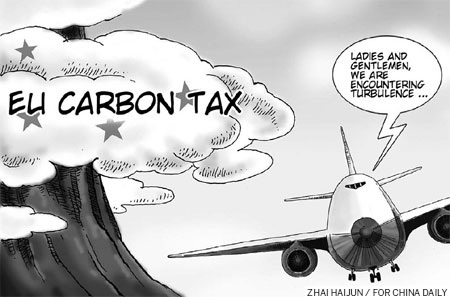
"Under the system, an airline that makes its passengers fly with a halt somewhere close to Europe will pay less than an airline that flies non-stop, even though the former would have used more fuel," he said.
James Hogan, CEO of Etihad Airways, the national carrier of the United Arab Emirates, said: "We have invested many millions of dollars to ensure that we operate a young and highly efficient fleet, but are still being penalized."
Etihad has increased ticket prices for flights in and out of Europe by $3 from this month.
Victoria Moore, general manager for communications at the Association of European Airlines, said that AEA members have only made a per-passenger profit of 2 euros and 40 cents over the last decade.
The AEA estimates that member airlines have only made an average profit of 0.8 percent per passenger over the past decade, while the International Air Transport Association (IATA) said that its members have only generated cumulative profit in three of the past ten years.
Despite the high costs of compliance, Simon Retallack, strategy manager of the London-based non-profit company The Carbon Trust, believes that the aviation industry "needs to play a part in order to help avoid the risks associated with dangerous climate change".
Dirk Willem te Velde of the Overseas Development Institute, a London-based think tank, said that in the absence of a global tax, the EU's ETS is a viable solution to global climate change because, based on fleet sizes, the developed nations will pay much more under the scheme, while emerging countries will pay less.
The AEA estimates that costs of compliance for its 33 member airlines will amount to 9.9 billion euros between 2012 and 2020. In comparison, the China Air Transport Association estimates a compliance cost of 17.6 billion yuan ($2.8bn) for Chinese airlines over the same period.
The 2012 payments will be calculated after each airline's annual carbon output has been added up, and will be paid in early 2013.
The EU first launched the ETS in 2005 to fulfill its own emissions-reduction targets under the Kyoto Protocol. Airlines were not originally included in the scheme because the protocol made the United Nation's International Civil Aviation Organization (ICAO) responsible for reducing the environmental impact of the aviation industry.
The EU proposed extending its ETS to aviation in 2006 because of what it saw as a lack of progress on the issue at ICAO.
For the EU, the inclusion of aviation in the ETS is a matter of common sense. Last year, Connie Hedegaard, the EU's commissioner for climate action, said: "Emissions from aviation are growing faster than from any other sector, and all forecasts indicate that they will continue to do so under 'business-as-usual' conditions."
But the move has aroused fierce international opposition. Last year, the US Air Transport Association attempted to stop the scheme. In a case presented to the European Court of Justice, the ATA argued that tackling emissions must be undertaken on a global basis.
The US airlines lost the case. The ECJ's Advocate-General Juliane Kokott said the EU was within its rights to take unilateral action because the ICAO has not yielded significant progress after more than a decade in operation.
Increasingly, the imminent threat of a trade war has led both EU politicians and airline associations to pressure the ICAO into urgently offering a global solution.
"We don't want a trade war," said Tony Tyler, director-general of IATA. "Europe's unilateral and extra-territorial EU ETS plans are clearly not acceptable to non-EU governments. We hope that the European states will be sincere facilitators at the ICAO."
Meanwhile, an ICAO working paper obtained by China Daily shows that the ICAO plans to "develop possible options for a global market-based-measure scheme by June 2012 for consideration by the (European) Council".
Conflicting laws
How Chinese airlines will respond to the scheme remains uncertain, because they are being instructed to take contradictory action by the Chinese and European governments.
The Civil Aviation Administration of China has formally instructed airlines not to join the EU ETS without government approval.
But the EU is not backing down. Airlines that do not comply will be fined 100 euros for each tonne of carbon dioxide emitted for which they have not surrendered allowances.
"Chinese airlines are stuck between two conflicting laws, and resolution can only come through negotiations between the two governments to achieve a compromise," said Mark Bisset, an aviation-finance partner at Clyde & Co LLP, a law firm headquartered in London.
The EU ETS legislation exempts flights from countries with "equivalent measures" to tackle carbon emissions, but Bisset said those "equivalent measures" are not defined in the legislation.
"The danger is that when EU airlines see Chinese airlines being excluded from the scheme based on measures by the Chinese government they do not believe are equivalent, they will take actions against the European Council," Bisset said.
For example, British Airways, part of the International Airlines Group, has endorsed the EU ETS. But a company spokesperson said: "We believe that any concessions which might be made to non-EU airlines should also be applied to EU airlines operating on the same routes."
Meanwhile, South Africa is planning to introduce its own emissions trading scheme later this year, a move not supported by the African Airlines Association (AFRAA).
Elijah Chingosho, secretary-general of AFRAA, said: "it is wrong for different countries to come up with their own emissions trading schemes, be they EU countries or any other countries."
Australia is also planning to introduce its own emissions-trading scheme in 2015, and intends to link it with the EU ETS.
Contact the writers at cecily.liu@chinadaily.com.cn.